Filipino helper hiring in Dubai with clear package details
Nov 03, 2026A Filipino helper package in Dubai is more than a placement: it includes two-year DMW contract registration, personal accident insurance for 24 months, and hospitalisation insurance for 12 months. The full package brings these elements together, while direct hire means the family handles more of the process itself.
It’s reasonable to want a clear cost and a precise list of inclusions before deciding. The price depends on the case and is given after a quote request; the recruitment route, visa and paperwork requirements, insurance, and placement terms shape the package.
This guide explains what to compare in full-placement and direct-hire arrangements, how visa and employment paperwork fit into the process, and what to consider if a placement doesn’t work out. You’ll come away with a clearer view of the practical steps and the details that matter when choosing support for your household.
Key Takeaways
- Compare full placement and direct hire by mapping who manages recruitment, paperwork, insurance and visa arrangements.
- Plan the hiring timeline around the placement route and the steps needed to complete employment paperwork and visa processing.
- Define the household’s priority duties, from childcare and elder care to cooking or home organisation, before assessing a candidate’s experience.
- Before proceeding, understand the contract terms and the steps available if the placement does not suit your household.
Ready-made helpers and urgent hiring
In the UAE, compare candidates by duties, experience and household fit, not nationality alone. Filipino helpers may have overseas work experience and skills in childcare, cooking or elder care. An urgent start may require careful timeline planning.
Hiring Timelines and Working Hours
Use the stated 12 to 14-week processing period as a planning guide, rather than assuming a ready-made candidate can start immediately. Recruitment, paperwork and visa steps all affect the start date. Before hiring, write down the required start date and household duties, such as school runs, meal preparation or care for an older relative.
Set out the working schedule and daily responsibilities before agreeing to a placement. Specify when childcare begins, which household tasks are expected, and how duties change on school days. A clear schedule gives the family and domestic worker practical expectations to discuss.
Direct Hiring and Agency Listings
With direct hiring, the household takes the lead in selecting a candidate and coordinating the next steps. Recruitment through Housekeeping Co gives families a way to review candidate profiles and match experience to household needs. In either case, compare relevant experience and expected duties rather than relying on nationality alone.
For example, a family needing help with two school-age children should prioritize relevant childcare experience and the daily routine. Filipino candidates have varied backgrounds, so discuss the specific role, including whether cooking or elder care is required, before deciding which profile fits.
Direct-Hiring Steps and Fees
Start with a clear role description that lists the duties, preferred start date and schedule. Then compare candidate experience with those requirements, discuss expectations and arrange the employment and visa paperwork for the chosen sponsorship route. Keeping the agreed details documented makes responsibilities easier to follow.
Direct-hiring costs depend on the recruitment route and the paperwork, visa and insurance arrangements involved. The price depends on the case and is given after a quote request. Compare what each arrangement covers, not just the initial recruitment charge; an addition such as visa processing can affect the overall package.
What happens if the placement does not work out?
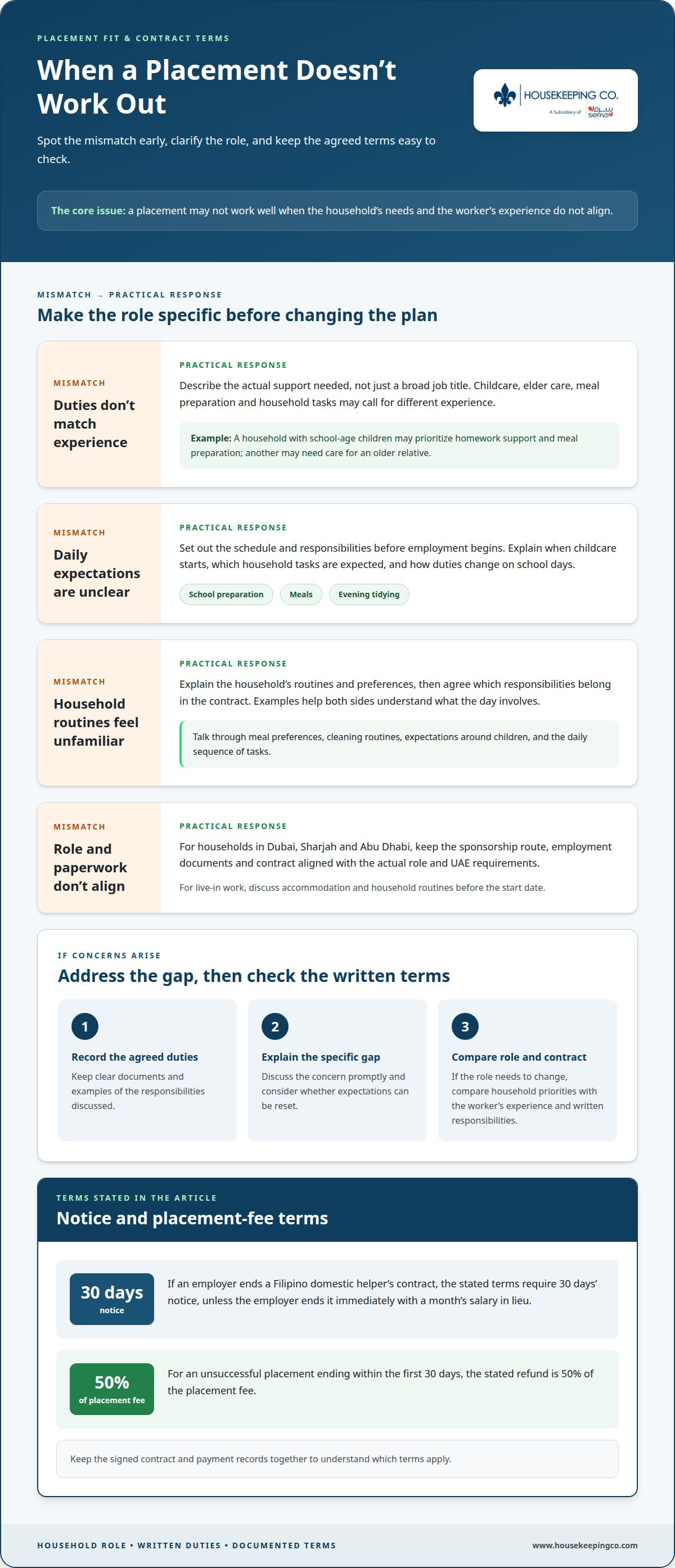
A placement may not work well if the household’s needs and the worker’s experience do not align. Define the role before hiring: a live-in nanny or maid may care for children, prepare meals and handle agreed household tasks. Elder care calls for different experience, so describe the support needed rather than relying on a broad job title—much like specialized home care providers when structuring person-centered support plans.
Review practical skills against real routines. For example, a family with school-age children may need homework support and meal preparation, while another household may prioritize caring for an older relative. Some Filipino domestic workers have experience with children, elderly family members or people with special needs. Discuss the specific duties and schedule before employment begins.
Adaptability matters too. A worker may need to learn a household’s meal preferences, cleaning routines and expectations around children. Explain the daily sequence, such as school preparation, lunch and evening tidying, then agree which responsibilities belong in the contract. Clear documents and examples help both sides identify a mismatch early.
For households in Dubai, Sharjah and Abu Dhabi, make sure the sponsorship route and employment documents follow UAE requirements. Permits or procedures from another country do not establish eligibility in the UAE. Keep the placement, contract and sponsorship details aligned with the actual role. For live-in work, discuss accommodation and household routines before the start date.
If an employer ends a Filipino domestic helper’s contract, the stated terms require 30 days’ notice, unless the employer ends it immediately with a month’s salary in lieu. For an unsuccessful placement ending within the first 30 days, the stated refund is 50% of the placement fee. Keep the signed contract and payment records together to understand which terms apply.
Address concerns promptly. Record the agreed duties, explain the specific gap and discuss whether expectations can be reset. If the role needs to change, compare the household’s priorities with the worker’s experience and the responsibilities written into the contract.
Employment paperwork and work visa applications
For hiring in the UAE, keep the employment terms, worker identity documents and visa application details consistent. Mismatched records, undocumented payments and reliance on another country’s procedures can complicate the process.
Overseas Requirements and Employer Eligibility
Separate Philippine overseas employment steps from UAE visa processing. The available requirements identify a TESDA National Certificate II in domestic work, or NC II, for domestic work. Treat that qualification as a distinct worker document, not as a substitute for UAE employment or visa paperwork.
Singapore has separate rules, which should not be applied to a Dubai household. For Singapore, employers must be at least 21 years old; first-time employers should attend the Employer’s Orientation Programme. Workers seeking Singapore employment need at least eight years of formal education and passports valid for six months upon arrival there. Those conditions do not establish UAE eligibility.
For the UAE, organize hiring around the intended household role, sponsorship route and required visa application. Keep the contract’s duties and worker documents aligned with the role. A two-year domestic worker visa is one available UAE arrangement.
Employer and Worker Documents
Prepare a document file before submission. Gather the records required for the selected UAE sponsorship and visa route, along with the worker’s identity and passport documents, relevant experience details and agreed employment contract. Check names and other details for consistency to help avoid preventable processing problems.
- Employer: sponsorship and visa application records, plus the signed employment terms.
- Worker: passport and identity records, relevant NC II documentation, and experience details.
- Both parties: a copy of the contract showing duties, schedule and agreed responsibilities.
Singapore paperwork may include an In-Principle Approval from MOM for a POEA application, alongside procedures with Singapore’s Ministry of Manpower and Philippine documents. These are Singapore-specific steps, not a Dubai checklist. To reduce scam and compliance risks, use consistent documents, retain payment records, and avoid undocumented arrangements. Keep the signed contract and application records together if questions arise about responsibilities or processing.
Full placement and direct-hire packages
Compare packages by responsibilities, not by the word “complete.” A full placement package can include contract registration and insurance, while direct hire places more coordination on the household. For a Filipino helper, the practical difference is who organizes each step and what protections the package names.
The listed full-placement package includes two-year DMW contract registration, personal accident insurance for 24 months, and hospitalisation insurance for 12 months. These are distinct inclusions, so read each duration carefully. The contract registration period and insurance periods do not match, and one should not be assumed to replace another.
Direct recruitment changes how the work is divided. The family takes the lead in selecting a candidate and coordinating employment paperwork, visa arrangements and insurance. Before proceeding, write down which tasks your household will manage and which are included in the chosen arrangement. This makes gaps easier to spot.
Assess the candidate and arrangement together. Families seeking childcare, care for older relatives or household support should match the role description to the worker’s experience. Discuss daily duties and communication needs, including the English needed for instructions. A clear match between experience and household requirements matters more than a general description of recruitment.
Keep country-specific processes separate: Singapore’s hiring arrangements do not replace UAE requirements. For a household in Dubai, Sharjah or Abu Dhabi, focus on the employment contract, sponsorship route, visa processing and insurance. Review the written inclusions and compare them with the responsibilities you would manage through direct recruitment.
Choose full-time placement if you want recruitment and package components arranged together; consider direct recruitment if you are prepared to coordinate more of the process yourself. Either way, review the contract and insurance terms before agreeing, and keep copies with the worker’s employment documents.
Hire Full-Time Live-In or Live-Out Nanny/Maid in Dubai
Housekeeping Co is a practical next step for Dubai families ready to move from comparing packages to arranging household support. It offers full-time live-in or live-out nanny and maid hiring, domestic worker visa arrangements, and private sponsorship options.
Choose the arrangement around your household routine. A live-in role may suit a family seeking support in the home, while a live-out role keeps work and home arrangements separate. For occasional home cleaning rather than ongoing domestic help, Housekeeping Co also provides on-demand hourly cleaning services.
Before proceeding, define the duties, schedule, sponsorship route and priority experience for the role. Clear requirements help match the recruitment arrangement to your family’s needs and keep the employment paperwork aligned. Contact Housekeeping Co to discuss household support in Dubai, Sharjah or Abu Dhabi.
Make Your Next Hiring Decision With Clarity
The right household arrangement starts with a clear picture of daily life. Consider who needs support, which responsibilities matter most and how the role should fit your family’s routine. This gives you a practical basis for discussing a Filipino helper placement and setting expectations for both sides.
Housekeeping Co arranges full-time live-in or live-out nanny and maid hiring, domestic worker visas and private sponsorship options. Share your priorities, including the duties involved and the experience your household needs. A focused discussion can help you move from comparing arrangements to planning a suitable placement.
When you’re ready to discuss your household’s needs, contact Housekeeping Co directly.
Clear expectations and a considered next step can help you approach hiring with confidence.
Frequently Asked Questions
What do you charge, and what is in it?
The price depends on the case and is given after a quote request. Package details depend on the recruitment route, household role, sponsorship arrangement and included processing or insurance. Compare each written quote by checking which services it covers, what responsibilities remain with you, and whether the stated inclusions match your needs. This makes the overall scope clearer before you decide.
What do you pay her, and what does the first year come to?
Agree the worker’s salary as part of the employment terms, and calculate first-year spending from that agreed amount plus applicable recruitment, visa and insurance arrangements. These are separate budget components, not one interchangeable figure. For example, a family comparing live-in and live-out roles should first define duties and the work schedule, then assess the salary and associated costs for that specific arrangement.
What standards apply to the employment?
Use a written contract that clearly describes duties, schedule, salary and agreed responsibilities. Keep the worker’s role aligned with the actual household position, whether it involves childcare, housekeeping or caregiving. If school support is expected, spell out the relevant tasks instead of relying on a broad “nanny” title. Keep the signed terms with the related employment records.
What does “Filipino helper” mean, and what duties does a Filipino domestic helper typically perform?
The phrase generally describes a domestic worker from the Philippines hired for household support. Duties depend on the agreed role and may include cleaning, cooking, childcare, helping children with homework, or caring for elderly family members. Some workers bring previous overseas experience or skills in teaching support or basic nursing. Set priorities in the job description and discuss relevant experience directly.
What is the average salary of a Filipino domestic helper in the UAE?
There is no single salary that applies to every Filipino domestic worker in the UAE. Salary depends on the agreed duties, experience, working arrangement and household requirements. A childcare-focused role may differ from one centered on cooking and housekeeping. Compare candidates against the same job description and schedule, then record the agreed salary in the employment terms.
What are the UAE laws and minimum wage rules for hiring a Filipino domestic worker?
For a placement in Dubai, Sharjah or Abu Dhabi, follow UAE employment and visa procedures rather than substituting rules for Singapore or Philippine overseas recruitment. The employment terms should identify the agreed role, salary and responsibilities, while the sponsorship route determines the relevant application documents. Keep the contract, identity records and visa paperwork together, with consistent details for the household position.
Share this


