Hiring Tadbeer Maids in Dubai: Costs & Process
Oct 29, 2026Choosing a maid is only part of the decision. Hiring domestic workers through Housekeeping Co in Dubai also means choosing the right role and sponsorship route, then arranging recruitment and visa processing.
It’s natural to focus first on finding someone who fits your household. But nationality, experience, live-in or live-out arrangements, and whether the worker is under a service provider’s or your private sponsorship all shape the decision.
This guide explains how to assess available worker nationalities, compare sponsorship options, and understand the visa process in practical terms. It also covers what affects the overall cost, how to screen candidates for a maid or nanny role, and how to make a considered selection for your household. With the key steps laid out, you can approach hiring with a clearer picture of what to decide and when.
Key Takeaways
- Compare available candidates by role, experience, communication needs, and the support your household requires.
- Choose between a worker visa under your private sponsorship and a service arrangement based on who will manage the sponsorship responsibilities.
- Understand the sequence of visa processing, medical clearance, and Emirates ID steps so you can prepare for each stage.
- Screen candidates against clear duties and household expectations, then use interviews to assess suitability for a maid or nanny role.
- Decide whether full-time live-in, live-out, or hourly household support best fits your needs before selecting a service.
Available worker nationalities
Candidate options depend on the recruitment pool and the role. Housekeeping Co recruits domestic workers from countries including the Philippines, Ethiopia, Myanmar, and Kenya. Compare candidates by relevant experience, language needs, duties, and live-in or live-out preference. Nationality alone does not determine whether someone is a good fit for your home.
How do you hire a maid through a Tadbeer centre in the UAE? Define the role, review candidate profiles, interview suitable workers, then agree on the placement and sponsorship route. The centre coordinates recruitment and domestic worker services, while you assess whether the candidate’s skills and expectations match your household.
Ask about the candidate’s previous domestic work, childcare experience, and comfort with the duties you expect. A household seeking a nanny can focus on childcare experience, while a maid role may require a different skill set. Agree on responsibilities and working arrangements before placement. Clear expectations make comparisons more useful than choosing by nationality alone.
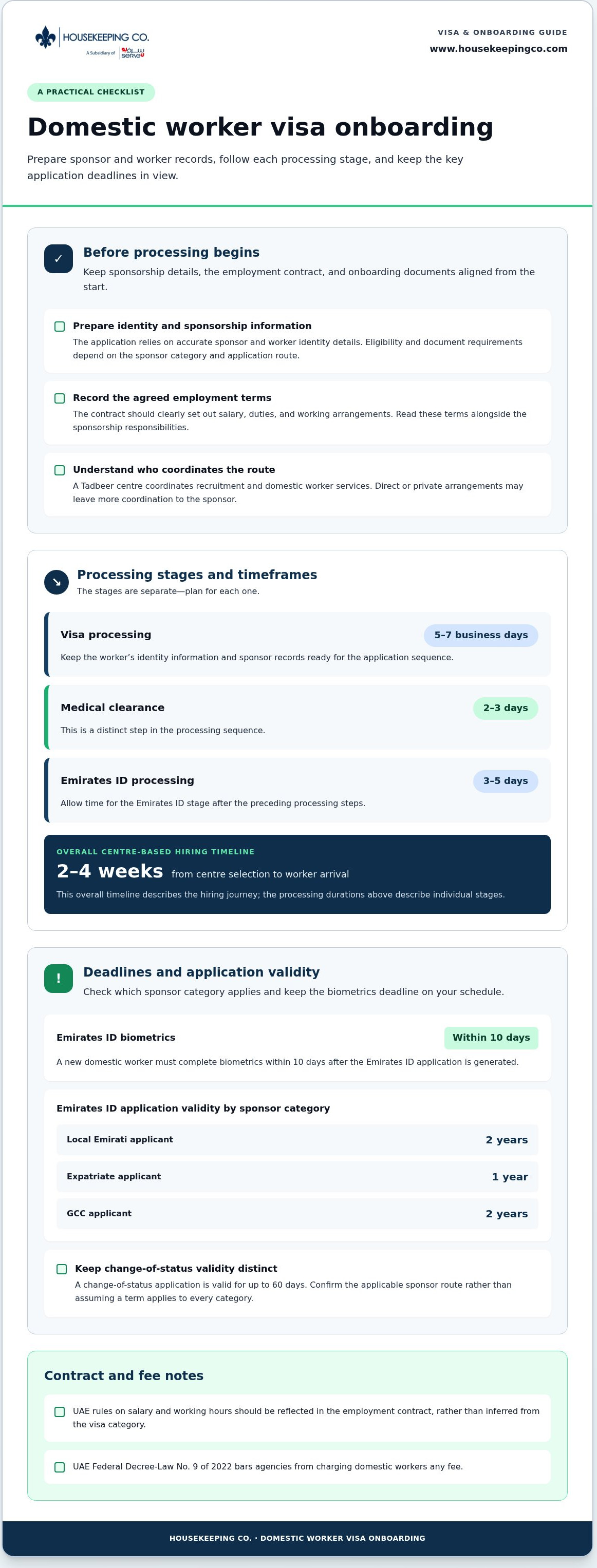
Visa-related administration can include renewal and cancellation, which are listed among domestic worker services. Emirates ID processing is another part of the documentation sequence. A new domestic worker applying for an Emirates ID in the UAE must complete biometrics within 10 days after the application is generated. The application validity differs by sponsor category: 2 years for a local Emirati applicant, 1 year for an expatriate applicant, and 2 years for a GCC applicant.
How can you find an authorised Tadbeer centre near you? The directory lists 40 centres in Dubai, 25 in Abu Dhabi, 23 in Ajman, 20 in Al Ain, 13 in Ras Al Khaimah, and 5 in Fujairah. Use your emirate to narrow the directory, then choose a centre identified as MOHRE licensed and approved.
If a worker leaves or proves unsuitable, review the placement agreement for the replacement or cancellation terms. Housekeeping Co provides free replacement for full-time live-in packages. Clarify the relevant administrative steps, including whether the worker’s visa needs to be cancelled, and review the agreement before accepting a candidate.
Compare workers against the same role requirements and interview questions. A family hiring a nanny might ask about childcare routines; a household hiring a maid can discuss cleaning duties and priorities. This structured review helps assess suitability. Housekeeping Co recruits directly from countries including the Philippines, Ethiopia, Myanmar, and Kenya, and presents candidates for domestic roles.
Visa sponsorship for Emirati, GCC and expatriate sponsors
The sponsorship route affects how the residence visa and employment processing are arranged. Keep sponsorship details, the employment contract, and onboarding documents aligned from the start.
Residence Visa Validity
Residence visa application validity differs by sponsor category. Application validity can vary by sponsor category, so confirm the applicable term before planning next steps. A change-of-status application is valid for up to 60 days. GCC sponsors should identify their correct sponsorship route rather than assume either term applies. These distinctions help sponsors plan renewals and maintain continuity between the worker’s visa and contract.
Consider the visa term alongside the role and intended employment arrangement. A visa term is not a recruitment timeline, and an application’s validity does not remove the need to manage its next steps. Keep the worker’s residence status and sponsor details consistent throughout the process.
Visa and Onboarding Support
Hiring through a Tadbeer centre brings recruitment and visa processing into a structured domestic worker service. The application relies on accurate sponsor and worker identity details, while the contract sets out the employment arrangement. Prepare the relevant identity records and sponsorship information before processing begins. This gives each onboarding step a consistent record.
Eligibility and document requirements depend on the sponsor category and application route. The contract should clearly record the agreed salary, duties, and working arrangements. UAE domestic worker rules are identified as New Domestic Workers Law 10/2017. UAE Federal Decree-Law No. 9 of 2022 bars agencies from charging domestic workers any fee.
Processing Steps and Timelines
The described process includes visa processing in 5-7 business days, medical clearance in 2-3 days, and Emirates ID processing in 3-5 days. These are separate stages, so prepare for each rather than treating them as one appointment. A new domestic worker must complete Emirates ID biometrics within 10 days after the application is generated.
Hiring through a Tadbeer centre typically takes 2-4 weeks from centre selection to worker arrival. Keep the worker’s identity information and sponsor records ready, then follow the application sequence through medical clearance and Emirates ID processing. The processing stages and the overall hiring timeline describe different parts of the process.
Hiring Route Comparisons
How does a Tadbeer centre compare with direct hiring or a private agency? The main difference is how recruitment, sponsorship, and processing responsibilities are arranged. A centre-based route coordinates domestic worker services through that service model; direct or private arrangements may leave more coordination to the sponsor. Compare the contract, responsibilities, and application route before choosing.
UAE rules on salary and working hours should be reflected in the employment contract, rather than inferred from the visa category. Read the agreed terms alongside duties and sponsorship responsibilities. This helps you understand the arrangement before onboarding and provides a clear reference for the sponsor and worker during employment.
Maid visa application and processing assistance
A Dubai maid visa process involves sponsor and worker documentation, medical fitness, and identity records. Prepare the recruitment choice and sponsorship details alongside the application steps.
Full-Time Live-In Packages
A full-time live-in arrangement suits households that need ongoing domestic support at home. Before selecting a worker, define the core duties, household routines, and required experience. A family seeking childcare alongside household tasks should distinguish those responsibilities clearly. A written role description helps align candidate selection with the employment contract and visa application.
Keep the recruitment choice and sponsorship route connected. The selected worker’s details must correspond with the application, while the contract should reflect the role agreed with your household. Housekeeping Co’s full-time placements include visa administration, so identify the steps handled through the service and the sponsor’s responsibilities.
Maid and Nanny Sponsorship
Maids and nannies can be recruited through a service arrangement or under a household’s private sponsorship. The route affects who coordinates the worker’s visa application and employment documentation. Decide whether your household wants to take on private sponsorship, then match the application and contract to that arrangement. Keep the role, duties, and candidate’s experience consistent across those records.
Nationality preferences can guide recruitment, but should sit alongside experience and role fit. A family may prioritize childcare experience for a nanny, while a housekeeping role may call for different skills. Set those criteria before reviewing profiles, then choose a candidate whose background matches the duties and household expectations.
For a maid visa in Dubai, opening the sponsor file requires 24 hours for approval. Organize the sponsor and worker information before filing so the application can proceed with consistent details. The medical fitness certificate is valid for 90 days, making the timing of later application steps relevant. Keep the certificate’s validity in view as the file moves through processing.
Immigration employment contracts for 2017 and 2018 are accepted for domestic-worker applications. Check that the contract information corresponds with the worker and sponsor details used in the visa file. This document review is a practical step before submitting the application, especially when an existing employment record forms part of the case.
A clear sequence helps prevent avoidable document mismatches:
- Choose the maid or nanny role and set the duties.
- Select the sponsorship route and prepare the related records.
- Open the sponsor file and align the employment contract.
- Complete medical fitness and continue with the required application stages.
For example, a household recruiting a live-in nanny can first define the childcare responsibilities, then select a candidate and align the sponsorship file. This keeps recruitment, contract details, and the maid visa process working toward one suitable placement.
Candidate screening and selection
Start with a written role profile before reviewing candidates. Describe your household’s routine, the duties required, and whether the position is for a maid or nanny. Separate essential responsibilities from preferences. A family needing regular childcare should prioritize relevant experience, while a household focused on cleaning should specify the tasks and standards expected.
Use the same criteria for each candidate. Review work history, relevant experience, languages needed for household communication, and comfort with the proposed duties. Ask for examples of previous responsibilities, such as preparing meals, supporting a child’s routine, or maintaining shared living areas. Compare answers against the role profile rather than relying on first impressions or nationality alone.
Structure the interview around the actual employment arrangement. Explain whether the role is live-in or live-out, outline typical household routines, and invite the candidate to describe how they would approach the work. A nanny interview could explore how the candidate supports a child’s daily schedule. For a maid role, discuss the household tasks and priorities that matter most.
- Clarify the duties expected in the home.
- Ask about experience relevant to those duties.
- Discuss communication needs and household routines.
- Compare each candidate against the same role criteria.
Practical scenarios can reveal how a candidate understands the position. Describe a realistic situation, such as a change to a child’s routine or a request to prioritize certain rooms. Ask how the candidate would respond, then discuss their reasoning. Keep scenarios relevant to the role, as a nanny and a maid may have different responsibilities.
Before agreeing to a placement, review the employment terms carefully. Confirm that the role description, agreed duties, and sponsorship arrangement are consistent. Make sure both sides understand the working arrangement and communication expectations. If your household expects childcare and general housekeeping, define those responsibilities clearly rather than leaving the scope open to interpretation.
Selection is a two-way decision. Give candidates a clear picture of your household, the duties, and the living arrangement, then allow time for questions. A candidate who understands the role can decide whether it fits. This conversation also helps identify differences between the household’s needs and the candidate’s expectations before employment begins.
Use a simple comparison record after each interview. Note the candidate’s relevant experience, responses to role-specific scenarios, communication needs, and points that require clarification. Keep observations factual. Record a specific childcare example rather than a broad judgment such as “good with children.” This makes the final selection more consistent and tied to your household’s needs.
Hiring maids and nannies in Dubai
Start by deciding whether your household needs full-time support or help with specific tasks. A live-in maid, live-out maid, nanny, and caregiver meet different needs, so define the role before reviewing candidates. A family seeking childcare should describe care responsibilities separately from housekeeping duties. This gives recruitment a clear brief and helps you avoid choosing by job title alone.
Next, compare the employment arrangement with the household’s preferred sponsorship route. A worker hired through a household service provider organisation follows a different arrangement from a worker directly employed under private sponsorship. Consider who will coordinate recruitment, visa processing, and employment documentation. OECD notes that using a household service provider organisation can make workplace monitoring and worker protection easier for labour inspectors than direct employment.
Build a candidate brief around the practical details of the home. Include the duties, live-in or live-out preference, relevant experience, and communication needs. If you’re hiring a nanny, describe the childcare routine and expectations; for a maid, identify the household tasks that matter most. Nationality preferences can guide recruitment from source countries, but compare candidates on their experience and fit for the role as well.
Costs depend on the arrangement and recruitment choices, not a single standard figure. Factors include the worker’s nationality, the role, whether the position is live-in or live-out, and the sponsorship route. A household should compare what each arrangement covers, including recruitment and visa administration, rather than treating the initial hiring decision as the only cost consideration. Agencies are barred from charging domestic workers any fee under UAE Federal Decree-Law No. 9 of 2022.
Before confirming a placement, work through a short decision sequence:
- Write down the role, core duties, and working arrangement.
- Review candidate experience against the household’s actual needs.
- Discuss the employment terms and sponsorship responsibilities.
- Make sure the selected worker understands the role before onboarding begins.
This approach also helps households choose between full-time staffing and task-based support. A family that needs ongoing childcare may prioritize a nanny’s relevant experience, while a household needing help with defined cleaning tasks may prefer a different arrangement. Set priorities first, then compare candidates or services against those requirements.
For a domestic worker placement, use an approved service route and clarify the role and employment terms before work begins. This helps both the household and worker understand the arrangement, including agreed duties and sponsorship administration. A considered selection is more useful than choosing quickly without matching the candidate to your home’s routine.
Contact Housekeeping Co to discuss the household support arrangement that fits your needs.
Housekeeping: Hire Live-In/Out Nanny or Maid in Dubai
Housekeeping Co helps families move from comparing candidates to arranging a household placement. Choose full-time live-in or live-out nanny or maid recruitment when you need ongoing support, or consider on-demand hourly cleaning for specific household tasks.
For sponsorship, Housekeeping Co offers a 2-year worker visa option for domestic workers and placements under your private sponsorship. The right route depends on how you want the employment and visa arrangements managed. Define the role, duties, and preferred working arrangement to make the next step clear.
Contact Housekeeping Co to discuss your household’s staffing needs and the arrangement that suits them.
Make your next hiring decision with clarity
Your next step is to turn household priorities into a clear role brief. When considering Tadbeer maids, decisions are easier when duties, communication preferences, schedule, and sponsorship route are considered together. A clear brief gives candidate conversations a practical focus and helps your household define a suitable placement. It also makes your expectations easier to explain from the beginning.
Before moving forward, identify which tasks need consistent support, which skills matter most, and what arrangement fits your household routine. Consider how the role may change during a typical day, and distinguish essential responsibilities from preferences. These details keep selection focused on daily life at home rather than a job title alone. A thoughtful brief also gives you a useful basis for discussing expectations and setting priorities.
Housekeeping Co can help you take the next step with a domestic staffing arrangement suited to your needs. Contact the team to discuss your household’s requirements and the way forward.
Contact Housekeeping Co
A clear brief is a confident first step toward a considered hiring decision.
Frequently Asked Questions
What is Tadbeer in the UAE and what maid services does it provide?
Tadbeer centres are official domestic worker service centres that support recruitment and visa-related administration in the UAE. Their services can include matching households with maids, nannies, or caregivers, and handling visa processing, renewal, or cancellation. A Dubai household, for example, can use a centre to coordinate a placement and its documentation. Tadbeer maids can fill different household roles, so define duties and care needs before reviewing candidates.
What risks, fees, and contract terms should I check before hiring a Tadbeer maid?
Review the written agreement before committing, especially the worker’s duties, salary, working arrangement, sponsorship responsibilities, and procedures for renewal or cancellation. Ask for a clear breakdown of sponsor-facing charges and what each charge covers; agencies must not charge domestic workers recruitment fees under UAE Federal Decree-Law No. 9 of 2022. Also understand how the agreement handles a worker leaving or a placement ending. Keep the signed contract and payment records together for reference.
What are the UAE rules for domestic workers hired through Tadbeer, including salaries and working hours?
The employment contract should state the agreed salary, duties, and working arrangements, including working hours. The article identifies New Domestic Workers Law 10/2017 as the governing legislation, and UAE Federal Decree-Law No. 9 of 2022 bars agencies from charging domestic workers any fee.
Share this


