Tadbeer Dubai: Maid Visas, Costs & Packages
Oct 28, 2026A maid visa is only one part of choosing domestic support in Dubai. Official service center assistance can include worker recruitment and visa sponsorship, while the right arrangement depends on whether you need full-time, live-in, live-out or part-time help. Private maid visa sponsorship terms can depend on the arrangement.
It’s understandable to focus first on the visa, especially when sponsorship and work arrangements affect how support fits into your household. But your choice also depends on the duties you need covered, the worker’s role and whether you need ongoing domestic help or hourly cleaning.
This guide explains official service routes, sponsorship options and household-worker roles, then compares full-time, live-in, live-out and part-time arrangements. You’ll also see how private sponsorship works and what can affect the cost, helping you identify the option that best matches your household’s needs.
Key Takeaways
- Compare Tadbeer, private-agency and direct-sponsorship routes to understand how each affects hiring and visa responsibilities.
- Learn which documents and process stages are involved in domestic-worker contracts, medical checks, Emirates ID and visa stamping.
- Distinguish maid, nanny and other household-worker roles so you can match duties to your household’s needs.
- Assess private sponsorship requirements, including the salary and housing documents involved.
- Choose between full-time live-in, live-out and hourly cleaning arrangements based on the type of support your household needs.
What Services are Offered at TADBEER Dubai Maid Visa Center?
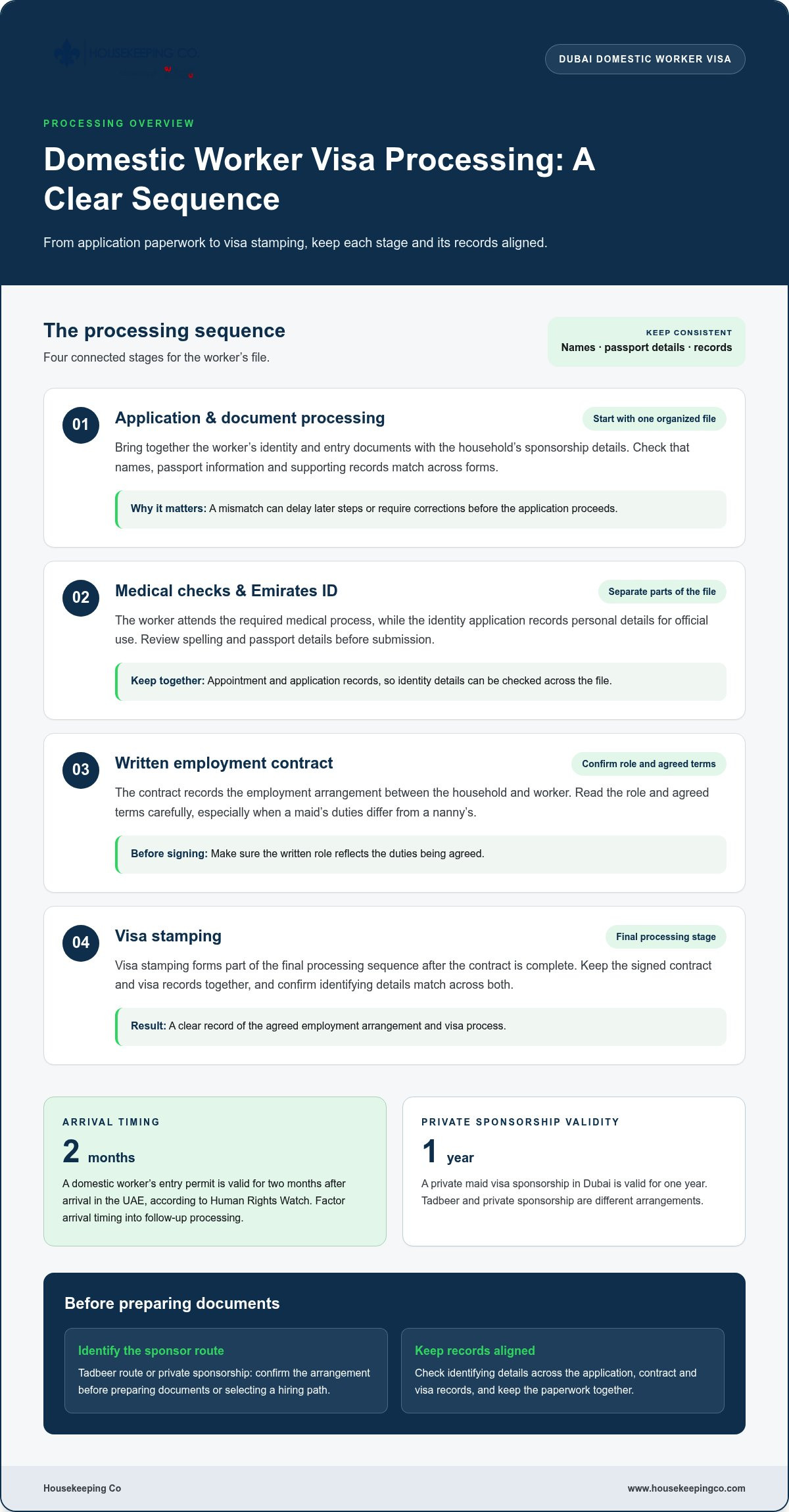
Domestic worker visa processing brings recruitment documents and employment administration into one sequence. In Dubai, the route can include application paperwork, medical checks, Emirates ID processing, a written contract and visa stamping.
Visa Application and Document Processing
The application stage brings together the worker’s identity and entry documents with the household’s sponsorship details. Keep names, passport information and supporting records consistent across each form. A mismatch can delay later steps or require corrections before the application proceeds. Organize the application first, then track the worker’s entry and remaining formalities. Human Rights Watch states that a domestic worker’s entry permit is valid for two months after arrival in the UAE, so factor arrival timing into follow-up processing.
Medical Checks and Emirates ID
Medical checks and Emirates ID processing are separate parts of completing a domestic worker’s file. The worker attends the required medical process, while the identity application records personal details for official use. Review spelling and passport details before submission, then keep appointment and application records together. For example, a mismatch between the worker’s passport name and the name on an ID application can require an avoidable correction. Treat each record as part of one file, not as separate household paperwork.
Contracts and Visa Stamping
The contract records the employment arrangement between the household and the worker. Read the role and agreed terms carefully before signing, especially when a maid’s duties differ from a nanny’s. Once the contract is complete, visa stamping forms part of the final processing sequence. Keep the signed contract and visa records together, and confirm that the worker’s identifying details match across both. This creates a clear record of the agreed employment arrangement and visa process.
Sponsorship and Visa Validity
Sponsorship determines who is responsible for the domestic worker’s visa route. A private maid visa sponsorship in Dubai is valid for 1 year. The Tadbeer route and private sponsorship are different arrangements, so identify the sponsor before preparing documents or selecting a hiring path. Then align recruitment, the worker’s arrival and application steps with that route. Households comparing recruitment and sponsorship can also review maid hiring in Dubai as they consider which arrangement fits their needs.
Maid, nanny and household worker categories
If a worker quits or seems unsuitable, the next steps depend on the employment contract and sponsorship route; replacement should not be assumed to be automatic. Record the circumstances and use the appropriate dispute-resolution channel: MOHRE will try to resolve a domestic-worker employment dispute within 2 weeks before referring an unresolved case to court.
Federal Decree Law No. 9 of 2022 concerns domestic workers in the UAE. For a household, the practical starting point is to match the worker category to the responsibilities required, rather than relying on a job title alone. “Maid” and “nanny” describe different household needs, while “domestic worker” is a broader term for employment in a home. Define the role clearly before discussing recruitment or sponsorship.
- Maid: identify the household tasks expected and explain which areas or routines need support.
- Nanny: describe the childcare responsibilities and the family’s daily routine.
- Other household worker: specify the work required instead of assuming every domestic role is interchangeable.
These distinctions help families describe a placement accurately. For example, a household seeking childcare should explain that need directly rather than calling the position general home support. A worker’s nationality does not establish their role or suitability. The job description and relevant experience are more useful points of comparison.
Start worker verification by checking that identity and employment details are consistent. Compare the worker’s name and identifying information across available records, including the Emirates ID, and discuss relevant experience before agreeing on duties. Prepare a short list of essential tasks, preferred experience and daily expectations. This gives recruitment discussions a clear standard and helps distinguish a poor role match from a concern to address through the employment process.
Support matters if expectations change after placement. Keep the signed contract, agreed duties and relevant communications together, then refer to them when documenting a concern. For a dispute, MOHRE provides a formal resolution process before an unresolved case goes to court. Clear records help explain the issue and the outcome sought, whether the concern involves duties, communication or a worker’s decision to leave.
Families considering domestic worker services can define the role first, then decide whether recruitment and placement suit their household. To discuss a maid or nanny placement with Housekeeping Co, prepare a clear description of the duties and experience you need.
How to Get a Domestic Worker on Your Own Private Sponsorship?
Private sponsorship requires the household to prepare eligibility documents, agree on employment terms and complete the worker’s visa process through authorized channels like Tadbeer Dubai. UAE rules also set responsibilities for contracts, salary, rest and leave.
Recruitment and Placement
Start by defining the domestic role, such as maid, nanny or another household position. Set out the duties, experience needed and working arrangement before recruitment begins. Recruitment and deployment should match the worker’s experience to the actual job, not just a preferred title or nationality. Whether considering candidates from the Philippines, Sri Lanka or elsewhere, compare relevant experience and role fit. A clear description helps both parties understand the placement.
Hiring and Sponsorship Options
Under private sponsorship, the household takes responsibility for the sponsorship route and its supporting documents. A monthly salary certificate showing at least AED 25,000 is listed as a document requirement. Housing documentation must show a two-bedroom apartment with a maid’s room or a three-bedroom apartment. Domestic-worker sponsorship requirements under UAE Federal Law depend on the applicable regulations and the guidelines enforced by Tadbeer Dubai. These criteria help determine whether the private route fits the household.
Before proceeding, prepare the required household and worker records, define the job category and agree on employment terms. A maid visa application depends on the sponsorship route and the worker’s documents. Keep recruitment records and the signed contract together so the agreed role and responsibilities remain clear throughout processing.
Rights, Benefits, and Employer Responsibilities
The contract should reflect the agreed role and salary. Employers utilizing Tadbeer Dubai services must also account for domestic workers’ rights and employment benefits, including the following:
- Workers are entitled to one paid day off per week and 30 days of paid annual leave.
- They may receive up to 30 days of sick leave annually: the first 15 days are paid in full, and the next 15 at half pay.
- Workers are entitled to 12 hours of daily rest, including 8 consecutive hours, and a round-trip ticket home once every 2 years.
- Salary must be paid within 10 days from the due date. Employing a domestic worker under the age of 18 is prohibited.
- For service periods exceeding one year, workers are granted 2.5 days per month. Employers must provide end-of-service compensation when a worker completes 1 year of service.
Keep salary records, contract details and sponsorship documents organized. These records help households manage their employer responsibilities and clarify the agreed terms if an employment issue arises.
Full-time, live-in, live-out and part-time arrangements
The right arrangement depends on how often your household needs support, the duties involved and whether the worker will live in your home. Decide on the schedule and living setup before comparing recruitment or visa service routes.
Full-time support
Full-time employment suits households with recurring duties throughout the week, such as childcare alongside household tasks. List your priorities clearly: a family with young children may need consistent nanny support, while another household may focus on routine cleaning and meal preparation. Keep the agreed role and schedule aligned with the employment contract. This makes expectations easier to discuss during recruitment and placement.
Live-in or live-out?
A live-in arrangement means the worker resides in the household, so families should consider suitable private accommodation and how daily routines will work. A live-out worker travels to the home for scheduled work, keeping the household’s living space separate from the employment arrangement. Choose based on available accommodation, privacy preferences and the hours when support is needed. For full-time live-in domestic workers, a 30-day settling-in program is described in the UAE.
Part-time and hourly support
Part-time help suits households that need defined tasks rather than continuous support. For example, a household may schedule cleaning around a weekly routine, while a family requiring daily childcare may prefer a full-time nanny. Write down the tasks, timing and areas to cover before choosing an arrangement. This keeps your request focused and distinguishes hourly cleaning from a broader household role.
The worker visa and employment setup should match the actual arrangement. A maid visa service relates to recruitment and sponsorship processing, while the household should separately define whether the role is full-time, live-in, live-out or part-time. Government processing does not determine which schedule suits a family. Household needs and agreed employment terms guide that choice. MOHRE is relevant to domestic-worker employment disputes, not a substitute for clear role planning.
Use this sequence to decide:
- Write the recurring duties and identify whether the role is childcare, household support or cleaning.
- Choose full-time or part-time based on the regularity of those duties.
- For full-time work, decide whether live-in accommodation suits the household or live-out work fits better.
- Align the written employment terms and worker visa route with the selected arrangement.
The practical takeaway is straightforward: choose the schedule that fits your household’s routine first, then match the role and sponsorship process to it. Hourly cleaning can address defined cleaning needs, while ongoing childcare or household responsibilities call for a clearly scoped employment arrangement.
How does Tadbeer hiring compare with hiring through a private agency or sponsoring a worker directly?
The main difference is how recruitment, sponsorship and visa administration are arranged. Compare who sources the worker, who sponsors them and which tasks your household must manage.
Tadbeer hiring route
A Tadbeer route can bring recruitment and visa administration together through a service center. This can suit households seeking one coordinated process for selecting a domestic worker and handling related paperwork. Before choosing, identify what the service covers, who holds sponsorship and which responsibilities remain with your household. The Tadbeer label alone does not explain every task included.
Private agency recruitment
A recruitment agency can match a worker’s background to the role you describe. Sponsorship and visa processing may be arranged separately, so distinguish placement support from immigration administration. For example, a family seeking a nanny can compare candidate selection, contract arrangements and who is responsible for visa steps. Review each responsibility, not just the agency name.
Direct sponsorship
With direct sponsorship, the household takes the sponsor role and manages the associated employer responsibilities. Recruitment can be handled separately, but the family must coordinate the placement with its sponsorship paperwork. This route can suit households prepared to organize documents, employment terms and follow-up administration. It may be less suitable if you want recruitment and sponsorship handled as one process.
Use these decision points to compare the routes:
- Recruitment: identify who sources candidates and helps match experience to duties.
- Sponsorship: establish who will sponsor the worker and manage the related responsibilities.
- Administration: clarify who handles applications, contracts and subsequent paperwork.
- Household involvement: assess how much coordination your family can manage directly.
Ask for a written breakdown of the service stages and responsibilities before committing. Compare like with like: recruitment-only support is not the same as recruitment combined with visa administration. For any paid route, the price depends on the case and is given after a quote request; key factors include the recruitment arrangement, worker category, sponsorship route and services included.
The clearest choice is the route that fits your preferred balance of coordination and direct responsibility. If you want to manage sponsorship yourself, compare direct-sponsorship support. If you prefer coordinated recruitment and administration, review what the Tadbeer route includes.
Discuss your household’s recruitment and sponsorship needs with Housekeeping Co.
Hire a Full-Time Live-In/Live-Out Nanny or Maid in Dubai
Housekeeping Co arranges full-time live-in and live-out nanny and maid placements in Dubai. Choose live-in support if the worker will reside in your home, or live-out if you prefer a separate living arrangement. Share the role, duties and schedule you need to guide the placement discussion.
For families arranging sponsorship, Housekeeping Co also offers a 2-year worker visa service and nanny or maid hiring under private sponsorship. If you need cleaning for specific tasks rather than ongoing household support, on-demand hourly cleaning is another option. Match the service to your actual requirement: a regular employment role, a sponsorship route or hourly home cleaning.
Contact Housekeeping Co to discuss the arrangement that fits your household.
Make Your Household’s Next Move With Clarity
Turn your household’s needs into a clear staffing brief. Describe the role, recurring duties, preferred living arrangement, schedule and sponsorship route. This gives you a practical basis for discussing recruitment and visa administration, without treating every household arrangement as interchangeable. A focused brief keeps the conversation centered on the support your family actually needs.
When considering Tadbeer Dubai, weigh how the hiring route fits your preferred level of involvement and the responsibilities you’re prepared to manage. Housekeeping Co can help you explore a domestic staffing arrangement suited to those priorities. Bring your role requirements and preferred setup to the discussion to shape a clear next step.
Clearly defined household needs make the way forward easier to plan. Contact Housekeeping Co to discuss your requirements and identify a suitable direction for your family in Dubai, Sharjah or Abu Dhabi.
A considered staffing decision begins with a clear understanding of what your household needs.
Frequently Asked Questions
What are the Best TADBEER Domestic Worker Packages?
The best option is the one that matches your household’s hiring and sponsorship needs. First decide whether you need full-time live-in or live-out staff, or residential cleaning for specific tasks. Then consider whether recruitment, visa administration or private sponsorship support is relevant. A household needing regular childcare has different requirements from one seeking occasional home cleaning. Review the service scope and responsibilities before selecting a package.
What is TADBEER in UAE?
Tadbeer Domestic Workers Service Centers handle official typing processes for housemaid visa processing, renewal and cancellation. Families use the center route to manage formal visa procedures alongside domestic-worker employment administration. Distinguish that administrative role from your household’s decisions about duties, schedule and living arrangement. The right service depends on whether you need visa processing, recruitment support or both, and who will hold sponsorship. Housekeeping Co provides domestic worker visa services and recruitment support.
Are there any hidden fees or additional costs?
Don’t assume a package covers every expense or administrative step. Ask for an itemized breakdown showing what the quoted service includes and which costs relate to recruitment, visa processing, medical checks or other required steps. The price depends on the case and is given after a quote request; the recruitment arrangement, worker category and sponsorship route affect the cost. A written breakdown makes comparisons clearer and helps prevent misunderstandings.
Can I hire a domestic worker on a flexible basis?
Yes, households can choose support according to the work required. Full-time placements suit ongoing nanny or maid duties, while on-demand hourly cleaning addresses specific residential cleaning needs. For example, a household preparing for a move may need cleaning rather than a continuing employment arrangement. Be clear about whether you need a worker placed in an ongoing role or cleaning staff for defined tasks, as these are different services.
How can You Hire a Maid or Nanny in Dubai, UAE?
Begin by writing a role description that names the main duties, preferred experience and living arrangement. Decide whether your household wants private sponsorship or a recruitment and visa service route. Then organize the worker’s identity information and employer documents for the selected process. A family seeking childcare, for example, should distinguish the nanny’s responsibilities from general household tasks so recruitment focuses on the right role.
How to Hire Full Time Maids (Live-in/Live-out) and Part Time Maids in Dubai?
For a full-time maid, choose live-in or live-out based on accommodation and household privacy. Define recurring duties and the schedule, then align recruitment and sponsorship with that employment arrangement. If you need cleaning for selected tasks rather than an ongoing worker placement, consider hourly residential cleaning. List the tasks and how often your household needs them, then choose the service that matches.
What documents and eligibility requirements apply to Tadbeer domestic worker hiring?
Requirements depend on the sponsorship route and the worker’s application file. Prepare accurate identity information and employer records, and organize documents before processing begins. Document requirements can vary by sponsorship route and application, so confirm the current checklist before processing. For private sponsorship, eligibility documentation also relates to the household’s income and accommodation. Keep records consistent with the worker’s details and agreed role to avoid corrections that disrupt the application sequence.
Which domestic worker job categories and nationalities are available through Tadbeer?
The categories discussed are maid, nanny and other household workers. Candidates may be from the Philippines, Sri Lanka or elsewhere, but the article does not identify specific nationalities available through Tadbeer.
Share this


