Tadbeer Dubai: Domestic Worker Visa & Hiring Guide
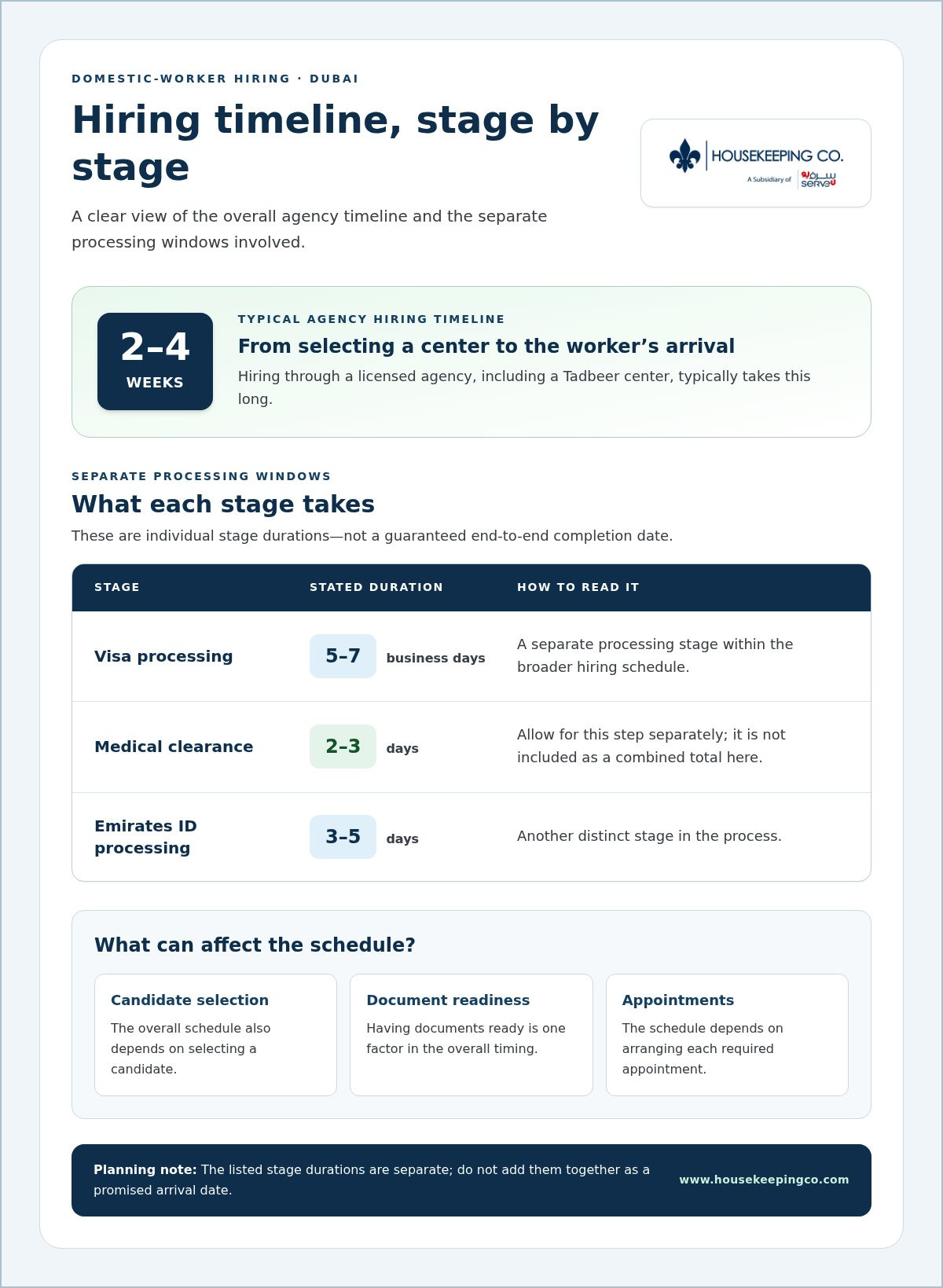
Oct 27, 2026Yes, a household can sponsor a maid in Dubai through the domestic-worker hiring process, while single people are not allowed to sponsor maids. Hiring through a licensed agency, including a Tadbeer center, typically takes 2-4 weeks from selecting a center to the worker’s arrival.
Choosing the right arrangement matters as much as understanding sponsorship. Temporary cleaning may suit a short-term need, while a full-time live-in or live-out worker can provide ongoing household support.
This guide explains the worker and placement options, what sponsorship involves, and how recruitment and visa processing fit together. You’ll learn how to choose an arrangement and understand the steps involved, so you can plan your household’s next move.
Key Takeaways
- Understand who can sponsor a maid in Dubai and how domestic-worker recruitment is arranged.
- Compare available worker roles and nationalities to identify a suitable fit for your household.
- Follow the main stages of hiring and visa processing, including the steps involved in renewals and cancellations.
- Choose between temporary support and a full-time live-in or live-out placement based on your household’s needs.
- See how Housekeeping Co’s recruitment, private-sponsorship and visa services can support your next step.
What is Domestic Workers Services?
In the UAE, domestic worker recruitment services connect households with workers and support the hiring process. Domestic work includes household roles such as maid and nanny positions. Recruitment through a licensed agency is the route for hiring a domestic worker. Housekeeping Co provides a formal channel for recruitment and related services, helping households organize candidate selection and administrative steps.
There is also a worker-protection rule to understand before recruitment begins. UAE Federal Decree-Law No. 9 of 2022 bars domestic worker recruitment agencies from charging workers any fee. This rule concerns charges to workers, not the household’s own costs. Ask for written details of the recruitment arrangement and keep records of agreements and payments.
Compared with arranging a worker directly, Housekeeping Co provides recruitment through a licensed service channel and can coordinate related procedures. A private agency is also a lawful route only when it is licensed. The important distinction is authorization: don’t treat a direct introduction or informal arrangement as a substitute for licensed recruitment.
To reduce scam risks, request the agency’s license details and verify its authorization through an official UAE channel before paying. Keep the quotation, service terms, receipts, and worker’s recruitment details together. Avoid relying only on social-media profiles or verbal promises; a documented agreement gives you a clear record of what the agency will handle.
To find an approved service provider near you, use the UAE directory of authorized agencies and search by emirate or city. The directory lists providers in several emirates, including Ajman, Al Ain, Ras Al Khaimah, Sharjah, and Fujairah. Check the location details against your preferred area, then verify the provider’s current authorization before starting recruitment.
Sponsorship eligibility is a separate decision from choosing a worker. In Dubai, single people are not allowed to sponsor maids. If you’re planning a household hire, establish who will act as sponsor before selecting a candidate, then make sure the arrangement follows the applicable sponsorship requirements.
Part-time domestic support serves a different need from a full-time placement. For example, a household needing help with scheduled cleaning may prefer hourly support rather than employing a live-in worker. Define the tasks, timing, and frequency first; those details shape the service arrangement and help distinguish temporary assistance from ongoing employment.
- Recruit through a licensed agency and document the agreement.
- Confirm sponsorship eligibility before selecting a worker.
- Use the UAE directory to locate a provider, then verify its authorization.
Available worker nationalities and roles
Licensed recruitment centers can help households compare domestic workers by nationality, experience, and role. The recruitment choices listed for the UAE include workers from Indonesia, Sri Lanka, Bangladesh, Kenya, Ethiopia, Uganda, Nepal, and the Philippines. Availability of a particular candidate depends on current recruitment and placement options.
Start with the work. A household seeking daily cleaning and routine support may need a maid, while childcare needs point toward a nanny. For a live-in role, discuss the duties, working arrangements, and household expectations before selecting a worker. Clear expectations help both sides assess whether the placement is suitable.
Profiles can add useful context, but experience should be matched to the tasks required. For example, Hay Mar Oo’s profile lists two years of experience in Bahrain, while Faith Mbula Kyalo’s lists two years in the UAE. Sareah Bt Marisin Marisah’s profile lists four years in Saudi Arabia. These examples show why reviewing a candidate’s work history can help refine a shortlist.
Before deciding, compare each profile against the household’s needs:
- Role: Identify whether the placement is for maid duties, childcare, or another domestic role.
- Experience: Review the candidate’s listed work history and the setting where it was gained.
- Arrangement: Establish whether the worker will live in the household or work under another agreed arrangement.
- Expectations: Explain the duties and household routines before recruitment is finalized.
A full-time live-in worker can provide ongoing support within the household. That arrangement calls for practical discussion about the job’s duties and living arrangements before the employment relationship begins. The worker should understand the type of work before arrival, and the employer should keep duties consistent with the agreed contract.
Under a Tadbeer contract, the worker’s employment terms should be documented, including the agreed duties and wage. In Dubai, domestic workers are entitled to at least 30 days of fully paid annual leave for each year of service; for service longer than six months but less than a year, the stated entitlement is two days per month.
For disputes, keep the contract and recruitment records, then report concerns through the competent authorities. An employer may be entitled to a replacement worker or a full or partial refund if the worker lacks professional competence or physical fitness, ends the contract or stops working, or the recruitment office fails to meet agreed conditions. Handle a worker’s complaint through the formal process, not through pressure or retaliation.
Hiring timelines and processing
Domestic-worker hiring combines recruitment, visa processing, medical screening, and Emirates ID steps. UAE visa processing takes 5-7 business days, medical clearance takes 2-3 days, and Emirates ID processing takes 3-5 days. These are separate stages, so don’t treat them as one guaranteed completion date. The overall schedule also depends on candidate selection, document readiness, and arranging each required appointment.
Manage the process one stage at a time. First, decide on the role and recruitment arrangement. Then prepare the required application details with the relevant service center. Clear records and prompt responses can help prevent avoidable delays.
- Start recruitment: Select a suitable worker and agree on the role and employment arrangement. Confirm the household’s sponsorship route before beginning the application.
- Submit visa processing: Provide the information needed for the domestic-worker visa application. The stated UAE processing time is 5-7 business days.
- Complete medical screening: The worker completes the required medical procedure. Medical clearance takes 2-3 days.
- Complete Emirates ID processing: The worker proceeds through the identification stage, which takes 3-5 days.
These durations describe individual processing stages, not a promise that every case will follow an identical calendar. Business days and days are different units, and the listed visa interval specifically uses business days. Keep the worker’s application details consistent throughout the visa, medical, and identification steps.
A fast-track request is no substitute for a realistic plan. To help avoid administrative delays, prepare the application information, respond promptly to document requests, and coordinate appointments early. The overall timeline depends on completing each stage in sequence.
For planning, distinguish recruitment time from government processing time. A selected candidate may still need to complete visa, medical, and Emirates ID steps before employment can begin. Set the start date with these requirements in mind, rather than assuming every stage will finish at once.
Before the application begins, note who is responsible for each task: candidate coordination, document submission, the medical appointment, and Emirates ID steps. This checklist helps track progress and prevents confusion between medical clearance and completion of the visa or identification process.
Tadbeer centres in Abu Dhabi manage domestic help visa processing, including documentation, fees, medical screening, insurance and Emirates ID biometric scanning. When coordinating the stages, keep a clear record of what has been provided and what remains to be arranged, so the household can follow the application without assuming that one task completes all others.
A practical handoff is to review the listed items against the household’s own task record before moving between stages. Keep the same application details available when organizing documentation, fees, screening, insurance and biometric scanning. This makes it easier to see which parts of the process have been addressed and where the next action sits, while keeping the timeline grounded in the separate steps already described.
Maid visa applications, renewals and cancellations
A domestic-worker visa can involve an entry permit, change of status, Emirates ID processing, insurance, residency visa stamping, and recruitment and placement. Treat each as a separate step and clarify what is included before proceeding. Keeping application and approval records together helps organize the employment arrangement.
For a two-year arrangement, sponsorship and insurance can be part of a domestic-worker visa package. Understand the coverage and responsibilities, and retain the relevant application and contract records. Review insurance alongside visa processing rather than assuming that the visa application includes every service.
Package pricing depends on the case and is provided after a quote request; the relevant factors include the recruitment arrangement, sponsorship route, and services included. Compare package descriptions by their actual components, such as recruitment, visa processing, insurance, and application handling. A headline package label alone doesn’t explain what administrative steps it covers.
For a Tadbeer application, organize the process in a clear sequence:
- Choose the sponsorship route: Establish who will sponsor the worker and which recruitment arrangement applies.
- Prepare the application: Provide the details requested for the entry permit and visa process, keeping information consistent across forms.
- Complete required processing: Coordinate medical screening, Emirates Identity procedures, insurance, and residency visa stamping as applicable.
- Keep the record: Store the contract, application information, and completed processing documents together for future renewals or changes.
A renewal continues sponsorship beyond the current visa period. Start by reviewing the visa record and contract, then organize the renewal application and related processing. Consistent sponsor and worker details can help avoid corrections. Keep the same careful records for changes of status and other updates.
Cancellation is a separate administrative step when employment or sponsorship ends. Address the worker’s contract and visa status together, then retain evidence of the cancellation. Do not assume that ending a contract also completes visa cancellation; record each step separately.
Tadbeer visa services cover distinct requests, including new applications, renewals, and cancellations. Identify whether you need a new application, renewal, change of status, or cancellation before proceeding. This helps the sponsor request the right service and keep employment records aligned with the visa process.
Services can include entry permits, changes of status, Emirates ID, government and medical insurance, residency visa stamping applications, domestic-worker visa renewals and cancellations, and recruitment and placement. Review the services included in your application or renewal so you know which steps it covers.
The cost of sponsoring domestic help in Abu Dhabi varies by the worker’s nationality and job title. The page lists 12,000 as the recruitment amount for a worker from the Philippines. Check which service and recruitment arrangement a quote covers before proceeding.
Temporary and full-time live-in placements
Choose an arrangement by defining how long you need support and what work it will cover. Occasional cleaning is different from consistent childcare or household assistance. Write down the tasks, preferred schedule, and whether the worker would live in the home. These details help distinguish temporary support from ongoing employment.
For a short-term need, hourly residential cleaning can suit a defined task, such as preparing the home before guests arrive. It is a cleaning service, not a full-time domestic-worker placement. List the rooms or tasks, preferred timing, and frequency before arranging support. A clear scope helps distinguish temporary cleaning from employment.
A full-time live-in placement suits households needing ongoing support that can accommodate a worker in the home. A live-out arrangement may suit families needing regular help without resident accommodation. One family may prioritize childcare routines, while another needs daily cleaning. Match the role to the work, not simply to a preferred title.
Before selecting a placement, make the household’s requirements specific:
- Tasks: Separate childcare, cleaning, and other household duties.
- Schedule: Describe the expected routine and the times support is needed.
- Living arrangement: Decide whether the role is live-in or live-out.
- Duration: Identify whether the need is temporary or ongoing.
- Employment terms: Ensure the agreed role and expectations are recorded clearly.
A clear role description also helps with candidate selection. If childcare is central, discuss the children’s routines and the specific responsibilities involved. If cleaning is the priority, identify the household tasks that matter most. Then assess each candidate’s profile against those requirements, rather than choosing based only on nationality or general experience.
Think through the practical impact of a live-in arrangement before recruitment progresses. Consider the accommodation available, household routines, privacy, and how the worker’s duties fit daily life. For a live-out placement, focus on the schedule and how the worker will reach the home. These decisions shape the placement and help both sides understand the arrangement before employment begins.
The main choice is straightforward: use hourly cleaning for defined cleaning tasks, or pursue a full-time placement for ongoing household support. Write down the role and arrangement first, then use those requirements to guide recruitment and visa planning.
Housekeeping: Hire a Full-Time Live-In/Live-Out Nanny or Maid in Dubai
Housekeeping Co helps Dubai households arrange full-time live-in or live-out nanny and maid placements. If you need ongoing household support, define the role and living arrangement first, then choose a placement that fits your routine. Housekeeping Co also offers a two-year worker visa for domestic workers and nanny or maid hiring under private sponsorship. For a shorter cleaning need, on-demand hourly cleaning is an alternative to a full-time employment arrangement.
Whether you’re planning recruitment, arranging a visa, or comparing household support options, Housekeeping Co can help you identify the service that fits. Contact Housekeeping Co to discuss the arrangement that suits your household.
Turn Your Household Requirements Into a Clear Plan
Before taking the next step, write a short household brief: the role you need, its duties, whether the placement is live-in or live-out, and your preferred sponsorship route. This gives recruitment conversations a practical starting point and helps align the employment arrangement with your routine. If you’re considering Tadbeer, consider the worker’s role and visa requirements together.
Housekeeping Co can help you move from that brief to a suitable nanny or maid placement in Dubai, with private sponsorship and domestic-worker visa support. For defined cleaning tasks rather than ongoing employment, hourly residential cleaning may be a better fit. Choose the service that matches your needs, then discuss the arrangement with Housekeeping Co.
Contact Housekeeping Co to discuss an arrangement that fits your household’s needs.
A clear plan makes the next conversation more focused. Take the first step with confidence.
Frequently Asked Questions
Can I sponsor a maid in Dubai?
Eligibility requirements may apply to households seeking to sponsor a maid in Dubai. Domestic workers must be hired through a licensed agency, such as a Tadbeer center. Decide who will act as sponsor before choosing a worker, then align recruitment with that sponsorship route. Housekeeping Co also offers maid hiring under private sponsorship and domestic-worker visa support.
What does Tadbeer mean in the UAE?
Tadbeer is a formal, licensed channel for domestic-worker recruitment and related services, including candidate selection and administrative steps.
How much does it cost to hire a domestic worker through Tadbeer in the UAE?
Costs vary by nationality, role and package.
Share this


