How to Get a Nanny Visa in Dubai: Step-by-Step Guide
Oct 26, 2026A nanny and a maid may have different household roles, but both need the appropriate domestic-worker visa to work in Dubai. A nanny visa in Dubai is arranged through family sponsorship or a licensed domestic-worker agency, followed by the required entry, medical-fitness, Emirates ID and residence-visa steps.
Choosing the right job title is only part of the decision. You also need to understand who can sponsor the worker, which documents to prepare and how the visa process works.
This guide explains the sponsorship routes, the process from entry documents to residence status, and the difference between a nanny visa and a maid visa. It also outlines what to prepare at each stage so you can plan your hire and next steps.
Key Takeaways
- Compare private sponsorship with an agency route, and assess sponsor eligibility and accommodation requirements before choosing how to hire.
- Understand the domestic worker’s rights and your responsibilities as an employer, including the required contract and health insurance.
- Prepare for the residence process by organizing the worker’s documents and completing the Emirates ID and visa steps in sequence.
- Plan for the entry permit, medical fitness test and identity application as connected stages of the process.
- Choose the role based on the work required: nanny and maid are job descriptions, while the visa process concerns domestic-worker sponsorship.
Can I Hire a Nanny in Dubai Without an Agency - Direct Sponsorship Rules?
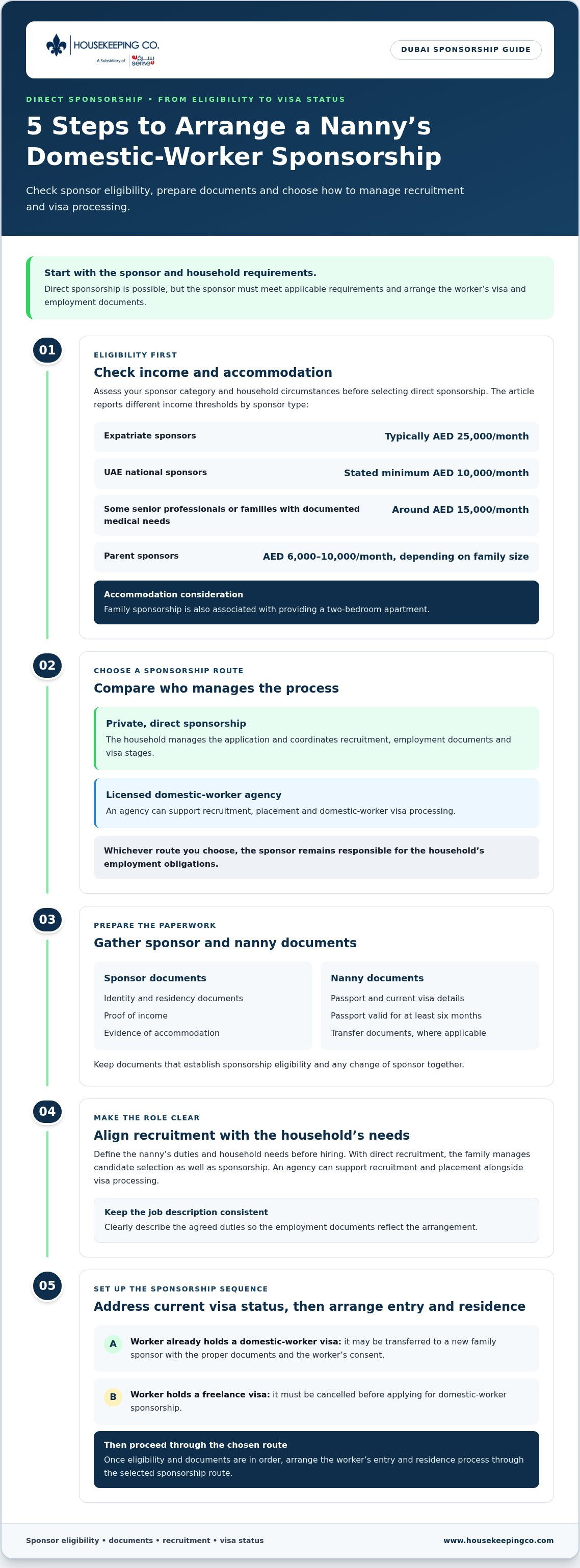
Direct sponsorship is possible in Dubai, but the sponsor must meet the eligibility requirements and arrange the worker’s visa and employment documents. An agency can support recruitment and visa processing, while private sponsorship leaves these responsibilities with the household.
If a nanny already works in the UAE, her domestic-worker visa may be transferred to a new family sponsor with the proper documents and her consent. If she holds a freelance visa, it must be cancelled before applying for domestic-worker sponsorship.
-
Check Sponsor Income and Accommodation Eligibility
Assess your sponsor category and household circumstances before selecting direct sponsorship. Reported income thresholds differ: expatriate sponsors typically need AED 25,000 per month, while the stated minimum for UAE national sponsors is AED 10,000 per month.
Some senior professionals or families with documented medical needs may qualify around AED 15,000 per month. Parent sponsors may face a AED 6,000-10,000 threshold, depending on family size. Family sponsorship is also associated with providing a two-bedroom apartment. Married couples and female heads of households with dependents are typical sponsor profiles.
-
Prepare Sponsor and Nanny Documents
Before starting the application, gather the sponsor’s identity and residency documents, proof of income and evidence of accommodation. These documents help establish who is sponsoring the worker and whether the household meets the relevant eligibility requirements.
Prepare the nanny’s passport and current visa details, along with any documents needed to record a change of sponsor. Her passport should be valid for at least six months. For a worker already in the UAE, keep the transfer documents and her consent together. A freelance visa must be cancelled before applying for domestic-worker sponsorship.
- Choose direct sponsorship or agency support. With private sponsorship, the family manages the application and coordinates recruitment, employment documents and visa stages. An agency can support recruitment and process the domestic-worker visa. Compare the administrative responsibilities as well as the hiring arrangements: the sponsor remains responsible for the household’s employment obligations.
- Match recruitment to the childcare role. Define the nanny’s duties and your household’s needs before hiring. A family recruiting directly manages candidate selection as well as sponsorship. An agency can support recruitment and placement alongside visa processing. Keep the job description clear so the employment documents reflect the agreed arrangement.
- Set up the sponsorship sequence. Once you have confirmed eligibility and gathered the documents, arrange the worker’s entry and residence process through your chosen route. For an in-country hire, address the current visa status first: a domestic-worker visa may transfer with proper documentation and the worker’s consent, while a freelance visa must be cancelled before applying for domestic-worker sponsorship.
What Is a Nanny Visa in Dubai and How Does It Work?
A nanny’s residence and work visa must match her domestic-worker employment arrangement. The process includes sponsorship, a registered employment contract, medical insurance and residence documents.
Processing and fees in Dubai can differ from those in Abu Dhabi and other emirates. Check the applicable sponsorship route and what its charges include instead of assuming Dubai’s costs apply elsewhere.
Visa validity depends on the sponsor: expatriate sponsors’ visas are described as valid for one year, while UAE and GCC national sponsors’ visas are valid for two years. Start renewal at least 30 days before expiry; cancellation or transfer requires the relevant sponsorship process and documentation.
Employing a domestic worker without proper sponsorship may result in fines of AED 50,000 to AED 200,000. Arrange valid domestic-worker sponsorship before employment begins.
-
Confirm Employment Conditions and Rights
Set out the nanny’s working conditions in the employment agreement, then keep them consistent with the domestic-worker contract. Under the UAE Domestic Workers Law (Federal Law No. 10 of 2017), a worker is entitled to at least nine hours of rest per day and one paid day off each week.
Domestic workers are entitled to a maximum of eight working hours per day, with reasonable rest breaks. After completing one year of service, a nanny is entitled to 30 days of paid annual leave. The sponsor must also pay for valid health insurance.
-
Review the Employment Contract and Passport Rules
Sign the standardized MOHRE domestic-worker contract and make sure it reflects the agreed employment arrangement. Register the contract as part of sponsorship, then keep a copy with the worker’s employment records.
Do not keep the nanny’s passport. Withholding it is illegal under UAE law. Explain where her documents are stored and ensure she can access her passport. Clear access can prevent confusion during renewal, transfer or cancellation.
- Record end-of-service entitlements. After completing one year, a domestic worker earns gratuity equal to 21 days of basic salary per year of service for the first five years. Include the salary basis and service dates in your records so the calculation can be made accurately when employment ends.
Families should provide a return flight ticket as part of the nanny’s end-of-service entitlements. Include this responsibility in your plans for ending the employment relationship.
- Keep the visa status aligned with the job. Domestic work must be performed under a domestic-worker visa, not a freelance visa. If the nanny already holds a domestic-worker visa, a new family sponsor may take over with the proper documents and her consent. A freelance visa must be cancelled before applying for domestic-worker sponsorship.
Use the same employment details across the contract and sponsorship records. That makes renewal, transfer and cancellation easier to manage in sequence.
Emirates ID and residence visa processing
Complete the residence process in sequence: submit the application, complete the required checks, then finalize the Emirates ID and residence documents. Keep the nanny’s records and sponsor details consistent throughout.
Submit the Emirates ID and Residence Visa Application
- Prepare the sponsor’s and nanny’s documents before submitting the application. Use consistent identity and employment details across the residence visa and Emirates ID forms. Mismatches can interrupt processing, so review names, passport details and sponsorship records before submission.
- Include the Emirates ID application in the residence process and retain its submission details. Treat these as separate application costs, not one combined fee.
Track the Processing Timeline
- Track each application stage from submission through final residence documentation. Estimates for nanny visa processing range from 1-3 weeks, depending on document readiness, while end-to-end processing is also estimated at 2-4 weeks. These timelines describe different estimates, so leave room for document preparation and individual processing stages.
- Keep copies of submitted documents and note any correction requests. If an identity detail needs amending, check it against the passport or sponsorship record before proceeding. This can help prevent an incomplete stage from delaying the Emirates ID or residence application.
Review Processing Time and Total Costs
- Budget by cost category rather than relying on a single fee.
- Before planning payment, compare what each estimate includes. An Emirates ID fee and a residence-stamping estimate cover specific steps, while an overall sponsorship estimate may include additional items. Keep receipts and records together, and distinguish refundable deposits from non-refundable processing charges in your household budget.
Entry permit, medical testing and Emirates ID process
Complete the entry-permit, medical-fitness, insurance and Emirates ID stages in sequence. A nanny arriving in Dubai must complete the medical fitness test within 30 days of entry.
Health insurance is mandatory for domestic workers in Dubai, and the sponsor pays for a valid policy. The Emirates ID application is part of residence processing.
- Confirm the worker’s eligibility and documents. Dubai nanny applicants are stated to be between 18 and 60 years old. Check the nanny’s passport and sponsorship details before beginning the permit application, then keep the identity information consistent across the entry permit, medical test and Emirates ID records. A mismatch can create delays between these connected steps.
- Arrange the entry permit. A Dubai work entry permit is typically valid for 60 days from its issue date. Treat these as different fee descriptions, not automatically as one combined charge.
- Book the medical fitness test within the required period. The nanny must complete the test within 30 days of arrival. Keep the appointment and test outcome with the sponsorship documents, because the medical stage follows entry and precedes completion of residence processing.
- Arrange valid medical insurance and household provisions. The sponsor must pay for the nanny’s valid health insurance. Dubai nanny packages typically include accommodation, return flights, medical insurance and visa sponsorship. Confirm which provisions apply to your employment arrangement and record them with the worker’s documents.
- Complete the Emirates ID stage and retain the records. Submit the ID application as part of residence processing, then keep its details with the medical-fitness and entry-permit records. Organizing these documents together helps you track each stage and see what remains before the residence process is complete.
Nanny visa versus maid visa
The practical difference is the worker’s role, not a separate sponsorship route for each job title. Nannies and maids are both domestic workers, so match the employment arrangement and visa sponsorship to the work required.
- Define the household’s main requirement. Choose a nanny when childcare is the primary role, such as supporting children’s daily routines. Choose a maid when your household needs domestic assistance. The job title should describe the actual work, not serve as a shortcut to a visa category.
For example, if childcare is your priority, describe that clearly during hiring. If you need help with domestic tasks, define those duties separately. Clear expectations help the sponsor and worker understand the employment arrangement.
- Separate job duties from visa sponsorship. “Nanny visa” and “maid visa” commonly describe sponsorship for different domestic-worker roles. The application is still for domestic-worker employment and sponsorship. A job title alone neither replaces the required visa nor authorizes work outside the sponsorship arrangement.
Keep the agreed duties consistent in hiring discussions and employment documents. The work defines the role; sponsorship establishes the worker’s legal employment status.
- Use the proper domestic-worker route. Domestic-worker visas are issued through MOHRE or a licensed domestic-worker agency. Families can choose private sponsorship or agency support. Neither job title changes the need to follow the applicable visa process.
For a worker already in the UAE, distinguish a domestic-worker visa transfer from a freelance visa. Transferring to a new family sponsor requires proper documentation and the worker’s consent. A freelance visa must be cancelled before applying for domestic-worker sponsorship.
- Compare responsibilities, not labels. The household sponsor must ensure the worker has valid health insurance and an appropriate employment arrangement. These obligations apply whether the role is nanny or maid. Calling the role “nanny” does not remove sponsorship responsibilities, and “maid” does not create an exemption.
Record the role and agreed work clearly. If childcare is central, state that; if you need household assistance, define those tasks instead.
- Make the decision by matching work to role. Choose a title that reflects your household’s actual needs, then arrange sponsorship through the appropriate family or agency route. Nanny and maid are distinct domestic-work roles, not interchangeable labels that change visa rules.
The key takeaway is simple: choose the role based on its duties, then handle the visa through domestic-worker sponsorship. This keeps hiring expectations and legal employment arrangements aligned.
Housekeeping: Hire a Full-Time Live-In/Live-Out Nanny or Maid in Dubai
Housekeeping Co. helps families move from understanding sponsorship requirements to arranging domestic staff for their household. If you’re ready to hire, choose a full-time live-in or live-out nanny or maid in Dubai, and consider whether private sponsorship suits your arrangement.
Housekeeping Co. also arranges two-year domestic-worker visas and supports hiring under private sponsorship. These options connect your staffing needs with the sponsorship route you’ve reviewed, whether you’re hiring a nanny for childcare or a maid for household support.
If you need cleaning rather than a full-time placement, Housekeeping Co. also provides on-demand hourly residential cleaning. The right next step depends on the work you need covered and how you intend to employ the worker. Contact Housekeeping Co. to discuss your household staffing needs.
Move Forward With a Clear Hiring Plan
Your next decision is which household role and sponsorship arrangement fit your needs. Define the work first, then choose whether to hire under private sponsorship or use a supported placement. A clear brief helps align expectations between your household and the worker.
Housekeeping Co. can help families hire a full-time live-in or live-out nanny or maid in Dubai, arrange a domestic-worker visa, or hire under private sponsorship. If you need temporary help or household cleaning rather than a full-time placement, on-demand hourly cleaning is another option. Choose the route that fits the work required and how you intend to employ the worker.
If you’re ready to arrange a nanny visa dubai, discuss your hiring needs and preferred sponsorship arrangement with Housekeeping Co. This will help you identify the next step for your household.
Contact Housekeeping Co. to discuss your household’s staffing needs.
A clearly defined role and sponsorship plan make it easier to move forward with your household hire.
Frequently Asked Questions
Who is eligible for a maid visa in the UAE?
A household can sponsor a maid if the sponsor meets the requirements for domestic-worker sponsorship and can support the employment arrangement. Typical sponsor profiles include married couples and female heads of households with dependents. Eligibility also depends on income and accommodation. The job title does not create a separate visa category, so describe the work accurately in the employment arrangement.
Are nanny salaries in Dubai really tax-free?
The UAE levies no personal income tax, so nanny salaries are not subject to UAE personal income tax. This does not determine whether another country may tax a worker’s income under its own rules. Agree on the salary in writing, and distinguish it from benefits such as accommodation, flights and health insurance.
Is there a legal “freelance nanny visa”?
A freelance visa is not the appropriate visa for domestic work in the UAE. A nanny working in a household needs domestic-worker sponsorship, not freelance status. If a candidate already holds a freelance visa, it must be cancelled before applying for domestic-worker sponsorship. Align the worker’s visa with the nanny role before employment starts.
What does a live-in nanny earn in Dubai?
This is market guidance, not a guaranteed salary or service price. The agreed amount depends on the role and employment terms, so define childcare duties, working arrangements and included benefits in writing before hiring.
Who should use this guide?
This guide is for Dubai households planning to hire a nanny, arrange sponsorship or understand the difference between nanny and maid roles. It is also useful when a candidate is already in the UAE and the family is considering a sponsor change. Use these steps to organize your hiring decision and identify which documents and arrangements need attention.
What are the eligibility requirements for sponsoring a nanny visa in Dubai?
Assess the sponsor’s residency category, household circumstances, income evidence and accommodation before applying. The nanny’s eligibility and identity documents matter too: applicants are stated to be between 18 and 60 years old, and the passport should have at least six months’ validity. Keep sponsor and worker records consistent with the role and sponsorship arrangement.
What is the minimum salary or income required to sponsor a nanny in Dubai?
Reported thresholds vary by sponsor category. The stated figures are AED 25,000 per month for expatriate sponsors, AED 10,000 per month for UAE national sponsors, and around AED 15,000 per month for some senior professionals or families with documented medical needs. Parent sponsors may face AED 6,000-AED 10,000, depending on family size. These categories shouldn’t be treated as one combined threshold.
How much does a Dubai nanny visa cost, including government and agency fees?
The total depends on the sponsorship route and what it includes. Budget categories may include government processing, medical-fitness testing, Emirates ID, insurance, a refundable deposit, flights and agency support. Estimates may cover different parts of the process, so compare inclusions and avoid adding overlapping charges. Service pricing depends on the case and is provided after a quote request.
Share this


