How to Get a Nanny Visa in Dubai: Step-by-Step
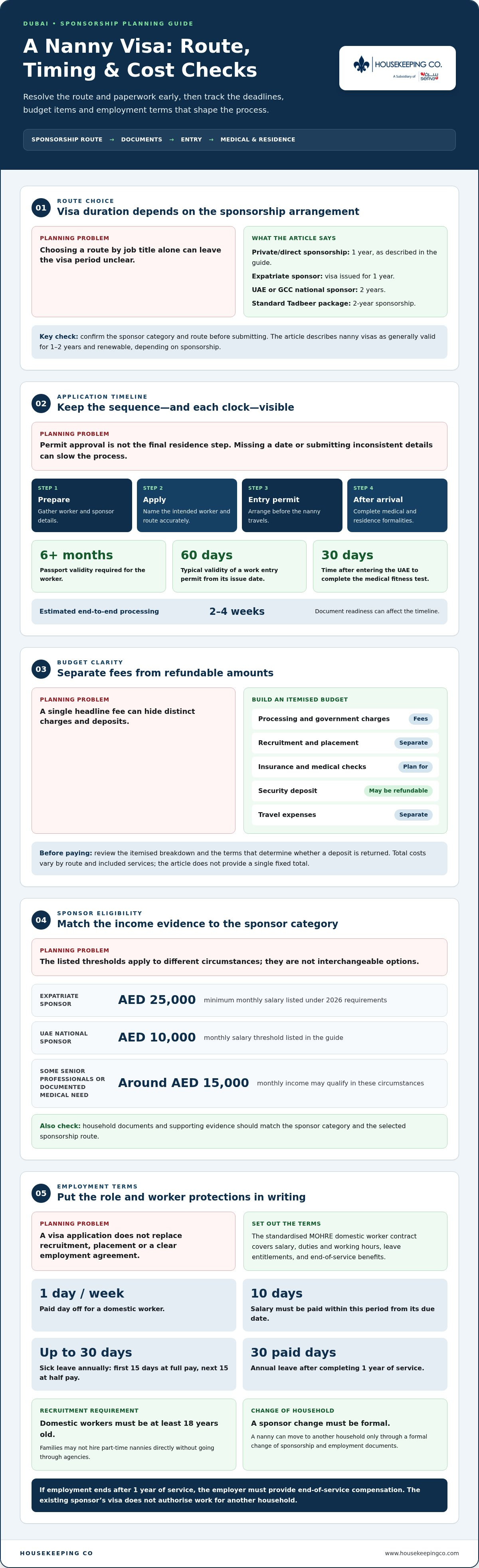
Oct 25, 2026The sponsorship route matters more than the job title. In Dubai, a nanny visa under private or direct sponsorship is valid for 1 year, while alternative agency-managed packages provide a 2-year visa. The nanny must hold a passport valid for at least six months and complete the medical fitness test within 30 days of arriving in the UAE.
Before deciding, it’s sensible to understand the paperwork, fees and deposits involved in a nanny visa. This guide explains who can sponsor a nanny, which costs and refundable deposits to consider, and how nanny and maid visa arrangements compare. You’ll be better prepared to choose a route that fits your household.
Follow the process from choosing a sponsorship route and preparing documents to completing medical checks and residence formalities. You’ll also see what can affect the overall cost and how to match the nanny visa arrangement to your household’s needs.
Key Takeaways
- Compare private sponsorship with a Tadbeer package to understand how the route affects the application and visa period.
- Separate visa and processing charges from the refundable security deposit when planning your budget.
- Review sponsor income and household requirements before preparing an application.
- Understand the health insurance obligation and how it contributes to the overall cost of sponsorship.
- Choose between a nanny and a maid based on the role your household needs, then match it to the appropriate sponsorship route.
What Is a Nanny Visa in Dubai and How Does It Work?
A nanny’s residence status depends on the sponsorship route and completion of the required application steps. Prepare the documents, submit the domestic worker application, then complete the entry, medical and residence formalities.
-
Gather the Required Documents
Prepare the worker’s passport and confirm it is valid for at least six months. The passport is essential, along with the sponsor’s application documents and information identifying the worker and sponsorship route. Match names and passport details across all records. Before submitting, check that scans are legible and sponsor and worker details are consistent.
-
Submit the Domestic Worker Visa Application
Select private or direct sponsorship, or a standard Tadbeer package, before submitting the application. This choice determines the sponsorship arrangement and affects the visa validity. An expatriate sponsor’s visa is issued for 1 year, while UAE and GCC nationals receive a 2-year visa. A standard Tadbeer package is described as 2-year sponsorship. Ensure the application names the intended worker and route accurately; corrections to core details can slow later steps.
-
Process the Entry Permit and Residence Visa
Arrange the entry permit before the nanny travels to Dubai, then complete residence formalities after arrival. A work entry permit is typically valid for 60 days from its issue date. The medical fitness test must be completed within 30 days after the worker enters the UAE. Keep both dates on the application schedule. The nanny visa process proceeds from entry permission to medical fitness and residence processing, so avoid treating permit approval as the final residence step.
-
Review Processing Times and Costs
Plan for the full application sequence. End-to-end processing is estimated at 2-4 weeks, with document readiness affecting the timeline. Separate government and processing charges from insurance, deposits, medical checks and travel expenses when budgeting. The total varies according to the route and included services, so compare itemised costs rather than a single headline fee. A nanny visa is generally valid for 1-2 years and renewable, depending on sponsorship.
If a visa expires or is cancelled, address the worker’s residence status promptly. Arrange renewal before expiry to avoid fines, or coordinate cancellation with the next immigration arrangement. Keep the worker’s documents and sponsor records together so you can manage the next steps without delay.
Domestic worker visa fees and refundable deposits
Budget for more than the application charge: deposits, insurance and employment obligations all affect the overall cost of hiring a nanny visa in Dubai. Separate refundable amounts from fees for processing or services.
- Separate fees from refundable deposits. Treat them as different budget items: processing fees cover application steps, while a security deposit may be returned under the applicable terms. Review an itemised breakdown and identify which charges are refundable before paying.
- Account for recruitment and placement separately. A nanny visa application does not cover every part of hiring. Recruitment and placement involve identifying a suitable worker, agreeing on the role, and preparing employment documents. Domestic workers must be at least 18 years old for recruitment or employment. Families may not hire part-time nannies directly without going through agencies. Keep the job details and sponsorship arrangement aligned from the start.
- Put the employment terms in writing. Families must sign a standardised MOHRE domestic worker contract covering salary, duties and working hours, leave entitlements, and end-of-service benefits. Domestic workers are entitled to one paid day off per week. Salary must be paid within 10 days from its due date. A worker may take up to 30 days of sick leave annually, with the first 15 days paid in full and the next 15 at half pay. Review each term before signing.
- Plan for the worker’s rights and future travel. A domestic worker earns 30 days of paid annual leave after completing one year of service. If employment ends after one year of service, the employer must provide end-of-service compensation. For a standard UAE domestic worker contract, ensure all local labour laws and residency guidelines are strictly followed to maintain legal compliance throughout the sponsorship period.
- Handle any sponsor change formally. Can a nanny change sponsors or work for another household in the UAE? A nanny can move to another household only through a formal change of sponsorship and employment documents. The existing sponsor’s visa does not authorise work for a different household. Align cancellation and new sponsorship arrangements before duties change.
Housekeeping Co recruits and places full-time nannies and maids, and can assist with private sponsorship arrangements. Contact the team to discuss your household’s requirements.
Nanny visa eligibility and sponsor income thresholds
Before applying, match the sponsor’s category, income evidence and household documents to the chosen route. These details shape eligibility for a nanny visa and help prevent inconsistencies in the application.
- Identify the sponsor category. Expatriate sponsors are listed with a minimum monthly salary of AED 25,000 under 2026 requirements; UAE national sponsors are listed at AED 10,000 per month. Some senior professionals or families with a documented medical need may qualify at around AED 15,000 monthly income. These figures describe different circumstances, not interchangeable options. Identify the sponsor’s category and prepare its supporting documents before relying on a threshold.
- Distinguish parent sponsorship from general thresholds. A sponsoring parent may need to meet an income threshold, which can depend on the household’s circumstances. This is a separate household scenario, not the standard threshold for every expatriate sponsor. Dubai sponsors are typically married couples or female heads of households with dependents. Consider the family structure alongside income when preparing the application and selecting a nanny visa sponsorship route.
- Prepare residence and housing evidence. Private sponsorship documents should include proof of a 2-bedroom apartment with a maid’s room, or a 3-bedroom apartment. Suitable accommodation is part of the sponsor’s responsibility to the domestic worker. Gather residence documents that clearly show the household’s address and layout. Salary evidence alone does not establish that suitable housing is available, so keep both types of documentation ready.
- Choose direct sponsorship or a Tadbeer route. Direct sponsorship places the domestic worker under the household’s sponsorship, while a standard Tadbeer package uses a different arrangement. UAE Golden Visa holders are generally exempt from the AED 25,000 income threshold under Cabinet Decision 65/2022. Match the route to the sponsor’s status and household needs; don’t assume one income rule applies to every applicant.
- Align the role, salary and application details. Before filing, compare the worker’s intended duties and agreed salary with the sponsorship documents and employment contract. Common mistakes include conflicting household details or job terms across records. Medical fitness is part of the process, but it does not replace sponsor eligibility or housing evidence. Keep information consistent from application through employment to support a clear nanny visa application.
Mandatory health insurance
Arrange health insurance as part of employing a domestic worker in the United Arab Emirates. Keep the insurance policy separate from the medical fitness test: they serve different purposes in the visa process.
- Arrange cover for the nanny. Families in the UAE must provide health insurance for their nanny. Treat this as an employer responsibility, not an optional extra or a substitute for visa processing. The policy should cover the worker during employment. Keep its details with the visa and employment records to distinguish insurance documentation from other application paperwork.
- Compare the annual premium with the level of cover. Policies offer different levels of cover, so compare their benefits rather than judging by the premium alone. The plan you select affects the household’s recurring costs.
- Review what medical visits the policy covers. The medical insurance described covers 80% of clinic and hospital medical visit costs. Read the policy terms to understand how that stated share applies to covered visits, and keep the insurance documents accessible for appointments. The remaining share of eligible costs can affect the household’s out-of-pocket spending. A premium alone doesn’t explain which medical services the policy covers.
- Keep insurance distinct from the medical fitness test. The medical fitness test is a separate visa-process requirement; insurance doesn’t replace it. For a nanny arriving in the UAE, the test must be completed within 30 days of arrival. Schedule the test within that window, and retain its result separately from the health insurance certificate. Keeping the two records distinct helps prevent confusion during residence processing.
- Include insurance in the sponsorship budget. Add the annual premium to the other costs of employing a domestic worker, and note when the policy needs renewal. Tadbeer and private sponsorship may package visa services differently, but the family remains responsible for providing the worker’s health insurance.
Nanny visa versus maid visa
Choose the worker’s role before comparing visa routes. In Dubai, “nanny” and “maid” describe household jobs; the title alone does not determine a different sponsorship process.
- Define the work your household needs. A nanny’s role centres on childcare, while a maid’s role generally focuses on household support. Write down the actual duties before starting recruitment. For regular childcare, for example, describe the care responsibilities clearly rather than relying on a job title. This helps align recruitment, the employment contract and the worker’s day-to-day duties.
- Compare sponsorship routes, not labels alone. Private sponsorship and a Tadbeer package are options for sponsoring domestic workers. The route affects the visa arrangement and validity, not simply whether the worker is called a nanny or maid. Both roles require the correct application and residence paperwork. Choose the arrangement that suits your household, then keep sponsor details consistent throughout the process.
- Prepare the core records carefully. The worker’s passport, sponsor documents, employment contract and Emirates ID process all matter to the application. Nannies and maids both need records identifying the worker and approved employment arrangement. Check spellings, passport details and household information across every form. Mismatches can lead to avoidable corrections, even when the job and sponsorship route are clear.
- Match the contract to the actual role. The UAE domestic worker framework is set out in Federal Decree-Law No. 9 of 2022. The contract should cover salary, duties and working hours, leave entitlements, and end-of-service benefits. A childcare role should accurately describe childcare duties; a household-support role should reflect its agreed tasks. Don’t use a generic title to obscure what the worker is expected to do.
- Make the decision based on your household’s needs. If childcare is the priority, recruit for a nanny role; if you need general household support, consider a maid role. Then select private sponsorship or a Tadbeer route and prepare the relevant documents. Housekeeping Co supports recruitment and placement, while the sponsor remains responsible for the employment arrangement. Choose the role that matches the work, then select a sponsorship route that fits your household.
For support matching a full-time nanny or maid role with private sponsorship, contact Housekeeping Co to discuss your household’s needs.
Housekeeping: Hire a Full-Time Live-In/Live-Out Nanny or Maid in Dubai
Housekeeping Co helps households move from choosing a sponsorship route to arranging domestic staffing. Select a full-time live-in or live-out nanny or maid based on the role you need, then consider whether private sponsorship or a worker visa arrangement suits your situation.
For families who want to manage sponsorship directly, Housekeeping Co also supports hiring a nanny or maid under private sponsorship. Its domestic worker visa offering provides a 2-year worker visa. These options connect recruitment and placement with the sponsorship path discussed in this guide, helping you make the next decision with the role and visa arrangement in view.
Contact Housekeeping Co to discuss your household’s nanny or maid requirements.
Turn your decision into a household plan
Before moving forward, define what effective support looks like in your home. Write a clear role brief covering responsibilities, the preferred live-in or live-out arrangement, daily routines and household expectations. This gives recruitment a practical starting point and helps align the employment arrangement with your family’s needs.
Next, assign responsibility for coordinating recruitment, organising documents, arranging insurance and tracking visa steps. A shared checklist keeps tasks visible and makes each stage easier to manage. For a nanny visa, clear planning connects the role, sponsorship choice and paperwork in one organised process.
Housekeeping Co can help you move from planning to domestic staffing, whether you need a nanny or maid and prefer private sponsorship or a worker visa arrangement. Start by identifying your household’s priorities and the type of support you need.
Contact Housekeeping Co to discuss the right staffing arrangement for your home.
A clear plan is a practical first step toward finding suitable support for your household.
Frequently Asked Questions
Can I Hire a Nanny in Dubai Without an Agency, and What Are the Direct Sponsorship Rules?
Yes. A household may use private sponsorship for a full-time nanny, subject to sponsor eligibility and application requirements. The sponsor is responsible for the employment arrangement and the worker’s residence status. Part-time nanny arrangements may involve different hiring considerations, so check the appropriate route before proceeding. First decide whether you need full-time employment or part-time care, as this affects how to arrange the work.
Nanny, Maid, Babysitter: Are They the Same Visa?
No. These labels describe different work arrangements, not automatically different visa types. A nanny or maid employed as a domestic worker needs the relevant domestic worker sponsorship and employment paperwork. “Babysitter” may describe occasional childcare rather than formal household employment, so consider the actual duties, schedule and employment relationship. For example, describe a full-time childcare role accurately in the contract rather than treating it as informal babysitting.
How Do I Get a Domestic Worker Under My Own Private Sponsorship?
First confirm that you meet the sponsor and household requirements. Then prepare the worker’s documents and submit an application under private sponsorship. The process continues with the entry permit, medical fitness, insurance and residence formalities. Keep the employment contract consistent with the agreed role and salary. As a practical first step, organise sponsor, housing and worker records together so you can prepare the application from one complete file.
How Do I Hire Full-Time Maids, Live-In or Live-Out, and Part-Time Maids in Dubai?
For a full-time maid, decide whether the role is live-in or live-out, then arrange recruitment, employment terms and the appropriate sponsorship. Part-time domestic employment may require a different arrangement from full-time hiring. Hourly residential cleaning is a separate service, not the same as employing a part-time maid. Specify whether you need ongoing household duties or scheduled cleaning before choosing an arrangement.
What Should Employers Know Before Hiring?
Employers should plan for written employment terms, suitable accommodation and the worker’s end-of-service arrangements. Never retain the worker’s passport; withholding it is illegal under UAE law. Families should also provide a return flight ticket as part of end-of-service entitlements. Before work begins, make sure both parties understand the duties, salary and working arrangements. Keep relevant employment documents organised throughout the arrangement.
What Jobs Fall Under the Domestic Workers Classification?
Domestic work includes household roles such as nanny, maid, housekeeper and caregiver. The actual duties matter: childcare differs from cleaning and broader household support. For example, describe childcare duties in the employment arrangement when hiring a worker to care for children, rather than relying on a vague general title. Define the role before recruitment so the contract reflects the household’s needs and the worker’s responsibilities.
What Is a Nanny Visa in the UAE?
A nanny visa is the residence and work sponsorship arrangement used when a household employs a nanny as a domestic worker. It links the worker’s immigration status to an approved sponsorship and employment relationship. It is not simply a travel document or a label for occasional childcare. The sponsor must arrange the relevant application steps and maintain the employment arrangement, while the nanny completes the required medical and residence formalities.
Who Can Sponsor a Nanny Visa in the UAE?
Eligible sponsors can include expatriate residents, UAE nationals and GCC nationals. Requirements vary by sponsor category and household circumstances. Authorities consider factors such as income evidence, family structure and suitable accommodation. Assemble the sponsor’s identity and residence documents alongside housing evidence before applying. Golden Visa holders may have different income-threshold treatment, so consider the sponsorship route and the sponsor’s status together.
Share this


