How to Get a Maid Visa in Dubai: Step-by-Step Guide
Oct 23, 2026The visa route and work arrangement need to fit together from the start. A maid visa in Dubai provides the immigration framework for employing a domestic worker; for expatriate sponsors, the residence visa application validity is 1 year. Live-in, live-out and part-time help are different arrangements, so it’s important to understand which one matches your household’s needs.
It’s understandable to want a clear picture of sponsorship eligibility, paperwork and the steps involved before making a decision. This guide explains what a maid visa in Dubai covers, who can sponsor a domestic worker, which documents are commonly needed and how the process works. You’ll also see how full-time live-in or live-out employment differs from hourly cleaning, so you can choose an arrangement that suits your household.
Key Takeaways
- Understand what a domestic worker visa covers and how an employment contract sets out the working arrangement and responsibilities.
- Review the sponsor eligibility criteria and prepare the household and worker documents needed for a private sponsorship application.
- Follow the application stages in order, including the residence visa process, medical examination and Emirates ID steps.
- Choose between live-in, live-out and hourly cleaning based on the type of support your household needs.
- Compare private sponsorship with a managed arrangement to decide which route best suits your circumstances.
What are the Benefits of Hiring a Maid or Nanny from Domestic Worker Service Center?
Employing a domestic worker without a valid visa or work permit can result in a fine of up to د.إ 50,000. Federal Decree-Law No. 9 of 2022 prohibits hiring or temporarily employing a domestic worker without a valid Ministry licence.
- Use a licensed recruitment route. A domestic worker service centre can coordinate recruitment and visa application steps, helping keep the worker’s employment and immigration arrangements aligned. If the worker is coming from outside the UAE, organise recruitment and entry through the proper process; the worker must remain in the UAE throughout the visa process. Avoid informal arrangements or work before the required authorisation is in place.
- Set out the job in a written contract. Before employment begins, make sure the contract records the domestic worker’s role, agreed duties, salary, working arrangements and leave. Clear terms help both parties understand expectations, whether the worker is a maid or nanny. Keep a copy for reference, and ensure the agreed duties match the role being performed.
- Understand the worker’s rights and your obligations. UAE domestic workers are entitled to one day of paid leave per week, 12 hours of daily rest including eight consecutive hours, and 30 days of paid leave per year. Employers must pay wages within 10 days from the due date. Include these conditions in your household planning and respect the worker’s agreed rest and leave.
- Plan the two-year visa arrangement. MOHRE domestic worker permits usually last two years. A two-year residence arrangement provides a defined sponsorship period, while the employment contract sets out the working terms. Keep both the visa period and contract duration in mind when planning continued employment, renewal or changes to your household’s needs.
- Follow the application stages in sequence. Prepare the sponsor and worker documents, submit the domestic worker permit and visa application, and complete the required medical test and residence procedures. Correct documents help prevent avoidable processing interruptions. For a Dubai household considering recruitment and sponsorship, the maid recruitment and visa process can be approached as one coordinated route rather than separate informal steps.
Private sponsorship eligibility and documents
Private sponsorship means the individual sponsor is responsible for the domestic worker’s employment and residence arrangements. Before applying, review the eligibility criteria, required documents and costs that apply to this route.
-
Check Sponsor Eligibility and Income
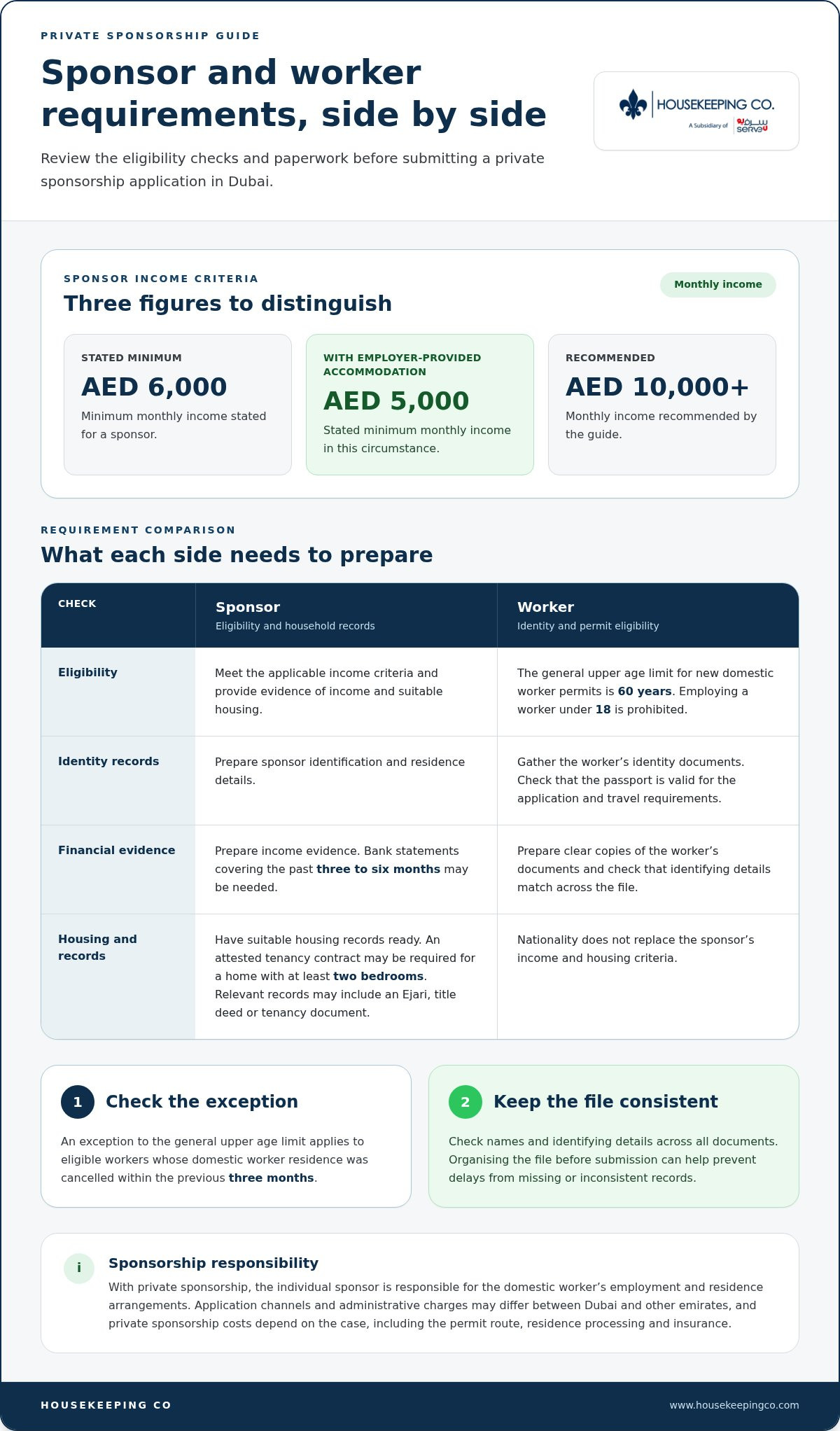
Start by comparing your income and accommodation documents with Dubai’s sponsorship criteria. The stated minimum monthly income is AED 6,000, or AED 5,000 when the sponsor receives employer-provided accommodation. A monthly income of AED 10,000 or more is recommended. Prepare evidence of income and suitable housing before applying; an attested tenancy contract may be required for a home with at least two bedrooms. Dubai and other emirates may differ in application channels and administrative charges. Private sponsorship costs depend on the case, including the permit route, residence processing and insurance, and are given after a quote request.
-
Gather Sponsor and Worker Documents
Gather the sponsor’s identification, residence details, income evidence and housing records, along with the worker’s identity documents. The sponsor may need bank statements covering the past three to six months and an Ejari, title deed or tenancy document. Check that the worker’s passport is valid for the application and travel requirements. Prepare clear copies and check that names and identifying details match across all documents. Organising the file before submission can help prevent delays caused by missing or inconsistent records.
-
Understand Maid Visa Sponsorship
Decide who will be the legal sponsor before employment starts. Sponsorship links the worker’s residence permission and work authorisation to an approved employment arrangement; it is not simply permission to live in the UAE. A private sponsor manages the application and related responsibilities, while a managed package handles administrative steps differently. Compare who is responsible for permit processing, residence formalities and required insurance. Do not allow work to begin before the necessary authorisation is in place.
-
Review Nationality, Age, and Family Rules
Check the worker’s age and the sponsor’s eligibility as part of the application review. The general upper age limit for new domestic worker permits is 60 years; an exception applies to eligible workers whose domestic worker residence was cancelled within the previous three months. Employing a worker under 18 is prohibited. Nationality does not replace the sponsor’s income and housing criteria. A family member applying as sponsor must meet the relevant sponsorship requirements; family relationship alone does not remove them.
What Is a Maid Visa in the UAE ?
A maid visa is the residence and work authorisation arrangement for a domestic worker employed by a UAE household. Follow the application stages in order, as the sponsorship route, documents and processing steps shape the process.
- Choose the sponsorship route. Decide whether the household will use private sponsorship or an authorized domestic worker service centre. The route determines who manages the application and which administrative steps apply. A private sponsorship residence visa application for expatriate sponsors is listed as valid for 1 year, while domestic worker work permits issued through MoHRE usually last two years. Keep those distinct periods in mind when reviewing the employment arrangement.
- Prepare the passport and application file. Check that the worker’s passport has at least six months of validity, then organise the sponsor’s and worker’s documents before submission. The application may include sponsor identification, proof of income and housing, and the worker’s identity records. Matching names and passport details throughout the file can help avoid corrections. For a worker arriving from another country, arrange the entry and application sequence before travel.
- Submit the permit application and allow for processing. MoHRE indicates that its new domestic worker work permit service typically takes two working days. A full maid visa application may take 2-4 weeks, while applications processed through the Dubai Now Domestic Worker Package take about five days. These timelines describe different stages and routes, so don’t treat a work permit decision as completion of every residence step.
- Complete the residence and medical requirements. Follow the application instructions for the medical test, insurance and residence formalities. The worker must remain in the UAE throughout the visa process. A change-of-status application is valid for up to 60 days, so coordinate each stage within its validity period. Keep the worker’s passport and application records accessible, particularly when appointments or further submissions are required.
- Review the service route and cost components. Specialized domestic worker service centres provide a dedicated route for recruitment and visa administration. Dubai’s Domestic Worker Package reduces the process from 12 steps to four and in-person visits from eight to two. Application expenses depend on sponsorship route and required processing components, such as the permit, residence formalities, Emirates ID and insurance. Compare what each route handles before choosing; no single fee figure represents every household’s application.
How to sponsor a maid in Dubai as a resident?
Dubai residents can sponsor a maid directly under private sponsorship if they meet the applicable requirements; an approved domestic worker service centre is another route. Begin renewal at least 30 days before expiry; cancellation or transfer requires formal processing of the sponsorship and the next residence application.
- Confirm the sponsorship route and prepare the residence application. For private sponsorship, organise the sponsor and worker documents before starting the residence process. Expatriate-sponsored domestic worker residence applications are listed as valid for 1 year. Keep the permit, residence application and employment records aligned, because they relate to different parts of the arrangement. If you choose a domestic worker service centre route, its package can coordinate the application stages.
- Arrange the medical examination at the correct stage. Complete the required medical fitness process as directed during the visa application. A domestic worker’s medical fitness certificate is valid for 90 days, so plan the remaining residence steps within its validity. If a worker is recruited from outside the UAE, licensed domestic worker recruitment agencies must arrange required medical tests within 30 days before the worker’s entry. Keep the resulting certificate with the application file.
- Apply for the Emirates ID and schedule biometrics promptly. Once the Emirates ID application is generated, new domestic worker applicants must complete biometrics within 10 days. Keep the application details and appointment information accessible to the worker, and ensure identifying details match the passport and residence records. The Emirates ID application validity is listed as 1 year for expatriate sponsors. Do not treat an ID application as a substitute for completing residence formalities.
- Complete insurance and residence formalities before the process closes. Medical insurance is mandatory for domestic workers in Dubai and is required before residence visa stamping. Coordinate the insurance documents with the medical fitness certificate, Emirates ID application and residence file. Keeping these steps connected can help prevent delays at the final residence stage. Retain copies of submitted documents and application records for future renewal or cancellation.
- Manage renewal, cancellation or a sponsor change as a formal process. Start renewal at least 30 days before the visa expires, allowing time to prepare updated documents and complete the required application stages. For cancellation, close the existing sponsorship through the applicable process and retain its records. For transfer, the incoming sponsor must arrange the next sponsorship application; the worker’s existing residence authorisation should not be treated as automatically transferred.
Live-in, live-out and part-time arrangements
Choose the working arrangement before deciding how to organise household support. Live-in and live-out roles involve a full-time domestic worker. Hourly cleaning is a separate service and does not establish a household-sponsored residence visa.
- Choose live-in support for regular help at home. A live-in arrangement means the worker lives in the household, making it suitable for families needing consistent support with daily routines. Before recruitment, list the duties, expected schedule, accommodation arrangements and household priorities. The employment contract should reflect the agreed role. The worker still needs the appropriate work authorisation, residence visa and mandatory insurance for Dubai.
- Select live-out support when the worker will live elsewhere. This full-time arrangement suits households needing a dedicated maid or nanny without providing accommodation at home. Set out the work schedule, duties and transport expectations in the employment agreement. Compare these practical requirements with a live-in arrangement before choosing a sponsorship route. Immigration paperwork relates to the worker’s legal employment and residence, not simply where the worker sleeps.
- Separate hourly cleaning from full-time employment. Part-time cleaning suits households needing help with specific tasks or on selected occasions rather than a dedicated full-time worker. Treat an hourly booking as a cleaning service, not a substitute for arranging a residence visa for a privately sponsored domestic worker. For example, periodic cleaning may call for hourly support, while daily childcare or ongoing household duties may suit a full-time role.
- Match visa responsibilities to the arrangement. For a full-time worker recruited under private sponsorship, the sponsor manages the relevant application steps and the worker’s residence arrangements. A domestic worker service centre offers another route for recruitment and visa administration. In either case, the worker’s medical fitness, approved work authorisation, residence visa and insurance must align with the employment route. A cleaning schedule alone does not provide immigration permission.
- Use a household needs list to make the final choice. Note recurring tasks, whether support is needed daily or periodically, and whether your home can accommodate a live-in worker. Then compare those needs with a live-out schedule or hourly cleaning. A family needing ongoing childcare and household help may prefer a full-time nanny or maid; a home needing targeted cleaning may be better suited to hourly support.
Housekeeping: Hire a Full-Time Live-In/Live-Out Nanny or Maid in Dubai
Housekeeping Co helps Dubai households arrange full-time live-in or live-out nanny and maid placements, including domestic worker visa support. For families who prefer to employ a worker under their own sponsorship, Housekeeping Co also offers private-sponsorship hiring. These options suit households seeking ongoing domestic or childcare support. For occasional cleaning, choose on-demand hourly residential cleaning instead.
Start by identifying the support your household needs, then decide whether a live-in, live-out or private-sponsorship arrangement fits best. Housekeeping Co can help you choose a suitable domestic staffing option and provides visa arrangements for domestic workers. Contact Housekeeping Co to discuss your household’s requirements and take the next step.
Choose Your Next Step with Confidence
Your next decision is how to match household support with the right employment arrangement. Consider which tasks need covering, whether a live-in or live-out role suits your home, and whether you prefer private sponsorship or a managed visa route. Making this choice first helps you move forward with a clear plan.
Housekeeping Co supports families seeking a full-time live-in or live-out nanny or maid in Dubai, a 2-year worker visa for domestic workers, or hiring under private sponsorship. If your needs are occasional rather than full-time, on-demand hourly cleaning offers a separate household option. The right path depends on the support your home requires.
To discuss how a maid visa in Dubai fits your household plans, contact Housekeeping Co and share the arrangement you’re considering.
Take the next step with a clear plan for your household.
Frequently Asked Questions
How to Get a Domestic Worker on Your Own Private Sponsorship?
Start by confirming that you meet Dubai’s sponsor income and accommodation criteria, then prepare the application file for yourself and the worker. Organise the worker’s passport, your proof of income and housing documents together. After submitting the application, follow the required permit, medical, residence and Emirates ID stages in sequence. This route suits households that want to employ a worker directly and manage the sponsorship responsibilities themselves.
Bringing Your Housemaid to Dubai?
Arrange recruitment and immigration steps before planning the worker’s arrival. First, agree on the role and employment terms, then organise the worker’s identity documents and the relevant sponsorship application. Check the worker’s passport requirements before arranging travel or submitting the application. The worker must remain in the UAE throughout the visa process, so coordinate travel and application timing carefully. For example, a family recruiting from abroad should align entry plans with the required medical and residence stages.
How can You Hire a Maid or Nanny in Dubai, UAE?
Choose between a full-time live-in or live-out placement, private sponsorship and hourly residential cleaning according to your household’s needs. Housekeeping Co provides full-time maid and nanny placements in Dubai and manages domestic worker visa arrangements for placed staff. Residential cleaning is a separate option for households needing part-time help. Housekeeping Co also serves families in Sharjah and Abu Dhabi, with arrangements suited to each household’s requirements.
How to Apply for A Housemaid Visa UAE?
Begin by selecting the sponsorship route and preparing the sponsor’s and worker’s documents. Submit the work permit and residence applications, then complete the required medical fitness, insurance and Emirates ID steps. Keep the worker’s passport details consistent across the application records. Processing times vary by route and stage; a permit decision does not mean all residence procedures are complete. Treat each approval and appointment as a separate step.
How to Hire Full Time Maids (Live-in/Live-out) and Part Time Maids in Dubai?
For full-time help, decide whether the worker will live in your home or elsewhere, then define the duties and working arrangements in the employment contract. A full-time placement involves domestic worker employment and a visa arrangement. Part-time residential cleaning is different: it provides household cleaning support, not a privately sponsored full-time worker arrangement. For example, ongoing childcare may call for a full-time nanny, while periodic cleaning may suit an hourly service.
What are the eligibility requirements for sponsoring a maid visa in Dubai?
Eligibility depends on the sponsor’s income, accommodation and application documents, alongside the worker’s identity and age requirements. Dubai’s general upper age limit for new domestic worker permits is 60 years, with an exception for eligible workers whose residence was cancelled within the previous three months. Employing a domestic worker under 18 is prohibited. Prepare evidence of income and suitable housing before starting, since both affect private sponsorship applications.
How much does a maid visa in Dubai cost, including government fees and medical tests?
The total depends on the sponsorship route and the application components required, including government processing, medical examination, residence procedures, Emirates ID and insurance. For a service offered by Housekeeping Co, pricing depends on the case and is provided after a quote request. Compare what each arrangement covers rather than relying on a single total: private sponsorship and a managed package may include different administrative responsibilities and processing components.
What is the minimum salary required to sponsor a domestic worker in Dubai?
The stated minimum monthly income for a Dubai sponsor is AED 6,000, or AED 5,000 if the sponsor receives accommodation from their employer. A monthly income of AED 10,000 or more is recommended. These figures relate to the sponsor’s income assessment, not the worker’s salary. Keep income evidence with the application documents, and consider the accommodation condition when determining which threshold applies to your household.
Share this


