How to Sponsor a Maid Visa in Dubai: 2026 Guide
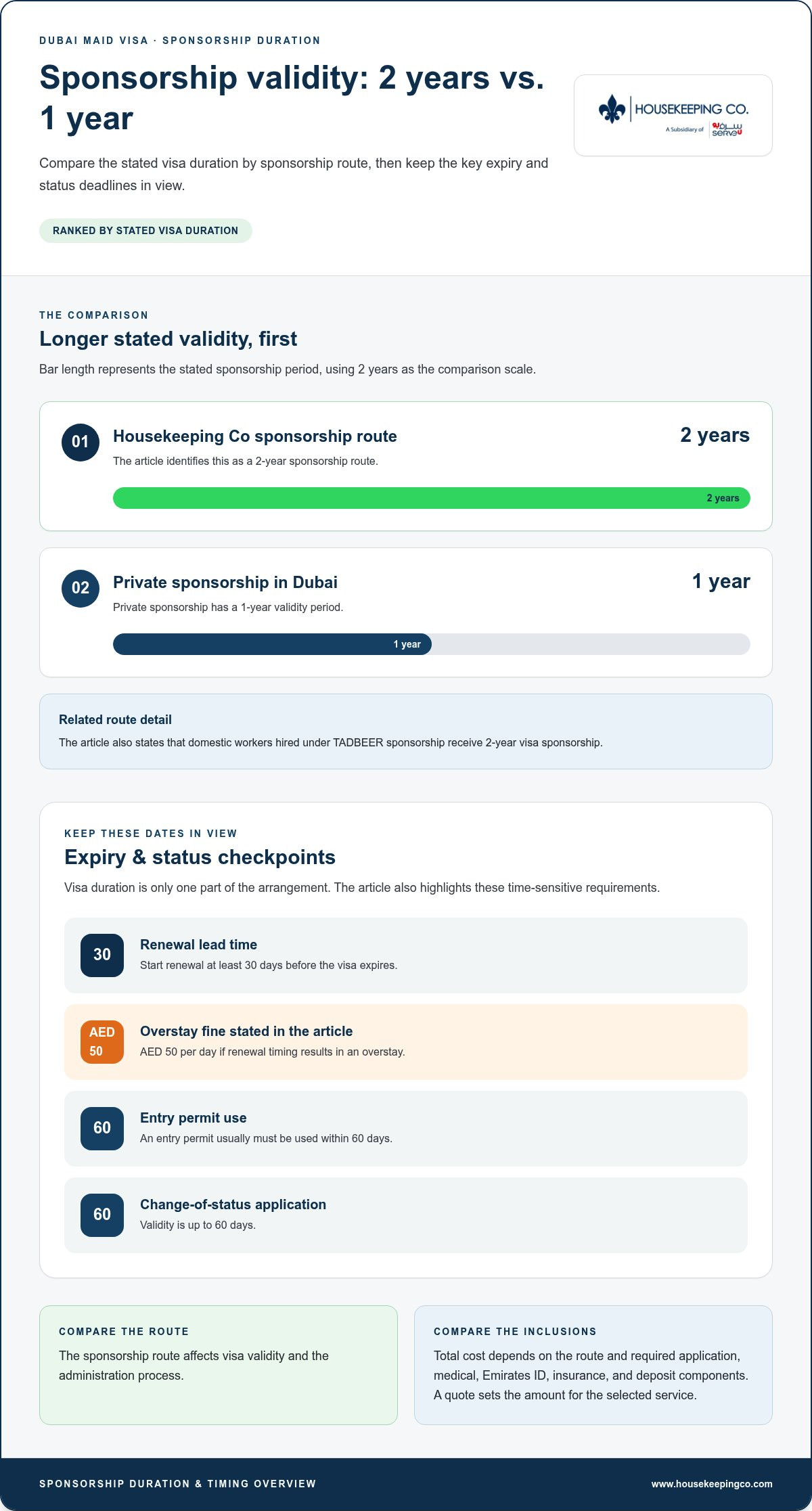
Oct 22, 2026A maid visa in Dubai covers a domestic worker’s sponsorship and residence administration. Private sponsorship is valid for 1 year, while Housekeeping Co sponsorship provides a 2-year route. The right maid visa arrangement also depends on the household role and living setup.
Choosing a maid visa is one part of planning household support. Live-in, live-out, and part-time arrangements meet different needs, so consider your home’s routine and the duties the worker will perform.
This guide explains what sponsorship covers, how residence and Emirates ID administration works, which domestic roles are available, and what to consider before hiring. It also helps you match a visa route to your household’s needs.
Key Takeaways
- Assess private sponsorship eligibility against household income and residence requirements, then prepare the sponsor and worker documents.
- Follow the residence and Emirates ID process in sequence, including medical fitness and biometrics requirements.
- Understand employer responsibilities for insurance, rest days, leave, wages, and lawful recruitment before hiring.
- Identify the domestic-worker role and entry-permit pathway that fit whether the worker is already in the UAE or arriving from abroad.
- Match the support arrangement to your household routine: live-in or live-out full-time help and hourly cleaning serve different needs.
What is a maid visa?
A maid visa in the UAE is the residence sponsorship used for a domestic worker employed by a household. Eligibility depends on the sponsor’s category, income, and accommodation, while the selected route sets the sponsorship period and administration process.
For a household in Dubai, distinguish private sponsorship from agency-arranged sponsorship before preparing an application. The route affects visa validity and the steps involved in arranging an entry permit, residence status, and supporting documents.
Private Sponsorship Eligibility
A UAE resident may sponsor a domestic worker if they meet the applicable sponsor, income, and housing criteria. Private sponsorship guidance specifies that the sponsor’s owned or leased home must have at least two bedrooms. Under the stated UAE domestic worker rules, bachelors cannot sponsor domestic workers.
Income thresholds depend on the sponsor’s circumstances. Expatriates generally need combined family income of AED 25,000 per month. Other guidance sets a minimum sponsor income of AED 6,000 per month, or AED 5,000 per month if the sponsor receives accommodation from their employer; Dubai guidance also gives AED 10,000 or more per month. UAE nationals generally need AED 10,000 per month, while medically necessitated sponsorship cases have a stated threshold of AED 15,000 per month. These are distinct eligibility circumstances, not interchangeable figures.
Prepare the sponsor’s identity and residence records, proof of income, and housing documents. The document list includes bank statements covering the past 3-6 months; another requirement lists a three-month bank statement. The worker’s passport must be valid for at least six months, and the application requires three passport photos. Private sponsorship housing documents list a two-bedroom apartment with a maid’s room or a three-bedroom apartment.
Before applying, match each document to the sponsorship route and sponsor category. The Dubai maid hiring service page describes the household hiring route relevant to this decision.
Visa Validity by Sponsor Category
Private sponsorship in Dubai is valid for 1 year. Domestic workers hired under TADBEER sponsorship receive 2-year visa sponsorship. A package may include sponsorship and insurance, so compare its inclusions and route rather than treating every arrangement as identical.
The total cost depends on the sponsorship route and required application, medical, Emirates ID, insurance, and deposit components. A quote sets the amount for the selected service. Consider these administrative costs separately from visa duration so you can see what the maid visa arrangement covers.
If the visa is approaching expiry, start renewal at least 30 days before expiry to avoid overstay fines of AED 50 per day. If sponsorship ends or the worker leaves the UAE, address the visa status through the relevant cancellation or status process. An entry permit usually must be used within 60 days, and a change-of-status application is valid for up to 60 days.
Residence visa and Emirates ID administration
Once you select a sponsorship route, complete the residence application and Emirates ID process in sequence. Key checkpoints for a domestic worker in the UAE include medical fitness, insurance, identity registration, and biometrics. Track each application separately to see what is complete and what remains outstanding.
Start with the worker’s medical fitness examination. The resulting certificate is valid for 90 days, so complete the next immigration steps within that period. Female domestic workers applying for a UAE visa are required to undergo a pregnancy test. Keep the examination record with the application documents, then use the certificate while it remains valid.
Medical insurance is required before residence visa stamping in Dubai. Arrange it as part of the application process, not as a last-minute step. Keep the medical result, insurance details, visa application information, and identity documents together, and track which requirements are complete and which still need attention.
Emirates ID registration follows its own application timeline. A domestic worker sponsored by an expatriate has an Emirates ID application validity of 1 year. For a UAE national or GCC national sponsor, the application validity is 2 years. These periods relate to the Emirates ID application by sponsor category, so don’t assume they are identical to every other visa validity period.
Biometrics are a separate required checkpoint for a new Emirates ID application. The worker must complete biometrics within 10 days after the application is generated. Record the generation date and arrange the appointment promptly; leaving this step until later can put the application timeline at risk. Keep the appointment details and completion confirmation with the immigration file.
A practical sequence is straightforward: complete the medical examination, arrange insurance before visa stamping, generate the Emirates ID application, then complete biometrics within the required 10-day window. Keep copies of each result together. If a certificate approaches its 90-day validity limit, prioritize the outstanding steps that rely on it.
What Employers Need to Know Before Hiring?
Before hiring a domestic worker in Dubai, understand the contract, recruitment rules, and your ongoing responsibilities as an employer. These include lawful recruitment, insurance, wages, rest, and leave.
Employer Responsibilities and Penalties
Hiring or temporarily employing a domestic worker without a valid Ministry licence is prohibited under UAE Federal Decree Law No. 9 of 2022 concerning domestic workers. Recruitment or employment of anyone under 18 years is also prohibited. Illegal hiring can result in a fine of up to AED 50,000.
Medical insurance is mandatory in Dubai and required before residency visa stamping. Employers must provide one paid day off per week and 30 days of paid annual leave. Workers are entitled to 12 hours of daily rest, including eight consecutive hours.
Pay wages within 10 days from the due date. A worker who completes one year of service must receive end-of-service compensation. These obligations continue after the permit and residence administration are complete, so keep payment and leave records organized.
Before recruitment, confirm the worker’s age and that the employment route is lawful. Arrange insurance before visa stamping, and establish a clear process for wages, weekly rest, and annual leave. Addressing these responsibilities early helps you manage the employment relationship from the start.
Employment Contracts and Recruitment
The employment contract sets out the agreed working relationship and should align with the recruitment and visa application process. Immigration employment contracts dated 2017 and 2018 are accepted for domestic worker applications. Keep the contract with the worker’s application records so its details remain available during immigration processing.
Recruitment and employment are distinct responsibilities: the recruitment route must be lawful, and the employer must meet continuing contract obligations. A domestic worker cannot be recruited or employed before turning 18, and work cannot begin through an unlicensed Ministry route.
Review the contract before employment begins. Make sure both parties understand the role, wages, and agreed terms, then keep the signed contract with the worker’s permit and insurance documents. If the worker completes one year of service, account for the end-of-service compensation obligation when employment ends.
Treat recruitment, contract records, insurance, and residence visa stamping as connected parts of a compliant hiring plan. Complete the contract and insurance arrangements before stamping, and keep the employment file consistent. During employment, track wage due dates, weekly rest, and annual leave as separate ongoing responsibilities.
What Jobs Fall Under the Domestic Workers Classification?
Match the application to the household role and the worker’s location. For a maid, nanny, or babysitter, describe the duties clearly. This helps establish what the family is hiring for and which documents belong in the application. Use a job title that reflects the actual work, not simply the family’s preferred label.
For a worker arriving from abroad, the sponsorship process includes an entry permit. A Dubai entry permit usually must be used within 60 days before it expires, so coordinate the worker’s travel with the permit period. The maid visa application and travel plan should be treated as connected steps, especially when a family has a preferred start date.
A worker already in the UAE follows a change-of-status route rather than entering on a new permit from abroad. A change-of-status application is valid for up to 60 days. Confirm which situation applies before assembling the file, because the worker’s location determines which immigration path is relevant.
Processing time also affects household planning. Applications usually take 2-4 weeks, while processing may take as few as five working days when requirements and documents are in order. A complete application can help avoid delays caused by missing supporting records, but the family should plan around the stated processing range.
Prepare the worker’s passport, sponsor records, and any nationality-specific documents together. The passport must be valid for at least six months, and the application requires three passport photos. Sponsor bank statements covering the past 3-6 months are listed among required documents; a three-month statement is also listed as a sponsor requirement.
Nationality may affect document requirements. Candidates from Kenya, Uganda, and Cameroon need Dubai Police clearance for a domestic worker application. Include the clearance in those candidates’ files rather than assuming the same document applies to every worker. Plan this step alongside the maid visa application documents.
Use this sequence to prepare:
- Define whether the position is for a maid, nanny, babysitter, or another domestic role.
- Establish whether the worker is inside the UAE or arriving from abroad.
- Gather sponsor bank statements, worker passport details, and required photographs.
- Add Dubai Police clearance for candidates from Kenya, Uganda, or Cameroon.
- Submit through the applicable permit or change-of-status route and track its validity.
For families, the worker’s location determines an important part of the process: an overseas candidate needs an entry permit, while a worker already in the UAE follows a change-of-status process. Align the role, documents, and route before applying.
Live-in, live-out, and part-time arrangements
Choose a household arrangement based on when you need support, the duties involved, and how your home operates. A live-in worker lives in the household; a live-out worker travels to and from the residence. Part-time help covers selected tasks or hours rather than providing full-time household support.
Choose live-in support when the role calls for a regular presence at home, such as childcare alongside household duties. Plan accommodation and responsibilities before recruitment. For example, a family hiring a nanny can distinguish childcare from cleaning or meal preparation. A clear description helps everyone agree on the role and daily routine.
Live-out support may suit households that need full-time help but prefer the worker to live elsewhere. Set the schedule around your family’s routine, then agree on duties and salary. If private sponsorship applies, the sponsor must still meet the relevant residence criteria. A live-out arrangement does not remove those requirements.
Part-time assistance suits specific needs, such as periodic home cleaning, rather than continuous childcare or household coverage. Distinguish task-based cleaning from full-time domestic employment. Caregiving also differs from general cleaning because it involves personal or childcare support. Define the responsibilities first, then decide whether you need ongoing employment or help with particular household tasks.
The immigration process is separate from the family’s choice of household support. Sponsoring a domestic worker may involve an application, medical fitness, insurance, and residence procedures. A maid visa establishes the worker’s immigration status; it does not determine whether live-in, live-out, or part-time support fits your daily routine.
Use this comparison to clarify the decision:
- Live-in: Consider this model when the role needs regular support at home and accommodation is suitable.
- Live-out: Choose it when the household needs full-time support without the worker residing in the home.
- Part-time: Select it for defined tasks, such as scheduled cleaning, without ongoing full-time household coverage.
Before hiring, list the essential duties, expected schedule, and whether the worker will live in your home. Then choose an employment and sponsorship route suited to the role. This creates a practical staffing plan while keeping household arrangements distinct from immigration administration.
Housekeeping: Hire a Full-Time Live-In/Live-Out Nanny or Maid in Dubai
Housekeeping Co helps families move from understanding sponsorship requirements to arranging household support. Choose a full-time live-in or live-out nanny or maid based on your household routine, accommodation, and the duties required. For families planning sponsorship, options include hiring under private sponsorship or arranging a 2-year worker visa for domestic workers.
If you need help with selected cleaning tasks rather than a full-time hire, on-demand hourly cleaning is an option for your home. Choose the service according to whether you need ongoing childcare, household assistance, or occasional cleaning. Contact Housekeeping Co to discuss the arrangement that fits your household.
Choose the Support That Fits Your Household
Turn your household’s priorities into a clear hiring plan. Decide whether you need a nanny, maid, or caregiver, and whether the role should be live-in or live-out. Then select the sponsorship arrangement that fits your circumstances before starting an application.
Housekeeping can help families arrange full-time live-in or live-out nanny and maid placements in Dubai, access a 2-year domestic worker visa option, or hire under private sponsorship. These are distinct routes, so start with the role and living arrangement you need, then consider which sponsorship model aligns with your plans. A defined brief makes it easier to take the next practical step with confidence.
When you’re ready to discuss household staffing or sponsorship, contact Housekeeping. You can begin with your preferred role and arrangement, then explore the relevant option for your home.
Make your next decision with a clear picture of the support your household needs.
Frequently Asked Questions
Bringing Your Housemaid to Dubai?
Arrange the worker’s entry permit before travel, then complete the required residence process after arrival. Plan the journey around the permit’s validity: a Dubai entry permit usually must be used within 60 days. Keep the worker’s travel and application documents together, including any nationality-specific clearance. For candidates from Kenya, Uganda, and Cameroon, Dubai Police clearance is required for the domestic worker application.
How can You Hire a Maid or Nanny in Dubai, UAE?
Define the role, duties, and living arrangement, then select a lawful recruitment and sponsorship route. Housekeeping Co arranges full-time live-in and live-out maid and nanny placements in Dubai, with domestic worker visa options. For occasional cleaning, choose a cleaning service rather than a full-time employment and sponsorship arrangement. A clear role description helps match recruitment to your household’s needs.
How to Apply for A Housemaid Visa UAE?
Prepare sponsor and worker records, choose the appropriate sponsorship route, and submit the application with its supporting documents. Allow time for medical fitness, insurance, Emirates ID registration, and immigration processing. Keep application receipts and certificates together, and note expiry dates as they are issued. A worker already in the UAE follows a different application pathway from an overseas candidate who needs an entry permit.
How to Get a Domestic Worker on Your Own Private Sponsorship?
First confirm that your household meets private-sponsorship eligibility, then assemble sponsor income and residence evidence alongside the worker’s identity documents. Make sure housing records reflect the property used for sponsorship, and keep bank statements available for the application. Employment and immigration sponsorship are separate parts of the process. Housekeeping Co also offers nanny and maid hiring under private sponsorship.
How to Hire Full Time Maids (Live-in/Live-out) and Part Time Maids in Dubai?
Choose full-time live-in or live-out staffing when your household needs ongoing employment, and define the duties and schedule before recruitment. For limited cleaning needs, on-demand hourly residential cleaning is a separate service, not the same as hiring a sponsored domestic worker. Housekeeping Co provides full-time maid and nanny placement as well as hourly cleaning for homes.
What are the Benefits of Hiring a Maid or Nanny from Domestic Worker Service Center?
A domestic worker service center can help organize recruitment and visa administration. Housekeeping Co recruits and places full-time maids, nannies, and caregivers, and manages domestic worker visa arrangements for placed staff. This can suit families who want support coordinating staffing and employment administration. Define the role and daily responsibilities clearly before recruitment begins.
What are the UAE maid visa requirements for sponsors and domestic workers?
Sponsors must meet the relevant income and housing criteria and provide supporting records. Workers need valid identity documents, including a passport valid for at least six months, and three passport photos. A Good Conduct Certificate is required for domestic workers. Additional requirements may depend on nationality: candidates from Kenya, Uganda, and Cameroon need Dubai Police clearance. Prepare documents for both parties before submitting the application.
How much does a maid visa cost in the UAE, including application and renewal fees?
The total depends on the sponsorship route and the required immigration, medical, Emirates ID, insurance, and deposit components. Renewal costs also vary with the applicable route and services. For your household budget, separate government and administration charges from recruitment or employment costs, and plan for renewal as a future expense. The service price depends on the case and is provided after a quote request, based on the selected route and requirements.
Share this


