Live-in Cook and Housemaid Services in Abu Dhabi
Oct 21, 2026Yes, you can hire an Indian cook in Abu Dhabi for a live-in role combining cooking and household support. A live-in cook and housemaid in Abu Dhabi may suit families seeking regular help at home, with duties clearly set out in the employment arrangement.
Choosing live-in or live-out support affects how the role fits your household routine. If childcare is included, define expectations for care and supervision as well. This guide explains how to approach hiring an Indian cook, what cooking, housekeeping, and childcare duties may involve, and how to compare the two living arrangements. It also covers practical points to consider when defining the role so you can make an informed choice for your family.
Key Takeaways
- You can hire an Indian cook in Abu Dhabi; define the cooking style and household responsibilities clearly before choosing a role.
- Separate recruitment or sponsorship expenses from monthly pay when planning your household budget.
- Set out cooking, cleaning, and childcare duties in the employment arrangement so expectations are clear for everyone.
- Compare live-in and live-out arrangements by considering accommodation, meals, household routines, and the level of support needed.
- Assess candidates against your family’s practical needs, including cooking experience, housekeeping skills, and childcare responsibilities.
How much does an Indian maid cost in Abu Dhabi?
To hire and sponsor a live-in cook or housemaid in Abu Dhabi, choose agency placement or direct household sponsorship, then arrange the employment contract and visa process. The route affects the paperwork, costs, and responsibilities the employer manages.
There is no single total cost for every household. A quote depends on the recruitment route, visa requirements, and agreed salary and employment terms. When planning your budget, separate recruitment or processing expenses from recurring pay and household provisions. The final placement cost depends on these details.
Compare packages by their stated inclusions, not just the headline figure. Check whether recruitment, visa processing, and employment documentation are covered, and identify the steps that remain the employer’s responsibility. A two-year worker visa is one possible arrangement, but visa duration does not replace valid employment documents or attention to expiry dates.
With direct sponsorship, the household manages the sponsorship route and related documentation. Agency placement involves recruitment through an intermediary. Either way, define the role clearly: cooking, housekeeping, and any childcare duties must match the employment terms. Domestic workers must not be assigned tasks outside their contract.
Documentation is part of the cost decision because incomplete paperwork can disrupt the sequence. Keep the signed employment contract and copies of the worker’s relevant visa and identity documents together. Some placements include a two-year MOHRE employment contract, Emirates ID, medical examination, and health insurance. Under Article 15 of the Domestic Workers Law, the employer must give the worker a copy of her contract within 10 days of starting work.
UAE domestic-worker hiring is governed by Federal Law No. 10 of 2017 on domestic workers, as amended by Federal Decree Law No. 9 of 2022. The contract can last up to 2 years. These terms give both parties a documented reference for the job and its conditions, including the duties the household expects.
Visa processing in Abu Dhabi typically takes 4-10 weeks, depending on the source country and visa category. Build that sequence into household planning rather than assuming the worker can start immediately. Keep the visa expiry date visible in your records and plan document renewals before status lapses. Visa protection means maintaining valid status and matching employment records, not relying only on a package label.
Budget for the entire arrangement, not just the initial placement. Salary, accommodation and meals for a live-in worker, and the sponsorship route all affect household costs. Agree on the weekly rest day and written duties before work begins. Clear terms give both the employer and worker a practical basis for managing the arrangement.
Household chores, cooking, and babysitting
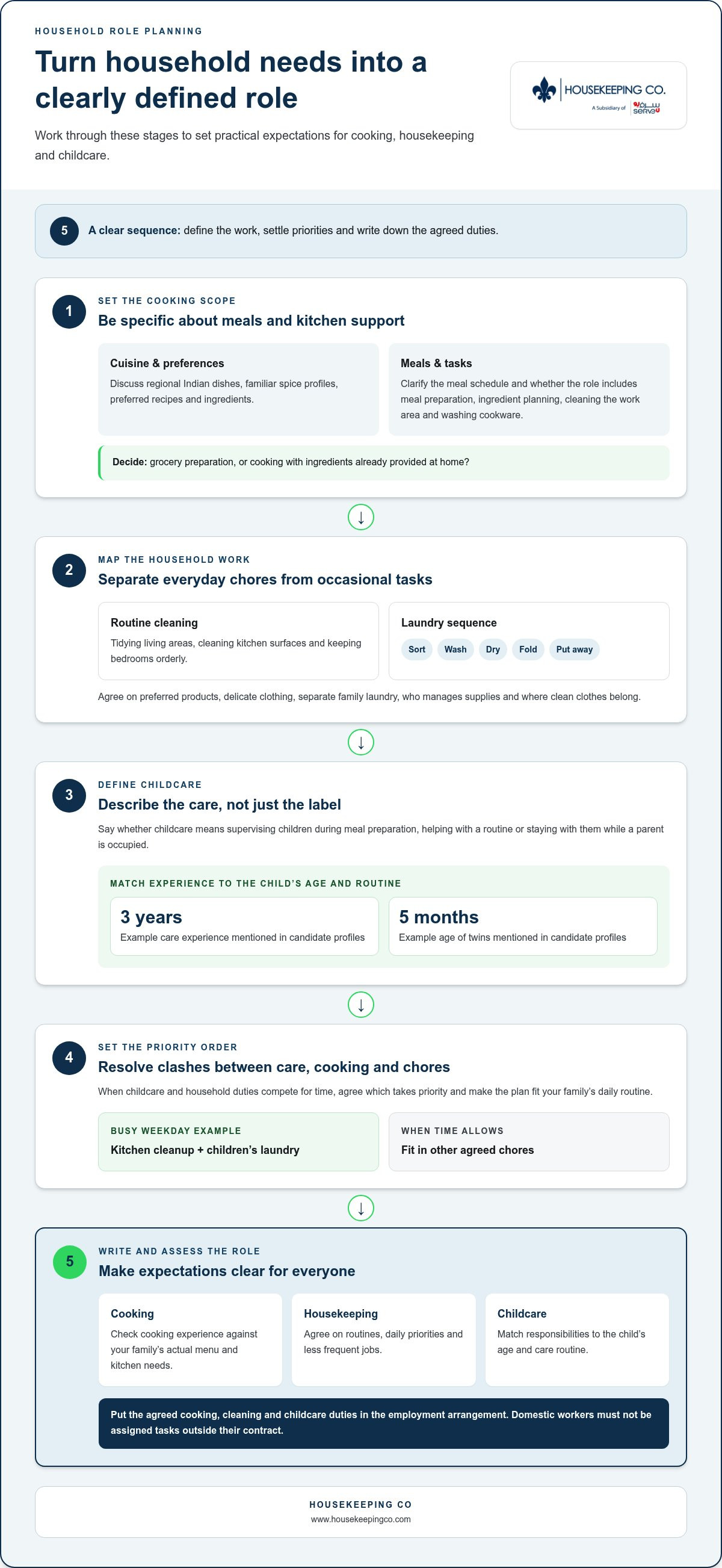
A combined household role may include meal preparation, routine cleaning, laundry, and agreed childcare. Set out the daily priorities, such as preparing dinner before folding laundry.
Household Chores and Laundry
Housekeeping may include everyday tasks such as tidying living areas, cleaning kitchen surfaces, and keeping bedrooms orderly. Laundry can involve sorting, washing, drying, folding, and putting clothes away. Specify preferred products and routines, especially for delicate clothing or separate family laundry.
Make the schedule practical by distinguishing daily tasks from less frequent jobs. For example, a household might prioritize kitchen cleanup and children’s laundry on busy weekdays, then fit in other agreed chores when time allows. Clarify who manages supplies and where clean clothes belong. A written routine helps prevent missed tasks and balances chores with cooking.
Define babysitting rather than assuming it is included. State whether the role covers supervising children during meal preparation, helping with a routine, or staying with them while a parent is occupied. Because childcare and household duties compete for time, agree which takes priority when both are needed. Make the description specific to your family’s daily routine.
Cooking and Kitchen Assistance
Cooking duties may range from preparing family meals to planning ingredients, keeping the work area clean, and washing cookware. Explain the expected meal schedule and level of kitchen support. One household may need lunch and dinner prepared, while another may need help with preparation only. Specific expectations make the role easier to assess.
Indian cooking can mean regional dishes, familiar spice profiles, or meals tailored to family preferences. Discuss preferred recipes and ingredients, then use a practical example, such as preparing a weekly menu of household favourites. Chinese cooking is another distinct skill: a Chinese Cook listing covering Abu Dhabi requires 1-4 years of experience, while a South Indian Cook listing in Abu Dhabi requires 0-5 years. These listings illustrate why cuisine experience should match the family’s actual menu.
Ask candidates which dishes they regularly prepare and which kitchen tasks they can handle independently. Discussing a familiar meal can show how they approach ingredients, timing, and cleanup. Agree whether the role includes grocery preparation or only cooking with ingredients provided at home. These details help distinguish a dedicated cook from a broader household role.
For childcare, experience should match the child’s age and care routine. Candidate profiles include examples of caring for a 3-year-old and for twins aged 5 months. Discuss supervision, meal timing, and the parent’s expectations before combining childcare with cooking or laundry. For regular cleaning support separate from a live-in role, households can define cleaning needs independently.
Can I hire an Indian cook in Abu Dhabi?
Yes, you can hire an Indian cook in Abu Dhabi, either as a dedicated cook or in a combined household role. For licensed domestic worker agencies, start with official MOHRE channels and look for Abu Dhabi recruitment or service centers.
Live-In and Live-Out Arrangements
A full-time live-in maid lives in the household, with accommodation and meals provided as part of the arrangement. A live-out worker manages her own housing and meals, so define working hours and transport expectations clearly. Consider your home routine: live-in support may suit daily meal preparation, while live-out support can fit a household with set work hours.
Before hiring, list the duties, schedule, and living arrangement in the contract. For example, specify whether cooking is required every day or only on agreed days. This distinguishes a full-time live-in role from a full-time live-out position and gives both parties a clear understanding of the job.
Hiring Costs and Rates
Part-time and hourly support suits households that need help with selected tasks or during specific periods. Full-time hiring is a different arrangement, with regular duties and defined employment terms. The total cost depends on the schedule, duties, recruitment route, and whether the worker lives in or out. Request a quote based on the arrangement you need.
For hourly support, describe the task and the time needed, such as kitchen cleaning after meal preparation. For full-time hiring, state whether the role includes cooking, housekeeping, or childcare. These details shape the arrangement and make comparisons more useful than relying on a general rate.
Combining Cook and Housemaid Roles
One worker can combine cooking and housekeeping when the duties fit a manageable routine and are clearly agreed. A separate cook and housemaid may suit a household with extensive meal preparation and cleaning needs. Consider the daily workload, cuisine requirements, and time available for each task before choosing one role or two.
For example, a family needing Indian meals and routine laundry can set priorities for busy days. A separate cook can focus on meal preparation while a housemaid handles agreed household tasks. Keep the contract aligned with the selected job description instead of adding unrelated duties later.
Finding Licensed Agencies
When comparing agency placement with direct sponsorship, check that the recruitment route and employment documentation suit your household’s needs. Housekeeping Co arranges full-time domestic staff and domestic worker visa services for households across the UAE, including Abu Dhabi.
Prepare a short role description before contacting an agency: include Indian cooking, housekeeping tasks, your live-in or live-out preference, and any childcare needs. Ask how recruitment and employment documentation are handled, then compare the proposed process with your household’s requirements. Clear details help you assess whether a placement fits the job you intend to offer.
Household and childcare skills
Assess household skills separately from childcare experience, even when one role combines both. A candidate may be confident with routine cleaning but have a different level of experience in infant care. List the tasks your family expects, then discuss relevant examples of previous work. This clarifies the role and helps you compare candidates against the same practical requirements.
For childcare, describe the children’s daily routine and the responsibilities involved. Separate direct supervision from household tasks that can be done while children are occupied. Agree how priorities change when a child needs attention during meal preparation or laundry. A live-in role still needs defined duties and rest periods; living in does not mean working continuously.
Newborn care calls for especially clear expectations. Discuss feeding support, settling routines, and communication with parents without assuming every candidate has specialist experience. Ask about relevant past responsibilities and explain your family’s preferences. If the role also includes housekeeping, decide which tasks pause when the baby needs care.
When comparing nannies with combined maid-and-nanny roles, focus on the balance of duties. A nanny role centers on childcare, while a combined position also includes the household tasks specified in the contract. In either case, write down responsibilities and do not assign duties outside the agreed job description. This gives the employer and worker a shared reference.
Rights are part of a workable employment arrangement. Domestic workers in the UAE are entitled to 30 days of paid annual leave per year and one rest day per week. They are also entitled to 12 hours of daily rest, including at least 8 continuous hours. Plan household coverage around these requirements instead of building a routine that depends on uninterrupted availability.
Assess skills through a practical discussion: describe a typical day, then ask how the candidate would organize the agreed tasks. For example, discuss what takes priority if childcare and a household responsibility overlap. Focus on the job, communication with parents, and relevant experience. The contract should reflect the final duties, not assumptions made during hiring.
Respectful treatment is essential. Sexual harassment of domestic helpers, whether verbal or physical, is prohibited. Employers should ensure the worker understands the job description and her rights as a domestic helper. Clear communication about boundaries, rest, and responsibilities supports a professional relationship and sets appropriate expectations from the outset.
Live-in and live-out salary ranges
Monthly salaries vary between live-in and live-out household roles in Abu Dhabi. When considering a live-in cook and housemaid in Abu Dhabi, compare pay alongside accommodation, meals, duties, and relevant experience.
Live-In and Live-Out Pay
These figures describe monthly salary, not recruitment or sponsorship expenses.
For a live-in cook and housemaid in Abu Dhabi, define the cooking and household duties before discussing pay. Workload, required cuisine skills, and candidate experience all help shape the agreed salary. Compare the full household commitment, not salary alone.
For example, when comparing two candidates, record whether each arrangement includes accommodation, meals, cooking, and housekeeping. A side-by-side comparison clarifies the difference between monthly salary and other household provisions.
Candidate and Starting Salaries
Candidate profiles can offer a reference point, but one profile does not establish a standard salary. Treat the figure as specific to that candidate, then assess it against the role, experience, and agreed responsibilities.
During recruitment, compare candidates using the same criteria: relevant work experience, Indian cooking experience, childcare duties, and whether the role is live-in or live-out. Salary expectations may differ depending on how closely a candidate’s background matches your household’s requirements.
Set the monthly salary in writing and distinguish it from the housing and meals provided for a live-in worker. With a live-out arrangement, account for the worker managing her own housing and meals. Clear terms help both parties understand the agreed compensation.
Start an agency recruitment discussion with a practical job description. Specify meal preparation, cuisine preferences, cleaning responsibilities, childcare expectations, and the living arrangement. This gives you a more relevant basis for comparing candidate salaries than nationality alone.
Before agreeing on a starting salary, compare the candidate’s experience with the actual schedule and duties. A cook focused on daily Indian meals has a different role from a housemaid whose primary responsibilities are household tasks. Record the agreed salary and duties in the employment contract, making sure the written terms match the expected work.
Use monthly salary ranges as a planning reference, then compare the full arrangement. A live-in role includes housing and food, while a live-out worker covers those needs herself. A useful comparison considers both cash salary and the practical provisions attached to each arrangement.
Housekeeping: Hire a Full-Time Live-In/Live-Out Nanny or Maid in Dubai
Housekeeping Co helps families arrange full-time live-in or live-out nanny and maid support across the UAE, including Abu Dhabi, Dubai, and Sharjah. For households that need a worker visa arrangement, its domestic worker visa and private sponsorship services can help organize the employment route. If you need occasional residential cleaning rather than a full-time role, on-demand hourly cleaning is another option.
Before choosing, define the duties, living arrangement, and sponsorship route you need. This helps you identify the service that fits your household and distinguish ongoing domestic staffing from occasional cleaning support.
Contact Housekeeping Co to discuss the household support arrangement that suits your needs.
Turn Your Household Requirements Into a Clear Plan
The next step is to turn your family’s priorities into a practical role description. Decide whether cooking, childcare, or household support should lead, then note which duties can be combined and which need separate attention. A clear brief helps you discuss the right arrangement without leaving expectations open to interpretation.
For families considering a live-in cook and housemaid in Abu Dhabi, the employment route matters as much as the day-to-day role. Housekeeping Co helps households hire full-time live-in or live-out nannies and maids, arrange a domestic worker visa, or hire under private sponsorship. Start with the arrangement that best fits your household’s needs and responsibilities.
Share your requirements with Housekeeping Co to discuss the domestic staffing options that fit your household. A clear plan makes the next conversation more focused and productive.
Contact Housekeeping Co to discuss the support your home needs.
Frequently Asked Questions
What live-in cook and housemaid jobs are available in Abu Dhabi?
Depending on the agreed duties, a live-in role in Abu Dhabi can combine meal preparation with household cleaning, laundry, and day-to-day home organization. Before hiring, decide whether cooking is the primary responsibility or part of a broader housekeeping role. Housekeeping Co arranges full-time domestic staff across the UAE, including Abu Dhabi, and can help match a candidate to your household’s requirements.
What is the salary for a live-in cook and housemaid in Abu Dhabi?
There is no single salary for every live-in cook or housemaid in Abu Dhabi. Agree on pay with the worker and record it in the employment arrangement. Consider the duties, cooking skills, experience, and schedule when setting an offer. Keep salary separate from recruitment or visa-related charges, and clarify payment terms before employment begins.
How much does it cost to hire a live-in cook and housemaid in Abu Dhabi?
Total hiring costs depend on the recruitment route, sponsorship arrangement, visa processing, and agreed salary or other employment expenses. Request an itemized breakdown to distinguish one-time processing charges from recurring payments. Housekeeping Co offers full-time placement and domestic worker visa services. Request a quote based on the candidate and sponsorship option you need before committing.
What are the domestic worker visa and sponsorship rules in Abu Dhabi?
Visa processing depends on the sponsorship route and the worker’s circumstances, so establish who will sponsor the worker before recruitment. Housekeeping Co offers a two-year domestic worker visa service and a private-sponsorship option. Check the documentation required for the worker and sponsorship route before recruitment. Official processing and typing centers handle the renewing, processing, and cancelling of housemaid visas in accordance with local regulations.
What are the employment contract requirements for a domestic worker in Abu Dhabi?
Use a MOHRE-approved employment contract and review it before the worker starts. Make sure it clearly describes the role, salary, payment arrangements, accommodation, schedule, and agreed household responsibilities. Housekeeping Co’s domestic worker visa services include a MOHRE-approved employment contract. If the role combines cooking, childcare, and cleaning, clarify priorities in writing so expectations are understood from the outset.
What accommodation, food, rest days, and working hours should a live-in domestic worker receive in Abu Dhabi?
Agree on suitable sleeping accommodation, meals, working hours, and rest days before employment begins, and put the practical schedule in writing. Live-in status does not mean constant availability. Distinguish meal preparation from cleaning duties and specify when the worker is off duty. Make sure the arrangement follows applicable UAE domestic worker requirements, especially if household needs change.
What are the risks and legal protections when hiring a domestic worker in Abu Dhabi?
Unclear duties, informal visa arrangements, and undocumented salary payments can lead to avoidable disputes. Reduce those risks by checking the worker’s documents, using the appropriate sponsorship process, and keeping a signed contract and payment records. Housekeeping Co’s visa services include WPS-protected salary payments. If you need occasional residential cleaning rather than a full-time live-in worker, consider its on-demand service instead.
Share this


