Special Needs Nanny Care for Children in Dubai
Oct 20, 2026The right caregiver offers more than supervision. A special needs nanny in Dubai can support a child’s daily care, communication, learning and social activities by following an individualized care plan. Depending on the child’s needs, this may include help with dressing, meals and mobility, or accompanying them to appointments and therapy sessions. Patience, compassion and clear communication help make that support consistent and reassuring.
Choosing care for a child with additional needs means considering their routines, strengths and the support that makes everyday life easier. This guide covers daily and developmental support, useful caregiver skills, and differences between live-in and live-out arrangements. It also explains how to define the role and assess its practical fit for your family in Dubai.
Key Takeaways
- Map the child’s daily routines and assistance needs to a clear care plan, including personal care, mobility and developmental activities.
- Match the caregiver’s experience and communication style to the child’s physical, developmental or behavioral needs.
- Build learning and social activities around the child’s interests, pace and preferred ways to communicate.
- Compare live-in and live-out arrangements by considering household routines, care coverage and the family’s practical needs.
- When you’re ready to arrange full-time care, Housekeeping can help you hire a live-in or live-out nanny in Dubai.
Support with daily care and developmental activities
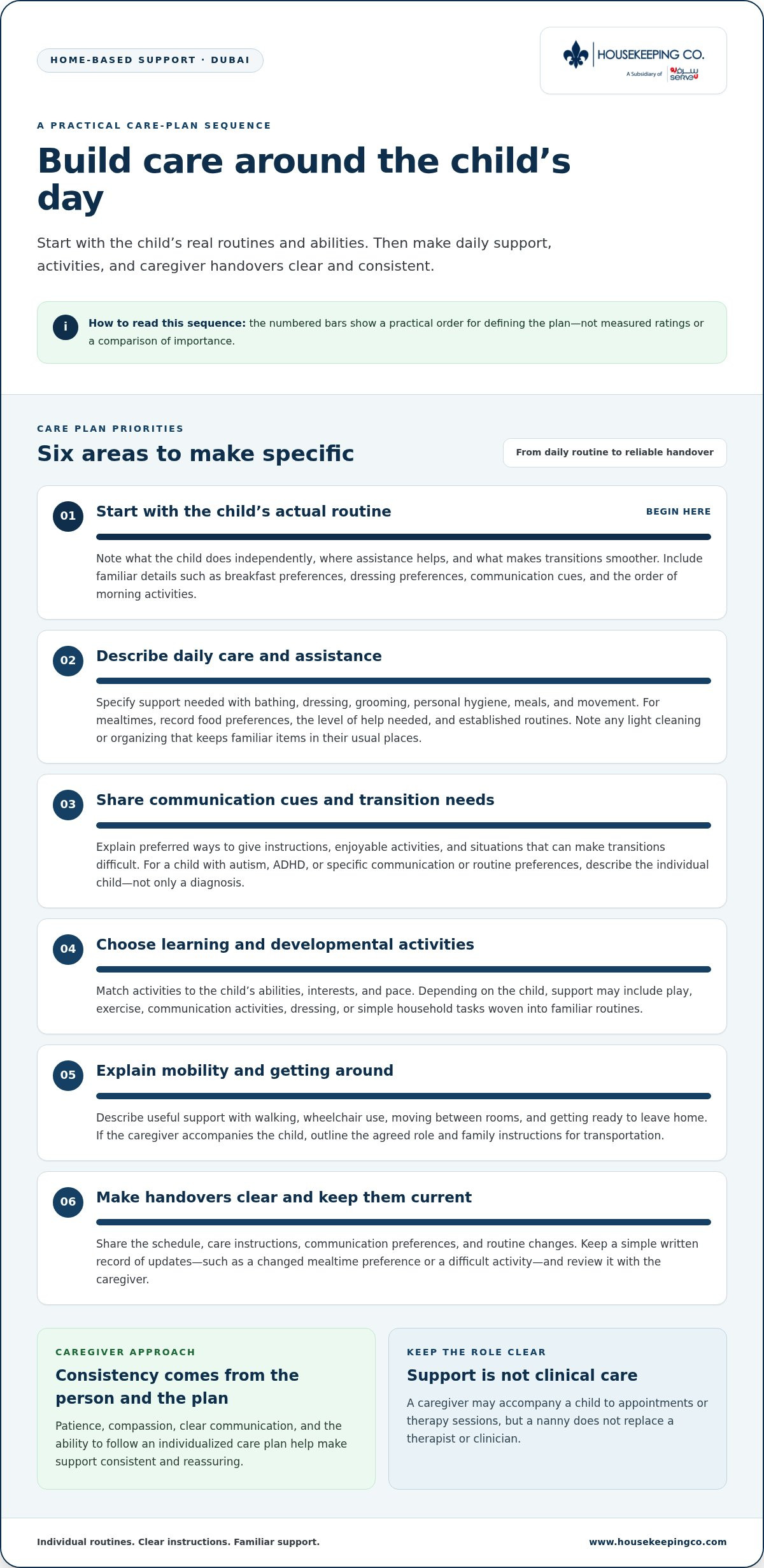
A useful home-based care plan begins with the child’s actual routine. Note what they can do independently, where they need assistance, and what helps transitions go smoothly. For example, record preferred breakfast foods, dressing preferences, communication cues and the order of morning activities. A special needs nanny in Dubai can use these details to provide consistent household support instead of making assumptions based on a diagnosis.
Daily assistance may cover personal care, meals, movement and household routines. Depending on the child’s needs, a caregiver may help with bathing, dressing, grooming and personal hygiene. Feeding support might include preparing meals and helping the child eat. Make instructions practical by noting food preferences, the level of assistance needed and established mealtime routines. Light cleaning and organizing can also help keep the child’s immediate surroundings familiar, with frequently used items in their usual places.
For children diagnosed with autism or ADHD, predictable routines and clear communication can make daily care more manageable. Share preferred ways of receiving instructions, enjoyable activities and situations that make transitions difficult. A caregiver can follow these individual cues during everyday activities, such as getting ready, eating or moving between play and rest. Children diagnosed with Aspergers may also have particular communication or routine preferences. Describe the child in the care plan, rather than reducing them to a diagnosis.
Developmental activities should suit the child’s abilities and interests. When appropriate, a caregiver may encourage exercise and physical activity, or support participation through play, dressing and simple household tasks. Connect activities to the child’s routine, such as practising a familiar task during a regular morning activity. The aim is consistent participation and support, not replacing professional therapy or setting unsupported developmental targets.
Mobility support should reflect how the child moves through familiar settings. A caregiver may assist with walking, wheelchair support and transportation. Explain the child’s needs in practical terms, including what help is useful when moving between rooms or getting ready to leave home. Transportation support can include accompanying the child, with the agreed care plan and family instructions guiding the caregiver’s role.
Consistent support relies on clear handovers. Share the daily schedule, care instructions, communication preferences and any relevant routine changes at the start of the placement. Keep a simple written record of updates, such as a changed mealtime preference or an activity the child found difficult. Review it with the caregiver and adjust household routines as the child’s needs or activities change. This gives each care day a practical reference.
Specialized childcare for children with physical, developmental, or behavioral needs
Specialized care starts with the child’s abilities, daily routines and support needs. Use those details to define the caregiver’s role clearly.
Specialized Care Versus General Nanny Care
General nanny care often focuses on supervision and household routines. Specialized childcare adds support suited to a child’s physical, developmental or behavioral needs. For example, a caregiver may follow an agreed communication approach or help with mobility during daily activities. Define practical care and companionship clearly, without implying clinical expertise. A nanny can accompany a child to therapy, but does not replace a therapist or clinician.
Care Matched to Abilities and Routines
Write down what the child does independently and where assistance helps. Include examples such as dressing, moving between rooms or following a morning routine. Note the child’s preferred language, communication cues and familiar sequence of activities. A written agreement can set out duties and schedule, while the handover explains how those duties fit the child’s routines.
Autism and Special-Needs Childcare
In Dubai, special-needs nanny roles may involve caring for children diagnosed with autism, ADHD or Aspergers. If you are seeking this experience, discuss your child’s actual needs and routines when considering the role. Ask candidates how they follow an individualized care plan and respond to communication cues. Developmental support may include learning and communication activities, while speech therapy remains a clinical service.
Hiring, Permits, and Background Checks
Nannies are domestic workers covered by Federal Decree Law No. 9 of 2022 Concerning Domestic Workers, updated by Federal Decree Law No. 21 of 2023. Hiring requires the applicable domestic-worker visa and work-permit process. To find a suitable nanny, define the child’s needs, identify relevant experience, and interview candidates using practical care scenarios. Before hiring, review identity documents, work history, references, and experience with the child’s specific routines. UAE law prohibits employing domestic workers under 18 years of age.
Before signing, document duties, schedule, pay arrangements, and the child’s care instructions. UAE domestic workers are entitled to at least one paid weekly rest day, 12 hours of rest per day including eight consecutive hours, and 30 days of paid annual leave per year. A clear agreement helps families and caregivers understand the role and its boundaries.
Caregivers need patience, compassion, good communication skills and the ability to follow individualized care plans. In Dubai, special-needs caregivers may also schedule and accompany individuals to medical appointments and therapy sessions.
Learning, communication, and social activities
A caregiver can support a child’s learning, communication and social participation through familiar activities. Choose one meaningful goal for an everyday moment, such as asking for a preferred book or joining a shared game. Shape activities around the child’s interests and abilities rather than expecting every child to learn in the same way.
For learning, connect practice to tasks the child already enjoys. A puzzle can encourage turn-taking and problem-solving, while sorting toys can support attention and choice-making. Keep instructions direct and specific, such as “put the red block here,” then give the child time to respond. Tell the caregiver which activities the child enjoys, what helps them stay engaged and when a break is useful. They can follow those preferences during ordinary play and household activities.
Communication support begins with noticing how the child expresses a choice or need. They may use spoken language, gestures, facial expressions or another established method. Share examples, such as pointing to a cup to request a drink or using a familiar phrase to ask for help. The caregiver should respond consistently and give the child room to communicate instead of speaking for them. This supports clearer everyday exchanges without treating one communication style as the only valid one.
Plan social activities around familiar people and manageable settings. A caregiver might help the child take turns in a board game with a sibling or prepare for a short visit with relatives. Beforehand, explain what will happen in language the child understands. During the interaction, use simple prompts to support participation, then leave room for the child’s own response. Afterward, share with the family what felt comfortable or difficult.
Emotional support is both practical and reassuring. If a child becomes unsettled when an activity changes, the caregiver can use a familiar transition cue, such as putting away one toy before bringing out another. Share signs that the child needs a pause, such as moving away or becoming quieter. The caregiver can respond calmly, offer an agreed choice and avoid adding unnecessary instructions in the moment.
Keep communication between the caregiver and family specific. A brief handover can record which activity the child chose, how they communicated and what helped them participate. For example, note whether a direct invitation or a visual choice helped them join a game. Review these observations together and adapt activities to the child’s interests. This supports continuity while keeping learning and social engagement centred on the child.
Live-in and live-out nanny arrangements
Choose an arrangement based on the child’s routine, household needs and agreed schedule. A live-in nanny stays in the household, while a live-out nanny travels to and from the home for scheduled care. Neither arrangement alone determines the quality or scope of support. First define the hours of care needed, then compare how each option fits family routines, privacy and handovers.
Live-in care may suit families with early mornings, changing routines or support needs at different times of day. For example, a caregiver living in the home may be present as the child prepares for school and returns later. This can simplify communication about routine changes, but the household should define working hours, rest periods, private space and duties clearly. Living in the home does not mean the caregiver is on duty at all times.
Live-out care can provide structured coverage around agreed start and finish times. One advertised Dubai live-out nanny role specifies about 50 hours of work per week and a maximum of 2 evenings of babysitting per week. Those details describe that particular role, not a standard schedule for every family. For your decision, list the times when the child needs care, including school transitions, appointments, and evening routines, then compare them with the proposed schedule.
Consider how either arrangement can support appointments and established exercises without turning the nanny’s role into clinical treatment. A caregiver may accompany a child to therapy sessions or medical appointments and encourage physical activities when appropriate. The family can document transport arrangements, equipment the child uses and any exercises that are part of an established routine. Clarify the caregiver’s role before, during and after each appointment.
Before settling on an arrangement, map a typical week. Include care periods, school or activity transitions, transport, family handovers and the caregiver’s rest time. Identify who covers any time outside the agreed schedule. This makes potential gaps visible before the placement begins and allows you to compare live-in and live-out options in practical terms.
The written agreement should reflect the chosen arrangement and the child’s care routine. Set out the schedule, duties, rest periods, accommodation expectations for live-in care, and any agreed transport or appointment support. Keep the child’s instructions in a separate care plan so routine updates do not make responsibilities unclear. A precise agreement supports continuity while respecting the caregiver’s working time and the family’s household boundaries.
Caregiver skills and compassion
Effective caregiving combines practical skills with patience, clear communication and respect for the child’s preferences. Assess these qualities through specific examples, not confidence alone.
Caregiver Skills
A caregiver should follow family instructions and communicate clearly about the child’s day. Ask for an example of adapting an activity when a child needed more time or a different approach. Practical skills also include noticing changes in behavior and sharing relevant observations. These abilities support consistent care without assuming one approach works for every child.
Medication requires careful attention to instructions. Ask how the candidate would follow written directions from a healthcare professional and communicate any concerns to the family. A suitable answer should show care in following established instructions, without suggesting they would change a dose or make treatment decisions independently.
Compassionate Care
Compassion shows when a child needs extra time, declines an activity or communicates unexpectedly. For example, a caregiver can pause when a child turns away from a game, then offer space or a simple choice. Patience and emotional awareness help the caregiver respect the child’s preferences and dignity in everyday interactions.
Look for respect in practical moments. At mealtimes, the caregiver might offer a choice without rushing the child. During a difficult transition, they can use a calm tone rather than criticize. These responses show how compassion shapes behavior, not just how warmly someone speaks. The aim is attentive care that treats the child as an individual.
Interviewing a Special-Needs Nanny
Ask, “How have you followed family instructions when a child needed a different approach?” and “What would you do if a child needed more time to respond?” These questions show how a candidate applies patience and communication skills. You can also ask how they share daily observations and respond to changes in a child’s mood or behavior.
Use a realistic example from your child’s routine, such as declining an activity or finding a transition difficult. Ask the candidate to describe their first response and how they would keep you informed. Listen for calm, respectful steps that follow your guidance. A clear answer should explain the caregiver’s role without claiming to diagnose or provide clinical treatment.
In Dubai, special-needs caregivers should give medication as directed by healthcare professionals. Use the interview to find out whether the candidate understands the importance of following those directions rather than relying on memory or personal judgment. Ask how they would confirm the instructions, respond if anything seemed unclear and tell the family about a concern. The aim is dependable communication, not independent treatment decisions.
The same attentiveness applies beyond medication. A caregiver can describe what they notice in the child’s responses while leaving interpretation and decisions to the family and relevant professionals. Ask for examples of listening, adapting calmly and seeking clarification when needed. These answers help distinguish a compassionate manner from practical respect for the child’s needs and the family’s guidance.
Housekeeping Co: Hire a Full-Time Live-In/Live-Out Nanny or Maid in Dubai
Housekeeping Co helps families in Dubai arrange full-time live-in or live-out special needs nanny dubai services. Share the role’s daily responsibilities and preferred arrangement to clarify the hiring process. Housekeeping Co also manages two-year domestic worker visas and offers the option of hiring a nanny under private sponsorship. These services help families choose an arrangement that fits their household’s employment plans.
For a child with additional needs, outline the required routine, communication approach, and practical care duties as you discuss the role. This helps establish expectations for specialized care and the caregiver’s responsibilities. Contact Housekeeping Co to discuss arranging a full-time nanny in Dubai.
Take the Next Step with a Clear Care Brief
Choosing a special-needs nanny in Dubai is easier when your family’s priorities are clear before discussions begin. Prepare a concise care brief covering preferred routines, communication style, essential daily responsibilities and the household schedule. Include the qualities that matter most, such as patience during transitions or experience supporting mobility. This gives you a practical basis for discussing the role and assessing how the arrangement fits your child’s daily life.
Keep the brief focused on what helps your child feel understood and participate comfortably. Refine it as your family’s needs become clearer, then use it to guide your next conversation about nanny care with Housekeeping Co.
A thoughtful first step can help your family move forward with greater clarity and confidence.
Frequently Asked Questions
What qualifications should a special needs nanny in Dubai have?
Look for relevant childcare experience, patience, clear communication and the ability to follow family instructions consistently. A nanny should understand the child’s routines and explain how they would handle practical situations, such as a difficult transition or a change in activity. Ask about previous responsibilities and request examples. Relevant qualifications depend on the care involved, and clinical responsibilities should remain with appropriately qualified health professionals.
What experience should a nanny have for autism, ADHD, or developmental disabilities?
Prior experience should relate to the child’s actual support needs, not just a diagnosis. Ask the candidate how they adapted communication, activities or transitions for a child with autism, ADHD or a developmental disability. A useful example might describe offering choices when a child struggled to move between activities. Discuss what the candidate did, how they followed family guidance and when they shared concerns with parents.
What training and certifications are useful for special needs nannies in the UAE?
Useful training can include childcare, early-years learning, effective communication and paediatric first aid. These areas can help caregivers respond to everyday situations and understand children’s developmental needs, but they do not qualify a nanny to provide clinical treatment. Housekeeping Co’s domestic-worker training covers childcare, early-years learning, effective communication and paediatric first aid. Ask how the training relates to your household’s duties and how the caregiver would apply it to your child’s routines.
Which Dubai agencies provide nannies experienced with children with special needs?
Housekeeping Co advertises special-needs nanny roles for children with autism, ADHD and Aspergers. Discuss the child’s specific needs and routines with candidates.
Share this


