Domestic Staff Management in Dubai: A Family Guide
Oct 07, 2026What if a smoother household doesn’t require more instructions, just clearer ones? In a busy home in Dubai, Sharjah, or Abu Dhabi, duties discussed in passing can be understood differently, while packed schedules leave little time to revisit expectations. Effective domestic staff management dubai starts with a shared understanding of what needs to be done, how priorities are set, and when to talk through concerns.
It’s understandable to want household work completed consistently while maintaining a respectful relationship with the person doing it. Clear, manageable expectations and regular communication can reduce misunderstandings and make it easier to raise issues constructively. Small, steady routines often provide more clarity than a long list of instructions delivered all at once.
This guide will help you define household responsibilities, establish practical check-ins, and give feedback with respect. It will also help you distinguish everyday management questions from matters that may involve UAE employment rules, so you can approach each with greater confidence and care.
Key Takeaways
- Use a simple planning sequence to clarify household priorities, responsibilities, check-ins, and review.
- Group tasks by frequency and importance, then agree which responsibilities belong to each person.
- Keep feedback calm and specific by focusing on observed tasks and agreed expectations.
- Review routines when family schedules change, and clarify priorities before frustrations recur.
- A practical domestic staff management dubai plan can help you identify when clearer routines are enough and when your household may need recruitment support.
Domestic staff management in Dubai starts with clear household expectations
Unclear expectations can create avoidable misunderstandings at home. A task that seems obvious to one person may be interpreted differently by another, especially when instructions are given in passing or household priorities shift. Strong domestic staff management starts by making the work, communication, and review process clear and respectful.
Effective household staff management means agreeing on what needs to be done, how expectations will be communicated, and when to review what is working. This is an everyday management practice, not a substitute for understanding the terms and obligations that apply to an employment arrangement.
What should families clarify before a working routine begins?
Start with the household’s priorities, recurring tasks, and preferred way to communicate. Explain what matters most, which tasks happen regularly, and how changes or questions should be raised. For example, a family might keep routine tasks in a shared written list and discuss changing priorities during a planned check-in.
Discuss working arrangements and household preferences in practical language. Be specific about what you mean, invite questions, and avoid assuming that an unwritten custom is understood. A preference about how a task is done is a household expectation; it should not be presented as a legal requirement unless it has been verified as one.
How can families distinguish management from legal compliance?
Task planning, communication methods, and feedback are operational management topics. Questions about employment obligations or applicable UAE rules are different and should be checked against current, authoritative information rather than answered through household custom or assumption. Keep the two conversations distinct: agree on a workable routine, and verify legal questions separately.
For legal questions, consult the dedicated UAE domestic labour law guide, and verify any specific legal statement against current authoritative sources before relying on it. This helps families avoid turning a personal preference into a supposed rule.
In practice, domestic staff management dubai is more effective when expectations are discussed openly before they become sources of frustration. Write down the agreed priorities and communication method in a format that works for the household, then revisit them when circumstances change. The goal is clarity and consistency, while keeping household decisions separate from questions that require legal guidance.
Create a household routine that makes domestic staff responsibilities clear
A reliable routine turns household priorities into clear, manageable instructions. It also reduces repeated reminders and conflicting requests, particularly when several family members communicate with the same staff member. For domestic staff management dubai, keep the plan simple enough to use and flexible enough to adjust when household needs change.
An agreed routine makes expectations easier to follow because everyone can see what matters, who is responsible, and how changes will be shared. A written schedule can be a shared document, a household calendar, or another format that works for everyone. Its purpose is clarity, not creating a rigid checklist that ignores changing priorities.
How should families organize recurring household tasks?
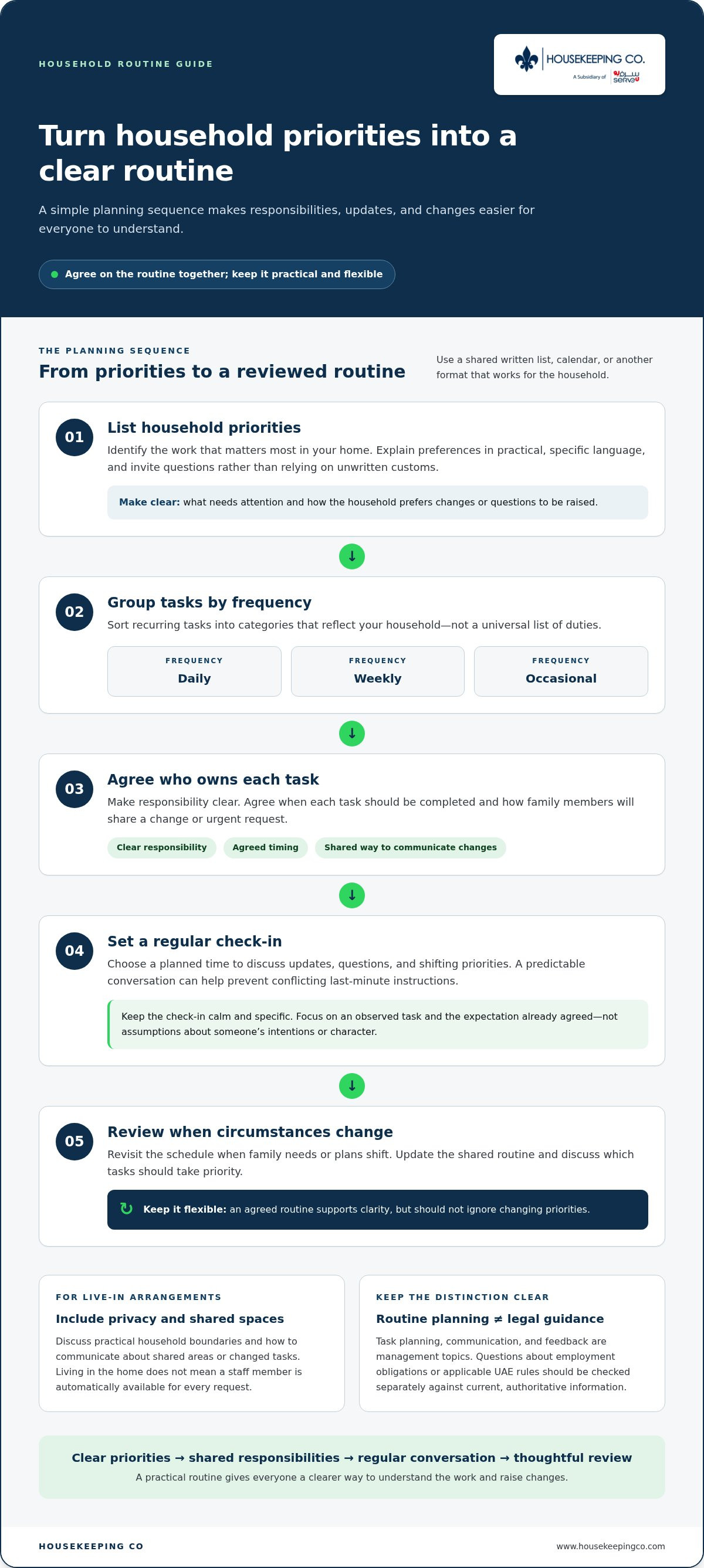
Begin by listing the household’s priorities, then group tasks by frequency, such as daily, weekly, or occasional. These categories should reflect your home rather than an assumed universal set of domestic duties. In some homes, this also involves deciding whether certain heavy chores, such as using a professional laundry service Dubai for delicate garments, are better outsourced to keep daily duties manageable. Next, agree who owns each responsibility, when it should be completed, and how family members will communicate a change or urgent request.
A practical sequence is:
- List priorities: Identify the work that matters most to the household.
- Agree ownership: Make responsibility for each task clear.
- Set check-ins: Choose a regular time to discuss updates or questions.
- Review: Adjust the schedule when priorities or circumstances change.
For example, if a family changes its weekly plans, update the shared schedule and discuss which tasks should take priority. This is clearer than giving separate, last-minute instructions that may conflict. Keep the wording specific, and allow space for questions or clarification.
How do live-in arrangements affect household routines?
In a live-in arrangement, a routine should also support privacy and respectful use of shared spaces. Discuss practical household boundaries, such as how family members will communicate about access to shared areas or changes to planned tasks. Keep work expectations distinct from assumptions about personal time; a staff member living in the home should not be treated as automatically available for every request.
Families considering this arrangement can learn more about full-time live-in staff placement. Agreeing on a routine early helps everyone understand how household work fits into the arrangement, while leaving room to review what works in practice.
Use respectful communication and feedback to prevent recurring problems
Even a clear household routine can need adjustment. A calm, specific conversation helps address a concern while it’s still manageable, rather than allowing the same frustration to build. Focus on an observable task and the expectation already agreed, not assumptions about a person’s intentions or character.
Regular check-ins create a predictable opportunity to raise questions, share updates, and catch small issues early. Keep them practical: ask what is working, whether any instruction was unclear, and whether a recent change needs discussion. When expectations change, invite questions and confirm the new agreement in plain language. This is especially useful when family members have different schedules and may otherwise give inconsistent instructions.
How can employers give clear feedback without creating tension?
Choose a suitable time and a private setting for a sensitive conversation. Describe what you observed, explain the agreed outcome, then discuss a reasonable next step. For example: “The kitchen counter was left uncleared after lunch, and we’d agreed it would be cleared before the afternoon. Could we review how that fits with the current schedule?” This addresses the task without assigning blame. Acknowledge improvements, too, and keep feedback consistent with expectations already discussed.
Be open to hearing that an instruction was unclear or that priorities conflicted. The purpose is to reach shared understanding, not to win an argument. If the expectation itself needs to change, discuss that directly rather than treating the difference as a performance issue.
What is a practical way to resolve a household misunderstanding?
First, listen to each perspective without rushing to decide who was at fault. Then restate the agreement neutrally and specifically, including what will happen next time. If a family member requested one priority while another gave a different instruction, clarify who will communicate household changes and how the updated direction will be shared. Agree on a follow-up point to see whether the adjustment has helped.
For instance, a family might agree that a changed priority should be shared in one message rather than passed along separately. At the next check-in, they can review whether that reduced confusion. Keep the conversation focused on the process and outcome, and recognize any improvement. In domestic staff management dubai, respectful feedback works best when it is timely, consistent, and grounded in clear agreements.
Review household arrangements fairly as family needs change
A routine that suited the household before may need to change when family schedules, priorities, or care needs shift. Review the arrangement before a new expectation becomes assumed. This gives everyone a chance to explain what has changed, what still works, and which parts of the routine need clarification.
A useful household review is specific, mutual, and practical: identify what has changed, hear both perspectives, and agree on a workable next step. Keep the discussion focused on the arrangement rather than personal criticism. If an update is agreed, record it in a simple shared format so family members and staff can refer to the same information.
When should a family revisit its household routine?
Revisit the routine when a family schedule or household priority changes, such as a new regular commitment that affects the timing of agreed tasks. Raise the proposed change in a conversation, explain why it matters, and discuss how it affects existing responsibilities before treating it as settled. Once agreed, update the shared schedule or notes and make sure everyone knows where to find the current version.
How can households assess whether a routine is working?
Look for practical signs: task ownership is clear, fewer misunderstandings recur, and communication feels timely, respectful, and manageable for both sides. Ask what is working and what remains unclear. If something needs adjustment, agree on one change at a time, then review whether it helped. Changing several parts of the routine together can make it harder to see what resolved the issue.
Keep everyday scheduling separate from employment or visa questions. A family may be able to adjust task priorities through discussion, but questions about how a change relates to employment arrangements or visa status need reliable, current guidance. Don’t treat a household agreement as a legal answer. This distinction helps domestic staff management dubai remain fair and organized without relying on assumptions about UAE requirements.
For example, if a change in family commitments affects when a task is expected, discuss the new priority, agree how it fits with other responsibilities, and document the adjustment. If the conversation raises a question about employment terms or visa arrangements, pause that part of the discussion and seek appropriate guidance before proceeding.
Approach each review as a practical reset, not a performance verdict. A clear record of what changed and what both sides agreed makes the routine easier to follow and revisit.
Build a sustainable domestic staff management plan with the right support
A sustainable plan doesn’t need to be complicated. Clarify household needs, agree on a routine, communicate consistently, and review the arrangement when circumstances change. If concerns continue, first identify whether the issue is unclear expectations or whether the household’s ongoing needs have outgrown the current arrangement.
Start with three expectations that need the most clarity. Write them down, arrange a calm discussion, and agree on a manageable routine together. Keeping the first changes focused makes them easier to understand and put into practice. From there, review whether responsibilities are clear and communication is working for everyone.
When might a household need new staffing support?
If recurring needs continue to exceed the agreed arrangement, another schedule adjustment may not address the underlying gap. Define the role the household needs before starting a recruitment process, including the main responsibilities and whether the family is seeking a maid, nanny, or caregiver. Housekeeping Co recruits and places full-time maids, nannies, and professional caregivers for residential households. Families can explore caregiver placement when their household needs include caregiving support.
Keep recruitment decisions distinct from day-to-day management. A new placement may be relevant when the household needs a different staffing arrangement, while clearer priorities and communication may be enough when the existing arrangement still fits. This distinction helps families choose a practical next step instead of repeatedly changing a routine that cannot meet their needs.
What should families do first to improve staff management?
Choose the three expectations that would reduce the most uncertainty. Discuss them calmly, agree who is responsible for each, and settle on a routine that is realistic for the household. Make a note of the agreement so family members can communicate consistently, then revisit it after allowing time to see how it works.
Effective domestic staff management in Dubai depends on clarity, respect, and a willingness to review what no longer fits. Keep household preferences separate from questions about employment or visa arrangements, which require reliable, current guidance. If the household’s needs point toward a new placement, a defined role gives the recruitment process a clearer starting point.
Put a clearer household routine into practice
Reliable household support begins with clear expectations, agreed responsibilities, and communication that stays respectful when plans change. A shared routine can reduce conflicting instructions, while regular check-ins and fair reviews help families address concerns before they become recurring frustrations.
Start with a few priorities: clarify what matters most, agree how changes will be communicated, and keep household preferences distinct from employment or visa questions that need reliable guidance. These practical steps give domestic staff management dubai a clear, sustainable foundation.
When your household needs a new staffing arrangement, Housekeeping Co recruits and places full-time live-in and live-out maids, nannies, and caregivers, and facilitates 2-year domestic worker visas. Its residential staffing services support families in Dubai, Sharjah, and Abu Dhabi.
For help arranging full-time household staffing, WhatsApp Housekeeping Co to discuss your family’s needs.
With clear expectations and the right support, you can build a household routine that works more smoothly for everyone.
Frequently Asked Questions
How do you manage domestic staff in Dubai effectively?
Effective domestic staff management dubai begins with clear responsibilities, respectful communication, and a routine that reflects your household’s actual needs. Agree on task ownership and how changes will be shared, then schedule regular check-ins to clarify concerns before they recur. Keep feedback specific and fair. If a question concerns employment or visa arrangements, treat it separately from household planning and seek reliable, current UAE guidance.
What should I include in a household routine for domestic staff?
Include the household’s priorities, recurring tasks, who is responsible for each, how changes will be communicated, and when you’ll review the arrangement. Group work by frequency, such as daily or less frequent tasks, based on your home rather than assuming every role has identical duties. A shared written schedule can help family members give consistent instructions and give everyone a clear reference when plans change.
How can I communicate expectations to domestic staff respectfully?
Use calm, direct language and describe the task and expected result clearly. Choose an appropriate time to discuss sensitive matters privately, and invite questions rather than assuming instructions were understood. For example, refer to a specific agreed task that needs attention instead of making a judgment about the person. Recognize improvements, keep feedback consistent with earlier agreements, and explain changes before treating them as new expectations.
What should I do if a domestic worker and I misunderstand each other?
Pause and listen to each perspective before deciding how to resolve the misunderstanding. Restate the original agreement in neutral, specific language, then clarify what should happen next time. If instructions conflicted, agree on one way household updates will be shared. Write down the adjusted arrangement if useful, and set a follow-up conversation to see whether the change has reduced confusion. Keep the discussion focused on the issue, not blame.
How often should a family review its domestic staff arrangements?
Review the arrangement when family schedules, priorities, or household needs change, and check in periodically to confirm the routine still works. There’s no single review interval that suits every household. Look for clear task ownership, fewer repeated misunderstandings, and communication that feels practical and respectful for both sides. If an adjustment is needed, agree on one change at a time so you can assess its effect.
Does domestic staff management in Dubai include visa and legal responsibilities?
Household management includes organizing daily work, while visa and employment matters are separate questions that require current, reliable UAE guidance. A household routine cannot replace understanding the applicable employment arrangements or visa processes. Avoid treating personal preferences as legal requirements, and verify specific legal questions through authoritative sources. Housekeeping Co facilitates 2-year domestic worker visas as part of its staffing support, but this FAQ isn’t a substitute for individualized legal guidance.
How should a family adjust household routines when its needs change?
Explain what has changed, discuss how it affects existing priorities, and agree on an adjustment before treating it as established. For example, if a new family commitment changes the timing of a recurring task, clarify the revised priority and how everyone will be informed. Record the update in a shared format, then review whether it works. If the change raises an employment or visa question, seek reliable guidance separately.
Share this


