Tadbeer Home Care in the UAE: How to Choose the Right Support
Oct 03, 2026The right home-care choice may have less to do with the Tadbeer label than with what your household actually needs. The phrase tadbeer home care can point families towards domestic support, but it doesn’t tell you whether you need help with household tasks, childcare, or dedicated in-home caregiving.
A maid, nanny, and professional caregiver have different roles. The right fit depends on who needs support, what responsibilities you want covered, and how regularly help is needed. This guide explains how to distinguish those roles and compare practical arrangements without relying on assumptions.
You’ll also learn how full-time live-in or live-out placements differ from part-time residential cleaning, and what to consider before choosing. Whether you’re in Dubai, Sharjah, or Abu Dhabi, a clear outline of your household’s needs gives you a practical starting point for discussing support.
Key Takeaways
- Tadbeer home care can refer to different household support needs, not one standard arrangement.
- Housekeeping, childcare, and dedicated caregiver support are distinct roles with different responsibilities.
- Match the support model to who needs help, the type of assistance required, and how consistently it’s needed.
- Before comparing options, note your preferred schedule, setting, arrangement, and household priorities.
- Households in Dubai, Sharjah, and Abu Dhabi can explore full-time maid, nanny, or professional caregiver placement, as well as part-time residential cleaning.
What Does Tadbeer Home Care Mean for UAE Families?
In UAE family discussions, tadbeer home care may be used broadly when talking about domestic support. The phrase alone doesn’t identify a specific role or spell out what a worker will do. Before comparing arrangements, clarify the responsibilities, work setting, and schedule your household has in mind.
Quotable definition: Tadbeer home care is a broad label for domestic support discussions. The actual role and responsibilities depend on the arrangement and the household’s needs.
What kinds of support might families mean by home care?
The phrase can describe different kinds of help. A household may need assistance with home routines, a nanny for childcare, or a professional caregiver for dedicated in-home support. These roles are not interchangeable: the person receiving support and the tasks involved differ from one arrangement to another.
Start by listing the practical needs. For household assistance, note the recurring home tasks you want covered. For childcare, outline the responsibilities and schedule your family expects. For caregiver support, describe the day-to-day help a family member needs. Avoid assuming that a general domestic role includes specialist or medical duties. Define the need first, then match it to a suitable role.
Why the service label is not enough to assess fit
Similar labels can be used for arrangements with different roles and responsibilities. Begin with the person who needs support: what tasks require help, at what times, and is the priority household upkeep, childcare, or dedicated caregiving? Specific answers make it easier to compare options on a like-for-like basis.
For example, a family arranging support for an older relative should distinguish that need from general housekeeping. A professional caregiver placement is a separate option from hiring a maid for household tasks. Read more about professional caregiver roles and support.
A needs-first approach also helps you compare different staffing arrangements. Rather than choosing by label alone, write down the role, expected responsibilities, and how regularly support is needed. This gives you clear criteria for deciding whether an arrangement fits your household.
How Tadbeer Home Care Arrangements Can Differ From Specialist Support
The name of an arrangement doesn’t tell you its full scope. When comparing tadbeer home care with private placement, focus on the role, how support is arranged, and what your household needs day to day. Compare the practical details rather than assuming that services described with similar terms cover the same tasks.
The right arrangement depends on the role and support required, not on the service label alone.
Domestic help, nanny support, and caregiver placement
These roles address different priorities. Household help focuses on domestic routines. Nanny support centres on childcare. A professional caregiver placement is a distinct option when a family member needs dedicated in-home support. These descriptions give the broad purpose of each role, not a fixed task list. Agree on the specific responsibilities for the arrangement you choose.
For dedicated support, explore qualified caregiver placement. If your family is arranging support for an older relative, describe the day-to-day needs instead of assuming a general household role will cover them.
What families should compare beyond the Tadbeer name
Use the following comparison to identify what to define for your household:
Household need: Keeping up with domestic routines.
Support role: Maid or household help.
Clarify: Which household responsibilities should the role cover?
Household need: Support with a child’s daily care.
Support role: Nanny.
Clarify: What childcare responsibilities and schedule does the family expect?
Household need: Dedicated support for a family member at home.
Support role: Professional caregiver placement.
Clarify: What day-to-day assistance is needed, and what falls within the agreed role?
Next, compare the staffing arrangement with your household’s routine. A family seeking help with home tasks may have different priorities from one arranging childcare or focused support for an older relative. Write down the expected responsibilities, setting, schedule, and consistency of support. Clear expectations help prevent a mismatch between the role you need and the arrangement you choose.
Once you have defined the role, you can assess options against your priorities. If your family needs dedicated in-home support, caregiver placement is a practical option to explore.
Which Home-Care Support Fits Your Household’s Needs?
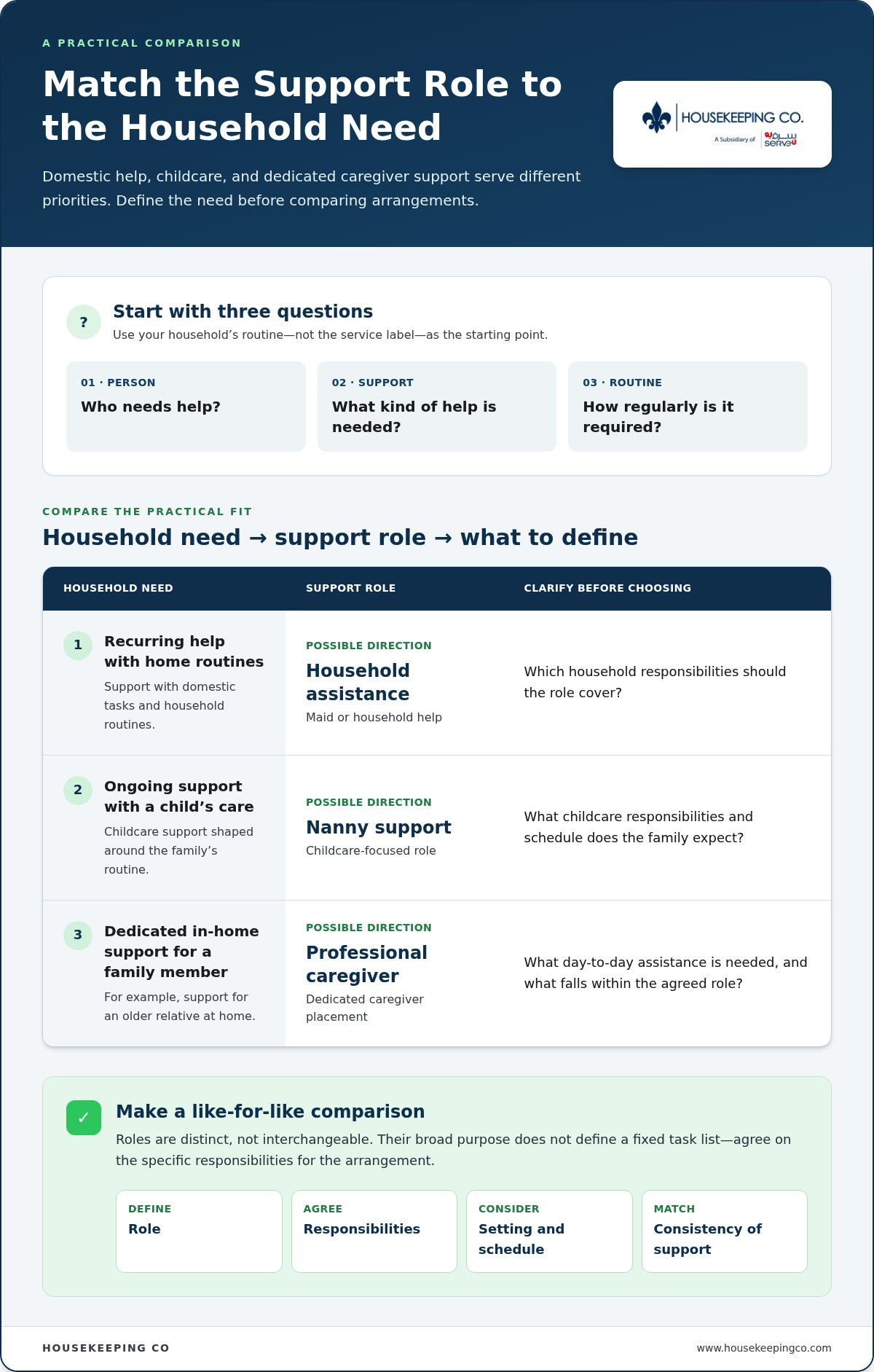
Choose support by answering three questions: Who needs help? What kind of help is needed? How regularly is it required? This approach makes tadbeer home care options easier to compare with private placement because it starts with your household’s routine, not an arrangement’s label.
Use these examples as a starting point for discussion, not as legal or clinical advice:
Household need: Recurring help with home routines. Possible direction: Household assistance. Consider: Which tasks matter most, and how consistently do they need support?
Household need: Ongoing support with a child’s care. Possible direction: Nanny support. Consider: Which childcare responsibilities and schedule should the role cover?
Household need: Dedicated in-home support for an older relative. Possible direction: Caregiver placement. Consider: What practical support is needed, and what arrangement fits the family’s routine?
When household help or childcare is the main requirement
List recurring responsibilities before comparing arrangements. For household help, note the home routines that need attention. For childcare, outline the support your family expects during the child’s day. Keep these needs separate: a maid’s household role and a nanny’s childcare role aren’t interchangeable, and neither automatically describes dedicated caregiver support.
If household assistance is your main requirement, explore full-time live-in maid support as one staffing arrangement. Compare it with your notes on tasks, schedule, and household priorities to decide whether it fits your routine.
When a family member needs dedicated caregiver support
For an older relative, describe the practical support needed at home and how regularly it is required. Consider the preferred staffing arrangement and your family’s daily routine as well. When the main need is focused, ongoing support for a family member, a dedicated caregiver placement may be more relevant than general housekeeping.
This distinction isn’t a judgment about medical suitability or a promise of clinical outcomes. It helps define the role clearly. Families considering professional caregiver placement can use their notes to describe the support they have in mind and assess whether a dedicated caregiver model fits their priorities.
How to Compare Tadbeer Home Care Options Step by Step
A useful comparison starts with your household, not a package name. Follow these steps to describe the support you need, compare roles and arrangements, and decide what to explore next. Keep your notes specific so household assistance, childcare, and dedicated caregiver support remain clearly distinct.
Define needs and role expectations before comparing
Start with the person who needs support and what a typical day involves. List tasks in plain language, then note when and how consistently help is required. For example, separate recurring home routines from childcare responsibilities and dedicated support for a family member. This helps define the role without assuming one kind of domestic support covers another.
Record your practical preferences as well:
- Schedule: When is support needed, and how regularly?
- Setting: Where will the support take place?
- Arrangement: Would live-in or live-out support suit the household, where relevant?
- Priorities: Which responsibilities are essential, and which are secondary?
Compare service scope and practical arrangements
Once the need is clear, compare options side by side. Focus on the stated role, staffing arrangement, and scope of support. Identify whether the role is for household tasks, childcare, or dedicated in-home support, then compare its responsibilities with your family’s routine. Similar labels don’t necessarily describe identical arrangements.
Keep legal and visa questions separate from this needs assessment. This comparison can help you identify the kind of support to explore, but it isn’t a substitute for current official information about UAE domestic-worker rules or processes. Don’t rely on remembered requirements or assumptions. For legal details, use authoritative, up-to-date information.
Choose the next step from your comparison
Review your notes and identify the closest fit: a household role, nanny support, or dedicated caregiver placement. If the role is still unclear, refine the list of expected responsibilities before comparing further. If it is clear, use your schedule, setting, preferred arrangement, and essential priorities to guide a focused discussion about your household’s needs.
This method keeps tadbeer home care comparisons grounded in practical requirements while leaving current legal details to authoritative sources. A concise brief makes it easier to discuss the support your household is looking for.
How Housekeeping Co Supports UAE Families Seeking Home Care
Comparing tadbeer home care with private placement is easier when you begin with the role your household needs. Housekeeping Co is a UAE domestic staffing agency established in 2011. It supports families in Dubai, Sharjah, and Abu Dhabi with full-time household staffing and part-time residential cleaning.
Choose support aligned with the role your household needs
For ongoing help with household routines, full-time maid placement offers a staffing option distinct from cleaning visits. Families seeking childcare can consider full-time nanny placement, with responsibilities shaped around the household’s needs. Part-time residential cleaning is a separate service for home cleaning, not childcare or dedicated caregiving.
If a family member needs focused in-home support, professional caregiver placement is a distinct option, not an extension of general housekeeping. Explore qualified caregiver placement to learn more about this type of support. Defining the role first helps keep expectations aligned with your household’s priorities.
Take the next step with a clear brief
Before discussing an arrangement, prepare a short outline of what your household needs. Include:
- Required role: Maid, nanny, or professional caregiver.
- Setting: The home environment where support is needed.
- Preferred arrangement: For example, live-in or live-out staffing where relevant.
- Key priorities: The responsibilities and schedule that matter most to your family.
This brief gives the conversation a practical starting point. Housekeeping Co provides staffing solutions for households considering full-time support, as well as part-time residential cleaning. For placed staff, the agency also facilitates two-year domestic worker visas. Visa facilitation does not constitute a guarantee or a statement of specific legal steps.
With the role and arrangement clearly outlined, you can move from comparing labels to discussing support that fits your home. Use the WhatsApp link below to talk through your household’s needs with Housekeeping Co.
Choose Home Support With Confidence
The right support starts with the right role. Tadbeer home care can describe different household needs, so compare the support required rather than relying on a label alone. Separate household assistance, childcare, and dedicated caregiver support, then consider who needs help, what responsibilities are involved, and how regularly support is needed.
A clear brief makes the next step easier. Note your preferred schedule, home setting, arrangement, and priorities before discussing options. These details focus the conversation on a staffing solution that fits your family instead of a general assumption about what a service includes.
Housekeeping Co is a UAE domestic recruitment agency offering professional caregiver, nanny, and full-time maid placement, as well as part-time residential cleaning. Families in Dubai, Sharjah, and Abu Dhabi can use these services as a starting point for discussing household staffing needs.
Whether you’re planning dedicated in-home support, childcare, or ongoing household help, a thoughtful match begins with understanding your routine. Share your requirements with Housekeeping Co to discuss the right support for your home.
Frequently Asked Questions
What is Tadbeer home care in the UAE?
Tadbeer home care is a broad phrase families may use when discussing domestic support in the UAE, rather than the name of one defined care service. The support could relate to household help, childcare, or dedicated caregiver placement. The role and agreed responsibilities determine what an arrangement covers, so clarify the support needed instead of relying on the label alone.
Is Tadbeer home care the same as hiring a private caregiver?
No. The phrase may refer broadly to different types of domestic support, while hiring a private caregiver describes a specific staffing need: dedicated in-home support for a family member. Recruitment and employment arrangements can also differ. Compare the role, responsibilities, and staffing model, and don’t assume that general household assistance includes caregiver support.
What services can families look for through Tadbeer home care?
Families may be looking for household assistance, childcare, or dedicated caregiver support. These are distinct needs, not interchangeable services. A maid may suit a household seeking help with home routines, a nanny’s role centres on childcare, and a caregiver provides focused in-home support. Responsibilities depend on the agreed role and arrangement, so describe your household’s needs clearly.
How do I choose between a maid, nanny, and caregiver?
Start with who needs support and what kind of help they need. Choose a maid when the priority is household assistance, a nanny when the role centres on childcare, and a caregiver when a family member needs dedicated support at home. Then consider how often support is required, the preferred arrangement, and the responsibilities you expect. Clear priorities make comparisons more practical.
Can Housekeeping Co help arrange a caregiver in Dubai?
Yes. Housekeeping Co provides professional caregiver placement in Dubai, alongside full-time maid and nanny placement. The agency specializes in domestic recruitment in the UAE and serves Dubai, Sharjah, and Abu Dhabi. To begin a focused discussion about caregiver placement, outline the support needed, home setting, and preferred arrangement.
How much does Tadbeer home care cost?
There isn’t one cost that applies to every home-care arrangement. The type of support and staffing arrangement affect the overall cost. For a useful comparison, first identify the role your household needs, such as a maid, nanny, or caregiver, and whether live-in or live-out support is preferred. Housekeeping Co can discuss a staffing solution based on those details.
Is a caregiver the same as a domestic helper?
Not necessarily. “Domestic helper” is a broad term that may refer to household assistance, while “caregiver” describes a role focused on supporting a person at home. Responsibilities depend on the agreed position. Don’t assume that general housekeeping includes dedicated caregiving, or that a caregiver role includes every household task. Clarify the support required before choosing an arrangement.
Share this


