Nepali Caregiver for Seniors in Sharjah: Hiring Guide
Oct 03, 2026When searching for a nepali caregiver for seniors sharjah, begin with the support your family member needs, rather than nationality alone. It is understandable to want someone trustworthy who communicates well and helps your senior feel comfortable at home. Relevant experience, a respectful approach, and a good fit with the household all matter.
This guide explains how to define day-to-day support needs, assess a caregiver’s suitability respectfully, and decide whether a live-in or live-out arrangement fits your family. It also covers practical placement and employment considerations for Sharjah, so you can approach the decision with greater clarity.
Caregiver support can include help with daily routines and companionship. Clinical needs may require a licensed healthcare professional. Housekeeping Co places full-time residential caregivers and supports families with the employment process, including facilitation of a two-year domestic worker visa for placed staff. Use the steps below to match care requirements, caregiver fit, and household arrangements before taking the next step.
Key Takeaways
- Write down the senior’s regular support needs and expected duties before discussing nationality or schedule.
- Assess a nepali caregiver for seniors sharjah by comparing relevant experience with your household’s needs, then discuss communication preferences together.
- Choose live-in or live-out care based on your family’s routines, privacy, available space, and required coverage.
- Prepare for placement by agreeing on duties and arrangements, and verify current employment and visa requirements with the relevant UAE authority.
- Housekeeping Co helps Sharjah families structure full-time caregiver placement around care needs, household fit, and employment-process support.
Choosing a Nepali Caregiver for Seniors in Sharjah: Start with Care Needs
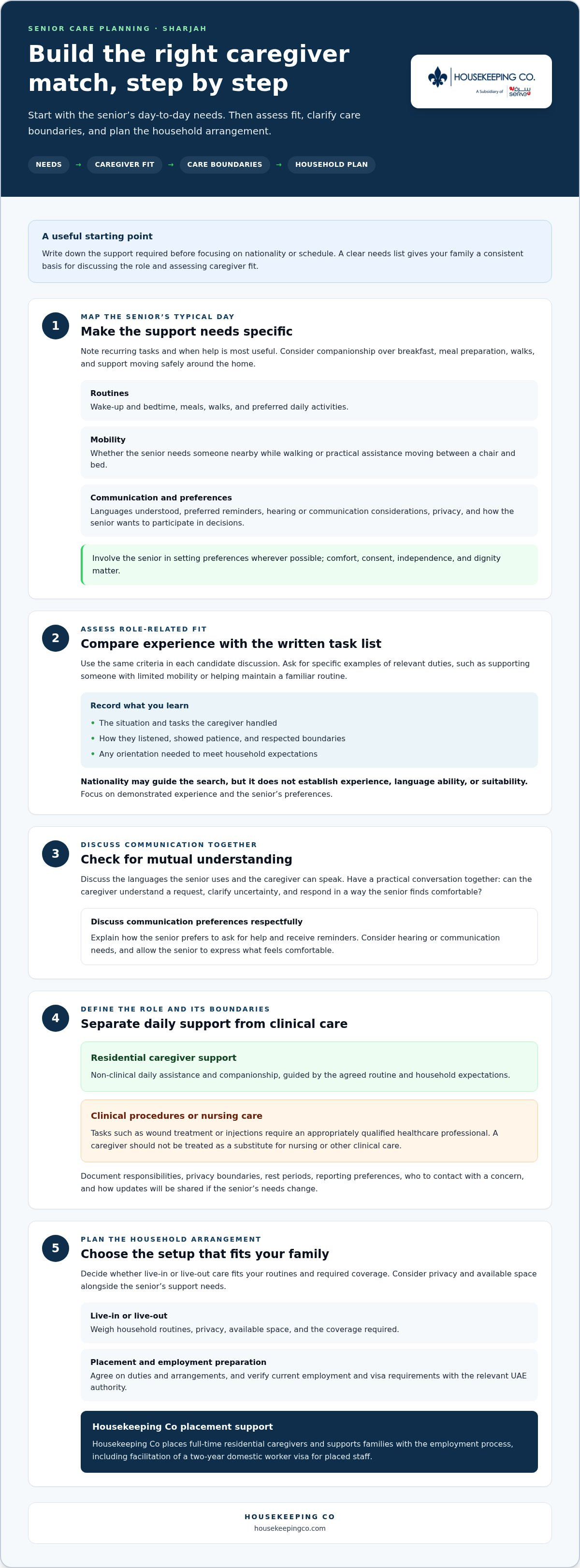
Choosing support for an older relative involves practical questions, such as the tasks and hours required, and personal ones, including comfort, privacy, and trust. Before focusing on nationality or a live-in or live-out schedule, define what assistance would make the senior’s day safer and more manageable. A clear needs list gives your family a consistent basis for discussing the role and assessing caregiver fit.
Which daily support does the senior need?
Map out a typical day, noting recurring tasks and the times when help is most useful. A senior may value companionship over breakfast, assistance preparing meals, or support moving safely around the home. Be specific about mobility: does the person need someone nearby while walking, or physical assistance moving between a chair and bed? These tasks call for different capabilities and should be discussed clearly.
A residential caregiver can provide non-clinical daily support and companionship. Clinical procedures or nursing care, such as wound treatment or injections, require an appropriately qualified healthcare professional. For a general overview of what a caregiver does, consider how the role differs from clinical care when defining the position.
Use this checklist to capture the household’s expectations:
- Routines: Usual wake-up and bedtime, meals, walks, and preferred daily activities.
- Mobility: The level of supervision or practical assistance needed when moving around.
- Communication: Languages the senior understands, preferred ways of receiving reminders, and any hearing or communication considerations.
- Household preferences: Privacy boundaries, personal routines, and how the senior wants to participate in decisions.
Involve the senior in setting these preferences wherever possible. Their comfort and consent matter. Family members can help clarify routines while preserving the older person’s independence and dignity.
Why nationality is only one part of caregiver fit
Searching for a nepali caregiver for seniors sharjah may reflect a family’s preference, but nationality alone does not establish experience, language ability, or suitability for a particular role. Discuss communication directly and respectfully with the senior and prospective caregiver. For example, explain how the senior prefers to ask for help, then discuss whether the caregiver can communicate comfortably in the languages the household uses.
Compare the caregiver’s stated experience with your written task list. Ask about relevant situations they have handled, such as assisting someone with limited mobility or following a familiar routine. Focus on listening, patience, boundaries, and willingness to learn the senior’s preferences rather than relying on assumptions.
Nationality may guide the search; demonstrated experience and communication help establish role-related fit. Housekeeping Co’s qualified caregiver placement helps families structure the match around care needs and household expectations.
What to Assess in a Nepali Caregiver for Senior Support
A useful assessment connects a caregiver’s experience with what your family expects them to do. Bring the written duty list to each discussion and ask for relevant examples: what support was needed, what the caregiver was responsible for, and how they followed the senior’s preferences. This makes it easier to compare candidates against the same criteria instead of relying on broad impressions.
How can a family assess experience and communication?
Use a consistent set of questions for every candidate. Ask about experience with duties that match the role, such as accompanying a senior on walks or helping maintain daily routines. Discuss the languages the senior uses and the caregiver can speak, then have a practical conversation together. Can they understand a request, clarify uncertainty, and respond in a way the senior finds comfortable? The WHO ICOPE Guidelines offer a useful person-centred framework for considering older people’s needs and preferences.
For families considering a nepali caregiver for seniors sharjah, nationality can inform the search, but assessment should focus on relevant experience, mutual understanding, and a respectful connection with the senior. Record specific examples and any orientation the caregiver may need to meet the household’s expectations.
How to agree on duties and care boundaries
Before placement, document routine responsibilities, household expectations, privacy boundaries, rest periods, and reporting preferences. Distinguish companionship and domestic assistance from tasks that require a qualified clinician. A caregiver’s role should not be treated as a substitute for nursing or other clinical care.
Agree on how updates will be shared, whom the caregiver should contact with a concern, and who to reach if the senior’s needs change. A clear plan for raising concerns reduces guesswork for everyone.
Use a simple comparison record for each candidate:
| Family requirement | Discussion prompt | Evidence to record |
|---|---|---|
| Relevant experience | “Can you describe a similar duty you’ve handled?” | Example, role, and tasks performed |
| Communication | “How would you clarify a request you didn’t understand?” | Languages discussed and shared understanding |
| Boundaries and privacy | “How would you respect the senior’s personal routines?” | Agreed expectations and limits |
| Reporting and changes | “Who would you inform if the usual routine changed?” | Named family contact and update method |
This structured record helps families make a considered decision and gives the placement conversation a clear foundation. Housekeeping Co supports families seeking qualified caregiver placement aligned with role expectations and household needs.
Live-In vs Live-Out Caregiver in Sharjah: Household Fit
Choosing between a live-in and live-out caregiver is a household decision, not a measure of care quality. Consider the senior’s routine, the support hours required, available space, and how the family values privacy. Either arrangement can work when duties, schedules, and rest periods are clearly agreed in advance.
When a live-in arrangement may suit the household
A live-in arrangement may suit a home with appropriate private living space for the caregiver and a routine that fits the agreed working schedule. For example, a senior who benefits from support during morning and evening routines may find it useful to have a caregiver living in the household, provided the role and hours are clearly defined.
Living in the home does not mean being available at all times. Agree on working duties, rest periods, privacy expectations, and how the caregiver’s personal time will be respected. Families considering this option can review Housekeeping Co’s full-time live-in placement service when planning a residential arrangement.
When a live-out arrangement may be a better fit
A live-out caregiver may suit a household that prefers privacy outside working hours or does not have suitable separate space. Start by matching the senior’s support needs to the hours the caregiver would be present. If help is mainly needed during daytime routines, write down those duties and agree on a schedule rather than assuming broader coverage.
Consider practical travel arrangements within Sharjah when discussing start and finish times, without assuming a particular commute or schedule. Also decide who will support the senior outside the agreed hours, such as a family member or through another established arrangement. This helps prevent gaps in the household plan.
For families seeking a nepali caregiver for seniors sharjah, the same household-fit questions apply regardless of nationality. Before placement, document:
- The caregiver’s agreed duties and working schedule.
- Rest periods and expectations around availability.
- Privacy boundaries and any living-space arrangements.
- Who is responsible for support outside working hours.
A written plan helps the family and caregiver share the same expectations from the outset. The right arrangement is the one that fits the senior’s routine, the home, and the agreed scope of support.
How to Prepare for Caregiver Placement and Employment in Sharjah
A prepared family can make the placement discussion more precise and productive. Before beginning, bring together the senior’s support needs, the household’s preferred arrangement, and the practical questions that will shape the role. This aligns expectations early and gives the placement process a clear starting point.
What should families prepare before discussing a placement?
Create a short written brief covering the senior’s usual routine, requested assistance, home setup, and preferred schedule. Note when help is needed and whether the family is considering live-in or live-out support. Choose one family member to coordinate communication and day-to-day instructions, so the caregiver receives consistent information instead of conflicting requests.
Prepare questions about the role, placement stages, and employment administration. For example, ask how the family’s duty list will inform the caregiver match, what information is needed to discuss placement, and how the household can communicate changes after the arrangement begins. Keep the senior involved in decisions to the extent they wish and are able.
What should families know about visa and employment procedures?
Employment and visa procedures can change, so verify current requirements with the relevant official UAE authority before acting. Avoid relying on outdated informal advice, particularly for legal or sponsorship matters. Housekeeping Co supports families through the domestic-worker employment process and facilitates a two-year domestic worker visa for placed staff. For wider context, read the UAE domestic worker law guide.
Housekeeping Co supports residential caregiver placement and employment administration, not medical care. Keep the placement discussion focused on matching the agreed duties and household arrangement with a suitable caregiver. Families arranging senior support in Sharjah can explore the qualified caregiver service.
Use this preparation sequence to move from an initial need to an organised placement conversation:
- Define needs: Summarise routines and the daily assistance requested.
- Agree on duties: Record responsibilities, boundaries, and reporting preferences.
- Discuss the arrangement: Set out the preferred schedule and household setup.
- Prepare questions: Clarify placement steps and employment-process support.
- Verify current rules: Check visa and employment requirements with the relevant official authority.
For a family seeking a nepali caregiver for seniors sharjah, this groundwork keeps the conversation focused on the senior’s needs and the role’s practical requirements, while leaving current employment procedures to the appropriate official guidance.
Arrange Senior Caregiver Placement in Sharjah with Housekeeping Co
Finding residential support is easier when you start with a clear picture of the senior’s needs and the household’s expectations. Housekeeping Co places full-time professional caregivers in Sharjah, Dubai, and Abu Dhabi. The placement discussion focuses on the role, caregiver fit, and household arrangement, rather than assumptions about what a family needs.
What families can expect from a placement discussion
Begin by describing the senior’s usual routines, requested assistance, preferred communication style, and whether the family is considering live-in or live-out support. Include practical details such as the times help is needed, household preferences, and who will coordinate instructions. A specific brief helps clarify the role and gives the family and caregiver a shared reference point.
Housekeeping Co supports families through caregiver placement and the domestic-worker employment process. This is residential support, not a substitute for clinical care. For additional background on caregiver roles and the kind of support they may provide, read this professional caregiver roles and support guide.
How to take the next step in Sharjah
Prepare a short summary before discussing placement. Keep it practical and focused:
- Support needs: The recurring daily duties the family wants covered.
- Schedule preference: The times support is required and the preferred live-in or live-out arrangement.
- Communication: The senior’s preferred language and how the family will share instructions or updates.
- Household expectations: Privacy preferences, routines, and who will be the main family contact.
This information gives the placement conversation a useful starting point and helps align role expectations with household needs. Families can explore Housekeeping Co’s qualified caregiver placement for senior support in Sharjah. If you’re looking for a nepali caregiver for seniors sharjah, discuss nationality as a search preference alongside experience and communication requirements. A clear brief supports an informed conversation about the role and household fit.
WhatsApp Us
Take the Next Step Toward the Right Senior Support
A thoughtful placement starts with the senior’s day-to-day needs. Define the assistance required, assess experience and communication against those duties, then choose a live-in or live-out arrangement that fits the household. For families seeking a nepali caregiver for seniors sharjah, nationality can guide the search, but role-related experience and mutual comfort should shape the decision.
Housekeeping Co is a UAE domestic recruitment agency that places full-time residential caregivers and supports the domestic-worker employment process, including facilitation of a two-year visa for placed staff. Caregiver placement focuses on household support, not clinical care.
Prepare a concise outline of the senior’s needs, preferred schedule, household routines, and communication expectations. A clear starting point can make the placement conversation more focused and help your family move forward with confidence.
With the right preparation, you can take a considered next step toward support that respects your senior’s needs and feels comfortable at home.
Frequently Asked Questions
How do I find a Nepali caregiver for a senior in Sharjah?
Start by listing the senior’s daily support needs, preferred communication, household routines, and desired working arrangement. Families searching for “nepali caregiver for seniors sharjah” can use that list to guide a structured placement discussion. Assess relevant experience and role fit directly; nationality alone does not establish suitability. Housekeeping Co supports full-time caregiver placement for residential households, with discussions centred on your requirements and the placement process.
What should I check when hiring a caregiver for an elderly parent?
Clarify duties, working schedule, relevant experience, communication needs, privacy expectations, and how concerns will be shared. Involve your parent wherever possible, so their preferences inform the arrangement. Distinguish companionship and household assistance from medical care, which may require a qualified clinician. Before placement, agree on responsibilities and boundaries so your family and the caregiver understand what the role includes.
Is a live-in caregiver better for a senior in Sharjah?
Not necessarily. The right arrangement depends on the senior’s needs and the household. Live-in support may fit routines that call for assistance at different points in the day, while live-out care may suit families with defined support hours. Consider the schedule, available private space, and household preferences. Discuss duties and rest arrangements clearly, and plan who will support the senior outside the caregiver’s agreed working hours.
Can a caregiver provide medical or nursing care at home?
Caregiver support and clinical care are different roles. A caregiver may provide companionship, agreed daily assistance, and household support, but these duties should not be treated as nursing or medical treatment. Identify clinical needs separately and arrange appropriately qualified healthcare professionals for those tasks. During the placement discussion, define the caregiver’s responsibilities and escalation contacts, and avoid assigning duties outside the agreed role or the caregiver’s qualifications.
Does Housekeeping Co help with a domestic worker visa for a placed caregiver?
Yes. Housekeeping Co facilitates a two-year domestic worker visa for placed staff as part of its employment-process support. Visa rules, documentation, and procedures can change, so use current guidance from the relevant UAE authority for legal requirements. Discuss the employment process as part of placement, and avoid relying on outdated information about documents, fees, or processing timelines.
What information should I prepare before contacting a caregiver placement agency?
Prepare a brief covering the senior’s daily routine, requested support, communication preferences, household setup, and preferred live-in or live-out arrangement. List clinical care needs separately so they are not confused with caregiver duties. Identify the family member who will coordinate instructions and updates. This preparation helps focus the placement discussion on role expectations, household fit, placement steps, and employment administration for your Sharjah home.
Share this


