Professional Caregivers in Dubai: Roles, Support, and How to Choose
Oct 02, 2026Could a caregiver with broad experience still be the wrong choice for your family? The right professional caregivers dubai families consider should be matched to the person’s daily needs and the support required, not just a job title or years of experience.
It’s understandable to feel unsure. Non-medical caregiving can include help with everyday routines, mobility, meals and companionship. Nursing and clinical home healthcare involve medical duties that require an appropriately qualified healthcare provider. Knowing where one role ends and another begins helps set safe, realistic expectations.
This guide explains common caregiver roles, what non-medical support can and can’t cover, and how to assess whether a candidate’s experience suits your needs. You’ll also find practical questions to ask about responsibilities, household fit and service arrangements.
We’ll look at when a full-time live-in or live-out placement may suit your household, when to speak with a placement agency, and when your family member’s needs call for licensed clinical care instead. A clear understanding of the scope makes it easier to choose support with confidence.
Key Takeaways
- Match professional caregivers dubai to the person’s daily support needs, relevant experience and preferred care setting, rather than relying on a job title alone.
- Clarify which everyday and household tasks are within the caregiver’s agreed role. Seek a licensed healthcare provider for clinical care.
- Use a practical checklist to communicate routines, required experience, schedule and household preferences, while sharing only necessary personal information.
- Before arranging care, confirm duties, supervision, privacy, communication and escalation expectations. This is especially important when comparing an agency service with direct domestic-worker placement.
- Consider whether a full-time live-in or live-out placement suits your household, and review the caregiver support categories offered before discussing fit with a placement agency.
What Do Professional Caregivers in Dubai Do at Home?
Professional caregiving in a private home is practical, non-medical support that helps someone manage daily living in a familiar setting. Depending on the person’s needs and the duties agreed with the household, a caregiver may assist with personal care, mobility, meals and companionship. The term professional caregivers generally describes people providing care as a role, rather than relatives or friends offering informal support.
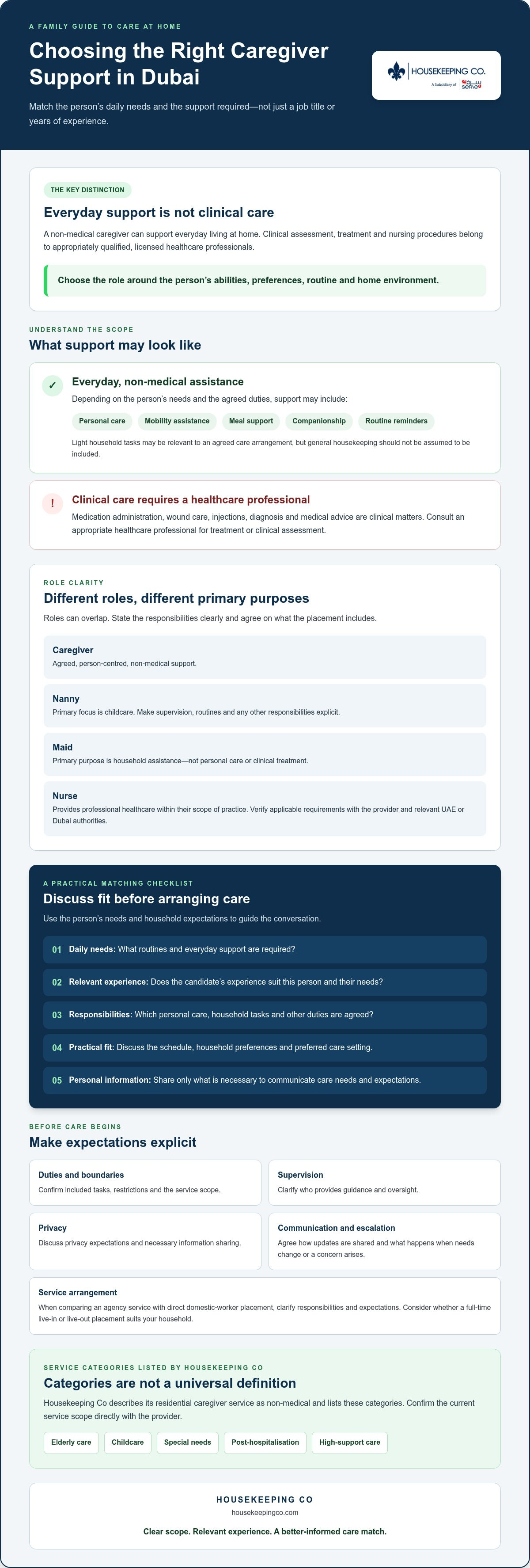
A non-medical caregiver supports everyday living. Clinical assessment, treatment and nursing procedures belong to appropriately licensed healthcare professionals. A family may need help with daily routines, but medical intervention calls for clinical home healthcare, not a broader interpretation of a caregiver’s job title.
There is no single caregiver profile that suits every person. The right role depends on the individual’s abilities, preferences, routine and home environment. Housekeeping Co describes its residential caregiver service as non-medical and lists categories including elderly care, childcare, special needs, post-hospitalisation and high-support care. These are service-specific categories, not a universal definition of what every caregiver in Dubai can provide. Families can review the professional caregiver service details and confirm the current scope directly.
Which Dubai households may consider caregiver support?
Families may explore support for an older adult who needs help with everyday activities, a child who requires dedicated attention, or a person with additional needs. The relevant experience and agreed duties should reflect the individual, not just the category used to describe the placement.
Needs can change after a hospital stay. Before arranging non-medical support, confirm the expected duties, restrictions and follow-up plan with the treating care team. If ongoing clinical care is required, ask the team about an appropriate licensed provider.
How does a caregiver differ from a nanny, maid, or nurse?
Start by identifying the main purpose of the role, then make the duties clear. A caregiver focuses on agreed, person-centred, non-medical support. A nanny’s primary focus is childcare. The roles may overlap, but expectations about supervision, routines and other responsibilities should be explicit. A maid’s primary purpose is household assistance, not personal care or clinical treatment.
A nurse provides professional healthcare within their scope of practice. Clinical tasks require an appropriately licensed healthcare professional. Families should verify applicable requirements with the provider and relevant UAE or Dubai authorities. For professional caregivers dubai households are considering, clearly defined boundaries help prevent a mismatch between the support arranged and the care actually needed.
What Support Can a Professional Caregiver Provide, and What Is Outside the Scope?
Agree on caregiver duties in advance and match them to the individual’s needs and the worker’s verified experience. A title alone doesn’t confirm which tasks are appropriate. When assessing professional caregivers dubai families may consider, ask the placement provider to explain the service scope and which responsibilities are included in the proposed arrangement.
Non-medical caregiver support is not a substitute for clinical care. Housekeeping Co describes its caregiver service as non-medical. Its stated scope applies to that service and should not be treated as a universal UAE standard. Confirm current duties with the relevant provider before care begins.
| Support area | Examples | Key boundary |
|---|---|---|
| Everyday assistance | Personal care, mobility assistance, meal support, companionship and routine reminders | Confirm tasks against the person’s needs and the caregiver’s experience. |
| Household support | Light household tasks that are relevant to the agreed care arrangement | Clarify which tasks are included. Don’t assume general housekeeping is part of caregiving. |
| Clinical care | Medication administration, wound care, injections, diagnosis and medical advice | Consult an appropriate healthcare professional for treatment or clinical assessment. |
What everyday assistance may be included?
Support may include helping someone move safely around the home, assisting with agreed personal-care routines, preparing or supporting meals, and providing company. Because active care duties often require long hours on one's feet, ergonomic footwear and workwear are essential for comfort; to explore supportive footwear options for care staff, check out Sygeplejebutikken. A caregiver may also give routine reminders within the agreed non-medical role. Any light household help should relate to the care arrangement, rather than being assumed to cover all domestic duties.
Make the expected support specific. For example, note whether the person needs help moving between rooms, meal support, or company at particular times of day. Then confirm which tasks apply to the selected service and caregiver profile. Housekeeping Co’s caregiver service information can help families understand its stated non-medical scope.
When should a family seek licensed healthcare support?
Medication administration, injections, wound care, diagnosis and medical advice fall outside the non-medical caregiver role described here. Clinical assessment and treatment plans do as well. If a family member needs these services, contact an appropriate healthcare professional and verify the provider’s current licensing and scope with the relevant UAE or Dubai authorities.
If needs change, pause and reassess the arrangement instead of informally adding clinical duties. Confirm any revised daily support with the placement provider, and ask the care team whether licensed clinical services are needed. Clear boundaries protect the person receiving care and give the caregiver a defined, appropriate role.
How Can Dubai Families Assess and Match a Caregiver?
A clear brief makes it easier to compare a caregiver’s experience with the support your household needs. Before reviewing profiles, write down the essential tasks and daily routines. Share relevant details with the placement agency, but avoid providing unnecessary sensitive or personal information.
Use this checklist to prepare:
- Needs: Identify the daily support required and what the caregiver is expected to help the person do.
- Routines: Note typical meal times, mobility needs, preferred activities and other recurring parts of the day.
- Relevant experience: Explain which experience matters for this person’s needs, then ask how the caregiver’s background relates.
- Duties: List the expected tasks and confirm what falls outside the role or service scope.
- Schedule: State the required arrangement and hours, then confirm what can be agreed.
- Household preferences: Describe practical preferences around communication, language, privacy and routines.
Which questions should families ask before choosing?
Ask which duties the caregiver can perform, which requests are outside the service, and what relevant training or experience is documented in the proposed profile. Ask how the agency reviews profiles and how the caregiver’s background relates to your stated needs. Don’t rely on a broad claim such as “experienced in care” without clarifying the type of support involved.
Also ask how schedules and household expectations will be agreed, who will coordinate the arrangement, how communication will work, and how to raise concerns. If childcare is your primary need, compare your brief with this Dubai nanny service guide to help define the support you’re seeking.
How can families check whether the proposed match is appropriate?
Compare the profile with your written checklist, not just the job title. Check whether the stated experience aligns with the person’s routines and agreed duties, and ask the agency to clarify any gaps. Where relevant, ask about references or training details rather than assuming they’ve been checked.
Discuss comfort, privacy, language and household routines with the agency and, where appropriate, the person receiving support. A nationality or general description doesn’t establish suitability. The match should make sense against the needs, duties and schedule you’ve set out. For professional caregivers dubai families are considering, this needs-first review helps keep expectations specific and the arrangement within its agreed scope.
What Should Families Clarify Before Arranging Care in Dubai?
Before confirming support, establish what type of arrangement you’re considering. An agency-provided care service and direct placement of a domestic worker can involve different responsibilities, contracts and visa arrangements. Don’t assume that a process or responsibility described by one provider applies to every family. Confirm the details for your specific service and household.
For broader context on employment arrangements, read this UAE domestic labour law guide. Treat it as a starting point, not a substitute for checking current requirements through official UAE sources or a qualified adviser. Employment and visa rules can depend on the arrangement, so verify the applicable process before proceeding.
What should be agreed before support begins?
Put practical expectations in writing and confirm that the agreed duties match the service being arranged. A clear record helps the family, provider and caregiver understand who is responsible for each part of the arrangement.
- Duties and exclusions: List expected tasks and identify any responsibilities that are expressly outside the role.
- Schedule and routines: Confirm the agreed schedule, household routines and how changes will be communicated.
- Supervision and reporting: Establish who gives day-to-day direction, who receives updates and how concerns should be raised.
- Privacy and communication: Agree on household privacy expectations and the preferred way to communicate routine matters.
- Changing needs: Clarify how the family and provider will review the arrangement if the person’s support needs change.
- Administrative arrangements: Confirm which service, employment and visa processes apply, and who is responsible for each step.
Keep clinical responsibilities separate from non-medical caregiving. If needs change to include treatment or clinical assessment, consult an appropriate healthcare professional and verify the provider’s current licensing requirements.
How do Dubai, Sharjah, and Abu Dhabi arrangements vary?
Housekeeping Co lists residential caregiver placement in Dubai, Sharjah and Abu Dhabi. Confirm availability and administrative requirements for your particular location and arrangement. Don’t assume a provider’s service model, licensing responsibilities or visa process is the same across different services or locations. Check current procedures with relevant official UAE sources or a qualified adviser before making decisions.
Families comparing professional caregivers dubai should clarify who places the worker, who manages the arrangement and what support the provider undertakes. This is especially important because an agency-managed care service and a direct domestic-worker placement may assign responsibilities differently.
How Housekeeping Co Helps Families Explore Caregiver Placement
Once you’ve defined the support required and its boundaries, a residential placement agency is one route to explore. Housekeeping Co describes its caregiver service as non-medical and lists support categories including elderly care, childcare, special needs, post-hospitalisation and high-support care. These categories can help families frame an enquiry, but they don’t guarantee a particular profile or establish that every task is included.
For professional caregivers dubai families are considering, keep the key question practical: does the stated service scope align with the person’s needs, and can the proposed duties be discussed clearly? Clinical needs should be referred to an appropriately licensed healthcare provider, not assigned to a non-medical caregiver.
What information can families share when enquiring?
A concise, relevant outline helps make an initial conversation more useful. Share the person’s general support needs, preferred schedule and location, then list the specific daily duties you want to discuss. You can also ask what experience is relevant, which responsibilities fall outside the stated scope, and how placement and employment arrangements are handled.
Keep personal details proportionate. You don’t need to include sensitive medical or identifying information in an initial enquiry unless it’s relevant and you’re comfortable sharing it through the appropriate channel. Confirm current service details and availability directly. Don’t assume a particular profile or placement timeline.
Where can readers learn more about suitable support?
Review Housekeeping Co’s qualified caregiver service information for its stated scope and support categories. If your household specifically needs a live-in arrangement, see the details for full-time live-in support and confirm whether it fits your requirements.
Housekeeping Co describes its caregiver placements as residential and non-medical. Use the service information as a starting point, then confirm the tasks, schedule, location and placement arrangements that apply to your situation. Match the service type to the person’s actual care needs, and seek licensed clinical support for treatment or medical assessment.
Choose Care With Clarity and Confidence
The right support starts with a clear understanding of the person’s daily needs, the caregiver’s relevant experience and the duties included in the arrangement. Keep non-medical assistance distinct from clinical care, and contact an appropriately licensed healthcare provider if treatment or medical assessment is needed.
Families comparing professional caregivers dubai can consider Housekeeping Co as a residential placement option. The company is a specialised UAE domestic recruitment agency established in 2011, and its caregiver service page explains its non-medical scope and service boundaries. Housekeeping Co lists residential services in Dubai, Sharjah and Abu Dhabi. Confirm current availability and details for your location before proceeding.
A thoughtful enquiry helps you clarify the support required, ask relevant questions and explore whether a placement suits your household. Before contacting a provider, write down the duties, schedule and location you want to discuss.
WhatsApp Us
With clear boundaries and careful planning, you can focus on finding support that fits your family.
Frequently Asked Questions
What does a professional caregiver in Dubai do?
A professional caregiver provides agreed, non-medical support with daily living in a private home. Depending on the person’s needs and the caregiver’s experience, this may include personal care, mobility assistance, meal support, companionship and routine reminders. The exact duties vary by service and arrangement, so families should confirm them in advance. Support for a child, older adult or person with additional needs may call for different experience and expectations.
Is a caregiver in Dubai the same as a nurse?
No. A caregiver supports everyday activities within an agreed non-medical role, while a nurse provides healthcare within their professional scope. A family needing clinical assessment, treatment or nursing procedures should contact an appropriately licensed healthcare provider. Job titles alone aren’t enough to establish what someone is qualified or permitted to do. Confirm the provider’s role, credentials and applicable licensing requirements with the relevant professional or official UAE authority.
Can a professional caregiver administer medication or provide nursing care?
Don’t assume a non-medical caregiver can administer medication or provide nursing care. Housekeeping Co describes its caregiver service as non-medical and outlines boundaries that exclude clinical responsibilities. If support involves medication administration, injections, wound care or another treatment, consult an appropriate healthcare professional. Confirm the clinical provider’s qualifications and current licensing requirements through the relevant authorities before arranging care.
How do I choose the right caregiver for my family in Dubai?
Start by listing the person’s daily support needs, routines, required duties and preferred schedule. Then compare that written brief with the caregiver’s relevant experience and confirm which tasks fall within the service scope. Ask how the profile is reviewed, how communication and supervision will work, and how concerns can be raised. Families comparing professional caregivers dubai should assess suitability by needs and relevant experience, not a title alone.
What is the difference between a caregiver and a live-in maid?
A caregiver’s primary purpose is agreed, person-centred support with daily living. A maid’s primary purpose is household assistance. Some roles or arrangements may involve overlapping expectations, so don’t assume that personal care is included in a maid placement or that a caregiver performs general housekeeping. Confirm the duties, schedule and exclusions before arranging support. Housekeeping Co offers residential live-in and live-out placements, but families should verify the specific service scope and current arrangements.
Do professional caregivers in Dubai provide medical treatment?
A caregiver providing non-medical home support shouldn’t be treated as a medical treatment provider. Everyday assistance and clinical care are different services with different scopes. If a family member needs diagnosis, medical advice, wound care or another clinical intervention, contact an appropriately licensed healthcare provider. For post-hospitalisation support, ask the treating care team what help is suitable at home and whether licensed clinical services are needed alongside non-medical assistance.
Can I hire a live-in caregiver in Dubai?
Full-time live-in caregiver placement is an option families can explore in Dubai. Housekeeping Co recruits and places residential caregivers, but confirm current availability and suitability directly. Before proceeding, clarify duties, schedule, accommodation expectations and the employment and visa process that applies to your circumstances. Requirements can depend on the arrangement, so check current details through official UAE sources or a qualified adviser rather than assuming one process fits every household.
How can I tell whether a caregiver’s experience matches my needs?
Compare the caregiver’s profile with a written list of the support required, such as mobility assistance, personal-care routines or childcare-focused duties. Ask the agency to explain how the person’s experience relates to those tasks, and ask about relevant training or references where applicable. Confirm role boundaries and discuss routines, communication, privacy and language preferences. Don’t treat nationality, a broad experience claim or a job title as proof of specific suitability.
Share this


