Domestic Worker Gratuity UAE: 2026 Calculation Guide
Sep 24, 2026Applying standard corporate labor rules to household staff is one of the fastest routes to an unexpected MOHRE dispute. When calculating domestic worker gratuity UAE household employers often default to commercial employment regulations, mistakenly assuming standard private-sector severance formulas apply to home-based personnel. In reality, domestic employment operates under a distinct statutory framework that demands its own precise accounting.
It's completely understandable to feel uncertain amid conflicting guidance, particularly when determining how unpaid leave, contract renewals, or partial service years impact final severance. You want to honor your helper's hard work fairly, but you also need total confidence that your settlement figures and documentation will pass official scrutiny during visa cancellation.
This 2026 calculation guide provides the verified statutory rules governing domestic labor under Federal Decree-Law No. 9 of 2022. Follow our clear breakdown to master your legal obligations, assemble the required settlement paperwork, and protect your household against compliance penalties with complete peace of mind.
Key Takeaways
- Understand the precise statutory framework of domestic worker gratuity UAE under Federal Decree-Law No. 9 of 2022 to prevent costly labor disputes.
- Master the 14-day basic wage calculation method used to determine accurate end-of-service severance for completed contract periods.
- Identify how resignations, contract completions, and legally permissible deductions alter final payout obligations.
- Navigate the mandatory settlement timeline and documentation required for seamless visa cancellation through official channels.
- Discover how structured placement and visa management services eliminate employer liability and guarantee total regulatory compliance.
Understanding Domestic Worker Gratuity Under UAE Labor Law
End-of-service gratuity serves as a statutory severance benefit designed to provide domestic workers with financial stability at the end of their employment. Many private employers make the costly mistake of referencing commercial corporate labor regulations. Corporate employment is governed by Federal Decree-Law No. 33 of 2021, whereas household staff fall under a completely distinct statutory framework. When calculating domestic worker gratuity UAE sponsors must apply the specific legal rules created for private households rather than commercial corporate formulas.
The Legal Framework: Federal Decree-Law No. 9 of 2022
Federal Decree-Law No. 9 of 2022, supported by Cabinet Resolution No. 106 of 2022, serves as the definitive legal framework governing household labor relationships across the Emirates. This statute consolidated protections for domestic staff while establishing formal compliance obligations for sponsors under the oversight of the Ministry of Human Resources and Emiratisation (MOHRE). Within broader policies concerning Migrant workers in the United Arab Emirates, domestic labor rules ensure clear statutory protections regarding fair compensation, defined rest periods, and transparent settlement terms. For a complete analysis of household employer obligations, review our domestic labor law uae guide.
Eligibility Criteria for Household End-of-Service Pay
Qualifying for statutory severance requires a minimum of one continuous year of service with the sponsoring household. The law applies across 19 domestic categories, including full-time live-in maids, nannies, private chauffeurs, cooks, and general housekeepers. Severance rights activate upon the completion of a standard two-year contract or through mutually agreed contract terminations. However, if a domestic worker leaves employment unlawfully without giving contractual notice or absconds, statutory end-of-service benefits are forfeited under MOHRE guidelines.
Basic Wage vs Total Allowance: Establishing the Baseline
Accurate severance calculations depend on isolating the worker's basic wage from incidental household allowances. Under standard domestic contracts registered with MOHRE, the basic salary represents the sole figure used to compute severance. Additional benefits provided by the household, such as private accommodation, food stipends, medical coverage, and utility costs, are classified as living provisions rather than basic pay. To determine the correct domestic worker gratuity UAE sponsors must apply the statutory calculation formula exclusively to the basic wage recorded on the official unified contract.
How to Calculate Gratuity in UAE for Domestic Workers
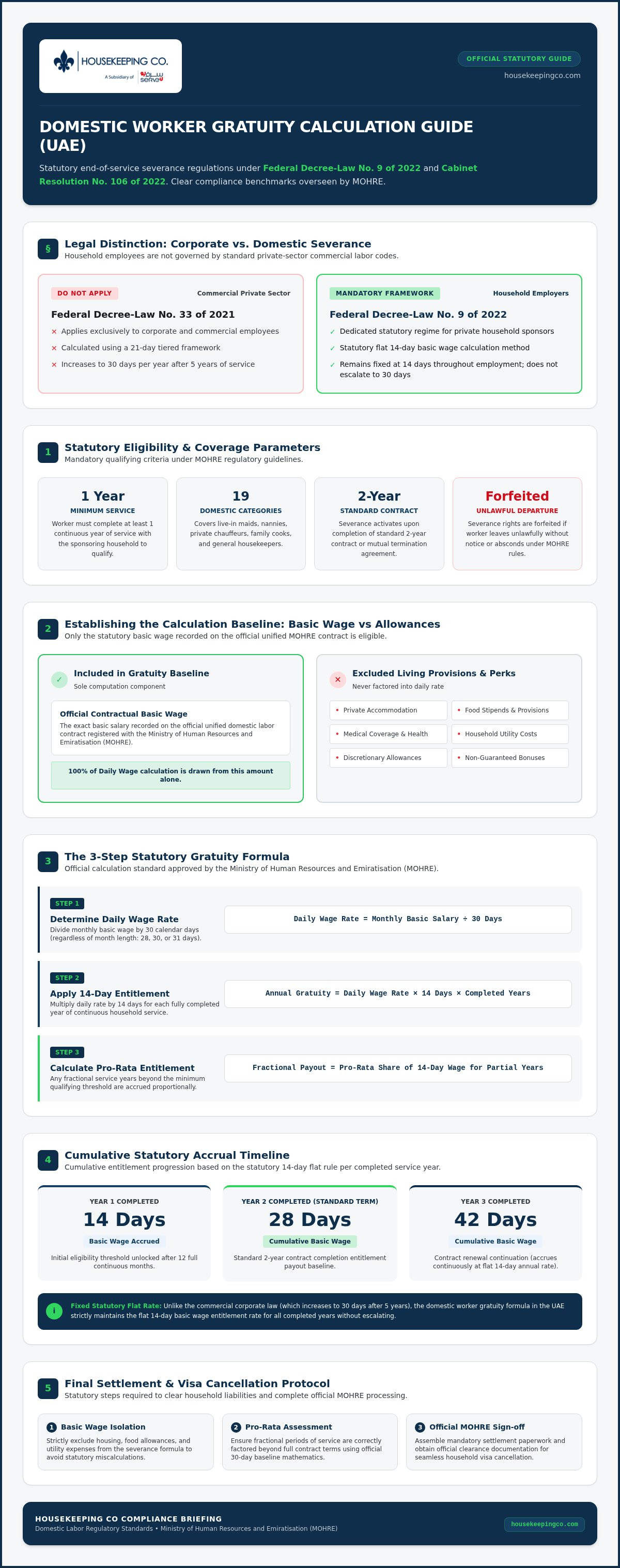
Calculating severance for household staff requires a precise mathematical process based on official regulatory guidelines. While corporate employees accrue benefits under a 21-day tiered framework, established domestic labor practices apply a flat 14-day calculation for every year of completed service. This standard is supported by the Ministry of Human Resources and Emiratisation (MOHRE) through its official domestic worker benefits calculator. Correctly computing domestic worker gratuity UAE entitlements requires employers to follow a transparent three-step method.
Step 1: Determine the Official Daily Wage Rate
Convert your worker's monthly basic salary into an official daily wage rate. Divide the basic monthly salary by exactly 30 calendar days, regardless of whether a particular month contains 28 or 31 days. Exclude food provisions, discretionary allowances, and non-guaranteed bonuses from this equation. For example, a basic monthly wage divided by 30 gives you the exact baseline daily rate required for statutory severance calculations.
Step 2: Apply the 14-Day Entitlement Per Full Year
Multiply the established daily wage rate by 14 days for each fully completed year of continuous household employment. Unlike the private commercial sector, this statutory entitlement does not increase to 30 days after five years. The rate remains fixed throughout the employment relationship:
- Formula: (Basic Monthly Salary / 30) x 14 Days x Number of Completed Service Years
- Year 1 Entitlement: 14 days of basic wage
- Year 2 Entitlement: 28 cumulative days of basic wage
- Year 3 Entitlement: 42 cumulative days of basic wage
Step 3: Calculate Pro-Rata Entitlement for Fractional Years
Calculate fractional years proportionally once a domestic helper completes the mandatory first year of continuous service. If an employee completes two years and four months before contract conclusion, calculate the remaining four months by dividing the annual 14-day allocation across the partial year.
Deduct any extended unauthorized absences or documented unpaid leave from total qualifying service days. Paid annual leave and approved sick leave count toward service tenure, but unapproved absences or unpaid leaves of absence freeze gratuity accrual for those specific periods. If you prefer to avoid the administrative burden of running these complex payroll equations yourself, you can work with Housekeeping Co to hire a full-time live-in/live-out nanny or maid in Dubai under comprehensive regulatory compliance.
Key Factors That Impact Domestic Worker Gratuity Payouts
Final settlement calculations rarely depend on simple math alone. Real-world household dynamics, contractual circumstances, and salary offsets frequently alter the net payout figure. Correctly administering domestic worker gratuity UAE obligations requires understanding how contract termination clauses, authorized wage deductions, and statutory caps interact under the law.
Contract Completion vs. Early Resignation Rules
Contract maturity sets the clearest baseline for settlement. When a domestic helper successfully completes their standard two-year contract, they are entitled to full severance accrual alongside an employer-provided return flight ticket to their home country. If the helper voluntarily resigns before completing their initial contract term, settlement terms shift based on contractual provisions and notice periods. While accrued basic severance remains legally protected after completing the first full year of service, an employee who resigns without completing their agreed term may forfeit employer-funded repatriation flights depending on the specific grounds of resignation.
Permissible Salary Deductions and Offset Boundaries
UAE domestic labor law strictly defines what employers may subtract from a helper's final severance payout. Offsets must be backed by transparent, documented evidence signed by the domestic worker:
- Authorized deductions: Documented cash salary advances, written personal loans, or formally verified replacement costs for deliberate property damage.
- Prohibited deductions: Recruitment fees, entry visa costs, medical fitness test expenses, Emirates ID processing charges, or mandatory insurance premiums.
Attempting to recover standard onboarding expenses from severance is an immediate compliance violation under MOHRE guidelines. To protect against costly administrative errors and maintain strict compliance with legal procedures, review our comprehensive domestic worker visa services dubai sponsorship guide.
Maximum Statutory Severance Caps and Exclusions
Statutory severance entitlements are subject to legal limitations. Total accrued domestic worker gratuity UAE payments cannot exceed the value of two full years of basic wages, regardless of how long the employee remains with the sponsoring family. Unpaid leaves of absence automatically adjust service continuity; days taken without pay must be subtracted from total service calculations. In cases of severe misconduct, intentional destruction of employer property, or unlawful departure without notice, employers can file official reports through MOHRE service channels to formally petition for severance forfeiture before completing visa cancellations.
Final Settlement and MOHRE Visa Cancellation Procedures
Executing an end-of-service settlement requires strict adherence to statutory timelines and precise official documentation. UAE regulations mandate that employers disburse all outstanding remuneration within 14 days of contract termination. Disbursing domestic worker gratuity UAE entitlements on time protects sponsors from administrative fines and labor disputes, paving the way for an uncomplicated exit process.
Drafting an Itemized End-of-Service Receipt
Never rely on informal verbal agreements or unrecorded cash transactions when concluding household employment. Draft a comprehensive, itemized settlement receipt detailing each financial element separately:
- Accrued statutory end-of-service gratuity
- Pro-rated regular basic salary for final active working days
- Accrued but untaken paid annual leave balance
- Itemized, legally permitted deductions supported by signed documentation
Draft this breakdown in clear bilingual format or provide verified translation. Ensure your helper signs the physical statement to certify full receipt of funds without coercion.
MOHRE Documentation and Visa Cancellation Sign-Off
Unlike corporate cancellations that require pre-approval steps through labor offices before residency processing, domestic worker cancellations run directly through authorized typing centers, Tadbeer centers, or the ICP portal. Sponsors must present their original Emirates ID alongside copies of the worker's passport and residency visa. Keep digital copies of signed settlement receipts and bank transfer slips. These proof points provide immediate legal defense if post-cancellation claims arise before labor inspection committees.
Managing End-of-Service Repatriation and Ticket Obligations
Sponsors bear the legal duty of providing a one-way economy flight home upon contract maturity. This requirement dissolves only if the helper signs a formal contract transfer directly to another UAE household or corporate sponsor within the country. Coordinate travel bookings within the permitted post-cancellation grace period to avoid overstay fines. If managing government portals, flight logistics, and clearance forms feels daunting, you can hire a nanny or maid under your private sponsorship through our concierge team to ensure seamless regulatory management from hire to final departure.
Eliminating Household Compliance Risks with Housekeeping Co
Direct household sponsorship carries substantial legal, administrative, and financial accountability. Miscalculating statutory severance, failing to record wage adjustments, or misinterpreting regulatory deadlines can quickly escalate into formal disputes before labor inspection committees. When managing domestic worker gratuity UAE employers often find that direct legal administration exposes them to avoidable liabilities.
The Hidden Complexity of Private Domestic Sponsorship
Managing household staff requires far more than handling daily household routines. Sponsoring families must comply with strict statutory standards governing health insurance, Wage Protection System protocols, contract renewals, and final severance balances. A single mathematical error or missing sign-off form can trigger administrative delays, financial fines, or visa blocks. Working alongside an established specialist replaces these vulnerabilities with structured legal protection, ensuring your household remains fully compliant through every contract phase.
Housekeeping Co's Professional Staffing and Visa Solutions
Operating since 2011, Housekeeping Co provides families across Dubai, Abu Dhabi, and Sharjah with reliable, bespoke household staffing services. Whether you want to hire a full-time live-in/live-out nanny or maid in Dubai or need to get 2 years worker visa for your domestic workers, our team oversees every operational requirement. We establish standardized employment contracts with compliant wage baselines, shielding employers from unexpected disputes and ensuring complete clarity for domestic personnel.
Partnering for Long-Term Household Harmony and Security
A legally sound household creates a secure, lasting working relationship. Professional vetting and structured contractual terms cultivate trust between families and their domestic staff from day one. Instead of handling immigration portals, settlement equations, and regulatory updates alone, you gain the backing of a seasoned industry guide. Take control of your household staffing today: Discover legal domestic staffing solutions with Housekeeping Co.
Mastering Household Severance and Long-Term Compliance
Navigating end-of-service severance doesn't have to be a source of legal anxiety. Applying the flat 14-day calculation to basic wages, honoring the statutory 14-day settlement deadline, and securing signed bilingual receipts protects your household against unexpected MOHRE disputes. Accurate accounting and transparent records ensure that calculating domestic worker gratuity UAE dues remains straightforward, fair, and legally sound.
Operating as a premier domestic staffing partner since 2011, Housekeeping Co eliminates the friction of household legal management. We deliver comprehensive oversight of 2-year domestic worker visa processing and regulatory compliance, while providing specialized placement of vetted full-time live-in maids, nannies, and professional caregivers. You never have to navigate shifting labor regulations or sponsorship complexities alone. Take the decisive step toward effortless household security: Secure fully compliant domestic staffing with Housekeeping Co.
Frequently Asked Questions
Is gratuity mandatory for domestic workers in the UAE?
Yes, domestic workers who complete at least one full continuous year of employment are entitled to statutory end-of-service benefits under UAE domestic labor regulations. Although Federal Decree-Law No. 9 of 2022 defers specific procedural bylaws to cabinet resolutions, MOHRE continues to uphold and calculate gratuity for household staff through its official portal. Employers in Dubai, Abu Dhabi, and Sharjah routinely settle these mandatory dues during visa cancellation to avoid legal blocks.
How many days of gratuity is a domestic worker entitled to per year?
Domestic workers are entitled to 14 days of basic pay for each completed year of continuous service. Unlike the private corporate sector that tiers severance up to 30 days after five years, household employees receive a consistent flat rate of 14 basic wage days per annum. Fractional service years beyond the initial qualifying year are calculated on a pro-rata basis using this identical 14-day annual standard.
Does a domestic worker receive gratuity if they resign before contract completion?
Yes, a domestic worker retains the right to accrued severance if they resign, provided they have completed at least one full year of continuous service. However, resigning before completing their two-year contract may impact other contractual benefits, such as employer-funded repatriation flights, unless the resignation stems from documented employer breach. Leaving without serving contractual notice or unlawfully absconding results in the complete statutory forfeiture of end-of-service entitlements.
Is domestic worker gratuity calculated on the basic wage or total monthly salary?
Statutory domestic worker gratuity UAE settlements are strictly calculated using the monthly basic wage stated on the official MOHRE employment contract. Allowances for meals, accommodation, medical provisions, and utilities are legally excluded from the calculation. To calculate the baseline, divide the contracted monthly basic salary by 30 calendar days to establish the daily wage rate, then multiply that daily amount by 14 days for each qualifying year.
Can employers deduct visa sponsorship expenses from a domestic worker's gratuity?
No, employers are legally prohibited from deducting recruitment costs, visa processing fees, medical testing charges, or Emirates ID expenses from severance payouts. UAE law strictly mandates that the sponsor must absorb all government sponsorship and onboarding costs. The only permissible deductions are documented salary advances, verified personal loans signed by the helper, or formal, documented compensation for deliberate household property damage.
What happens if an employer fails to pay domestic worker gratuity on time?
Failing to disburse end-of-service dues within the statutory 14-day settlement window exposes employers to formal labor complaints through MOHRE or Tadbeer centers. Unresolved disputes lead to administrative penalties, official fines, and restrictions on sponsoring domestic staff in the future. The domestic worker gratuity UAE guidelines require prompt, verified payment to ensure transparent labor compliance before immigration authorities approve the final residency visa cancellation.
Are domestic helpers entitled to paid leave compensation in their final settlement?
Yes, domestic workers are legally entitled to cash compensation for accrued, untaken annual leave days upon contract termination. Under UAE domestic labor law, full-time helpers earn 30 calendar days of paid annual leave for each full year worked. Any remaining leave balance must be converted into cash using the helper's basic wage rate and added to the final end-of-service settlement statement alongside statutory gratuity.
Does a helper receive gratuity if they transfer their visa to another family?
Yes, the outgoing employer must calculate and pay all accrued gratuity and leave balances up to the exact date of transfer. When a helper transitions to a new household sponsor in Dubai or Abu Dhabi, the existing contract terminates legally, requiring a full settlement sign-off. The incoming sponsor begins a fresh two-year contract, and the helper's gratuity accrual resets under the new household's sponsorship.
Share this


